Yumeji Takehisa
Yumeji Takehisa is a painter representative of Taisho Romanticism who left behind numerous bijin-ga (paintings of beautiful women) known as “Yumeji-style beauties.” Beyond bijin-ga, he also did work such as book cover design, and it’s fair to understand him as a historical artist who left his mark on commercial design as well.
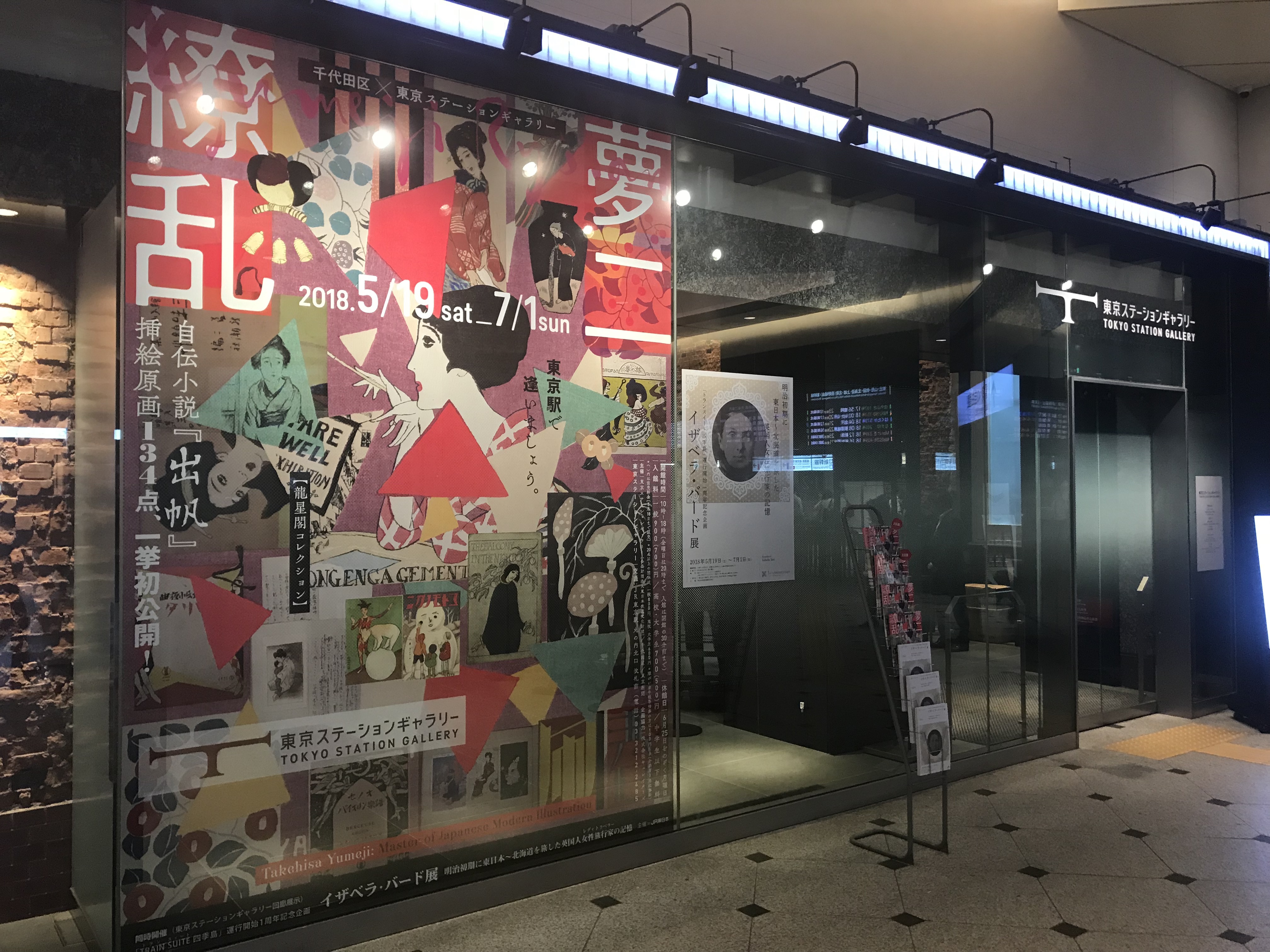
The solo exhibition “Yumeji Ryoran” held this time is a joint project of Chiyoda Ward and Tokyo Station Gallery. Beyond the sheer number of works on display — more than 500 — it was a rewarding exhibition that also let you learn about the printing industry of “Chiyoda Ward,” a district where printing flourished and which was deeply connected to Yumeji’s own activities.
Chiyoda Ward
Chiyoda Ward has developed as one of Japan’s foremost towns where the publishing and printing industries are concentrated. Ryuseikaku, a publisher located in Marudan-minami, Chiyoda Ward, is known as the publisher of Kotaro Takamura’s “Chieko-sho,” but after the war it also published one Yumeji Takehisa art collection after another, becoming a driving force behind the second Yumeji boom.
This exhibition commemorates the donation to Chiyoda Ward of Yumeji’s writings and the vast Yumeji collection amassed by founder Ishiro Sawada for the publication of art collections, and Chiyoda Ward and Tokyo Station Gallery co-host it to present the finest of that collection.
Let’s meet at Tokyo Station
[Exhibition Structure]
The exhibition is organized into four chapters. Chapter 1 examines Yumeji’s youthful days. Chapter 2 covers Yumeji’s work centered on publishing, printing, and prints; Chapter 3 takes up, among these, his work relating to music and sheet music; and Chapter 4 introduces the original drawings of Yumeji’s autobiographical novel “Shuppan (Setting Sail)” and the publishing activities of Ryuseikaku after his death.
Chapter 1: Yumeji’s Beginnings
In his young student days, Yumeji scraped a living by submitting pictures and poems to newspapers and magazines. The turning points were his first-prize win for the panel picture “Tsutsuizutsu,” submitted to the “Seinen Kessaku-shu” summer special of “Chugaku Sekai” in June of Meiji 38 (1905), and the publication of “Yumeji Gashu: Haru no Maki (Yumeji Art Collection: Spring Volume)” in Meiji 42 (1909).
In this exhibition, “Yoran (Cradle),” a hand-brushed collection of pictures and writings he produced while enrolled at Waseda Jitsugyo School, is shown for the first time, introducing the figure of the young Yumeji while, through early examples, approaching Yumeji’s origins and how he began to walk the path of a painter.
Chapter 2: Cute Things, Beautiful Things
In October of Taisho 3 (1914), “Minatoya Ezoshiten” opened in Nihonbashi Gofukucho. Minatoya, run by Tamaki Kishi — the only woman Yumeji formally married — was a brand shop selling chiyogami paper, stationery and envelopes, han-eri collars, and other items designed by Yumeji. It was also a gallery where young artists such as Koshiro Onchi and Kyokichi Tanaka could gather and present their work.
During this period, not only was the “Yumeji-style beauty” style established, but Yumeji also expanded his activities across many fields — postcards, magazine covers and illustrations, book binding, and more. While setting his sights on holding his own solo exhibitions, he continued to provide art that reached the hands of viewers, readers, women, and children; we look at Yumeji’s wide-ranging body of work.
Highlight ②: More than 500 exhibits that convey the full scope of Yumeji
Yumeji’s creative activity was deeply connected with publishing. In this exhibition, more than 500 exhibits — among the largest number ever — introduce Yumeji’s diverse activities from a variety of angles. From the many art collections of his that were published, to bound books, sheet-music collections, picture books for children, postcards and chiyogami paper, han-eri collar designs, and even hand-brushed paintings, it is an exhibition that lets you feel the full scope of Yumeji Takehisa.
Chapter 3: Music Seen with the Eyes
Yumeji painted the covers of many pieces of sheet music. Representative are the Senoo Gakufu sheet music published by Senoo Music Publishing, in which he expressed the images of Japanese and international musical pieces through designs that incorporated elements of various genres. Across more than 270 pieces of sheet music, including “Yoimachigusa,” for which he wrote the lyrics himself, Yumeji was entrusted with what were, in effect, the jackets. Yumeji also actively took part in the sheet music of children’s songs. The exhibition introduces the rich musical world of the Taisho era that Yumeji depicted.
Chapter 4: Shuppan
“Shuppan,” serialized in the Miyako Shimbun in Showa 2 (1927), is an autobiographical novel recounting Yumeji’s life. Its illustrations depict, in ink wash, the women he loved and the landscapes he visited with them, as well as abstract psychological portrayals.
After the serialization of “Shuppan,” Yumeji set off overseas, having clipped and compiled the newspaper articles himself and entrusted friends with turning “Shuppan” into a book. Through the people who associated with Yumeji and the publication of Yumeji’s writings and art collections that Ryuseikaku worked so hard on, the exhibition reconsiders the publishing that supported, discovered, and connected Yumeji.
Impressions After Viewing
Since photography was not allowed at this exhibition, I’d like you to check the details on-site, but the display and its structure were truly wonderful.
The section I was able to view with particular interest was “Chapter 3: Music Seen with the Eyes.” The many cover-design works were quite rewarding to see. You can sense how he took on the realm of commercial design with genuine creative drive.
Also, in the “Chapter 4: Shuppan” section, you follow along a chronology of Yumeji Takehisa’s life, and there was a fascination in tracing the trajectory of his life through his succession of romances while viewing it alongside works from the same periods. It’s an exhibition I recommend.