White Cube
While making the gallery rounds in Kiyosumi-Shirakawa, I stopped by HARMAS GALLERY. Seen from the outside it looked open, but I couldn’t spot any work on view.
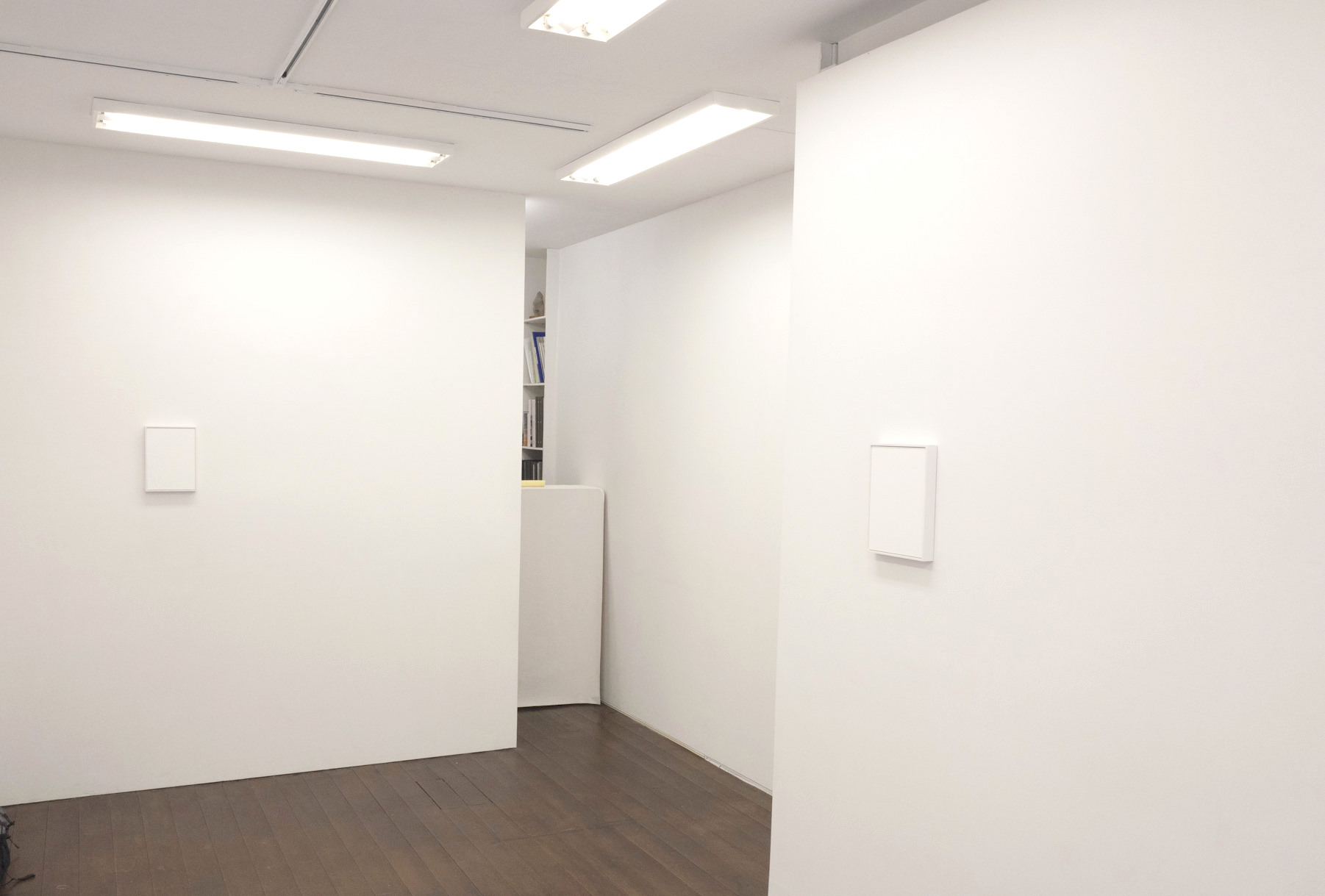
…or so I thought — until I noticed there are only two small white works on view.
White works displayed on the gallery’s white walls, a strange feeling indeed. You might mistake it for a space undergoing renovation.
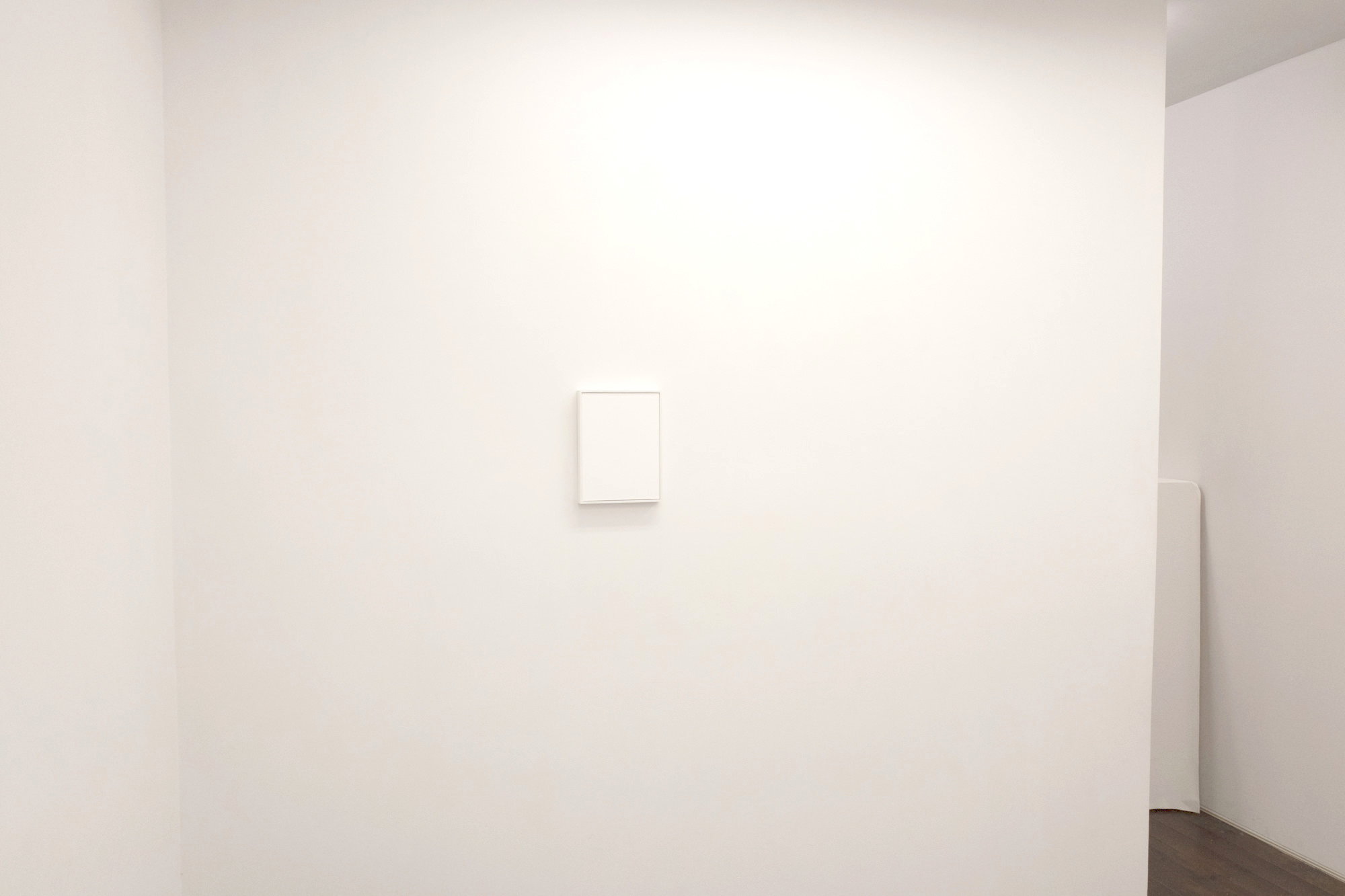
“What could this be…?” I thought, and as I moved closer, the surface of the painting began to reveal itself.
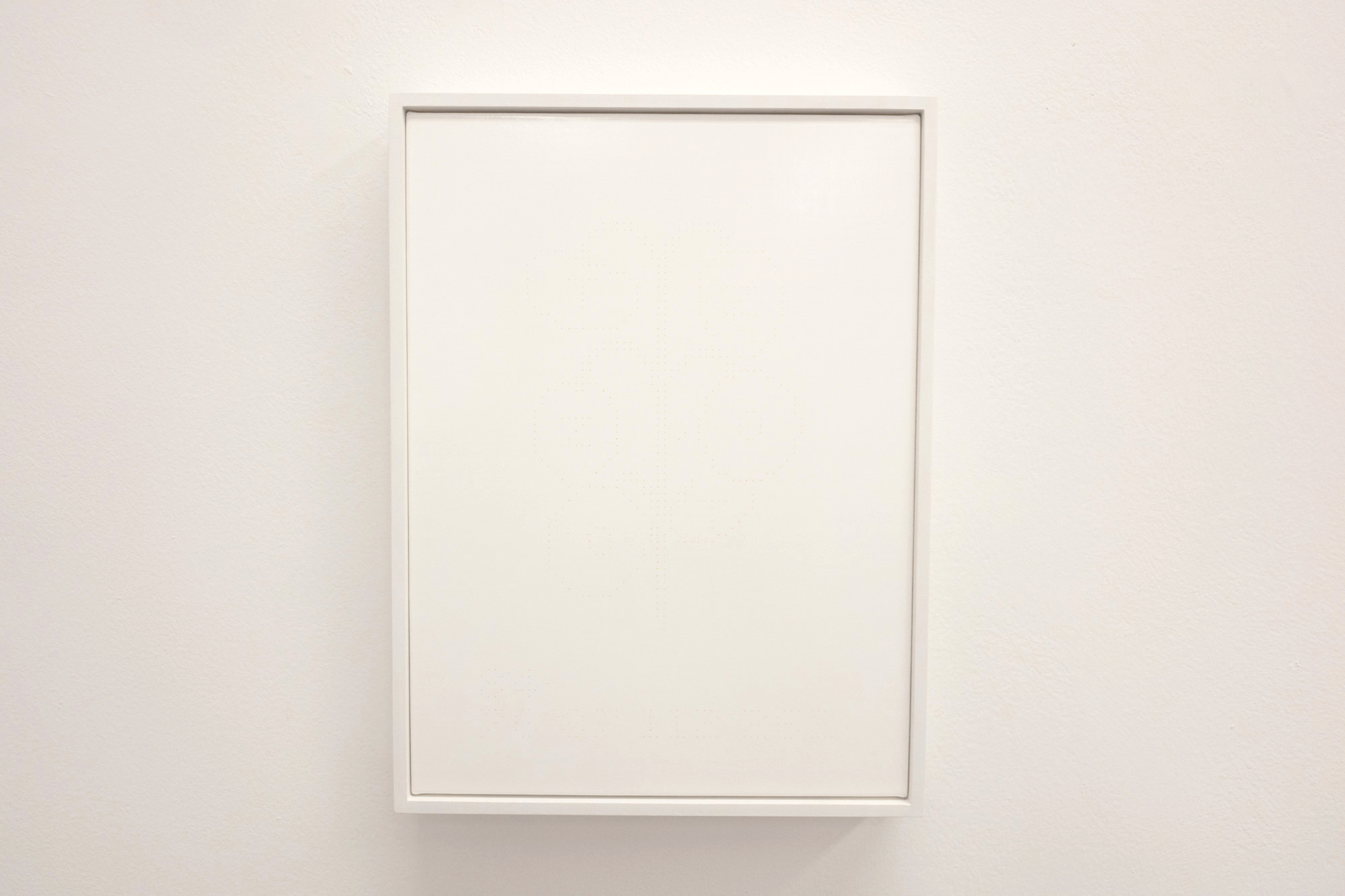
“Hmm?” — I looked more carefully.
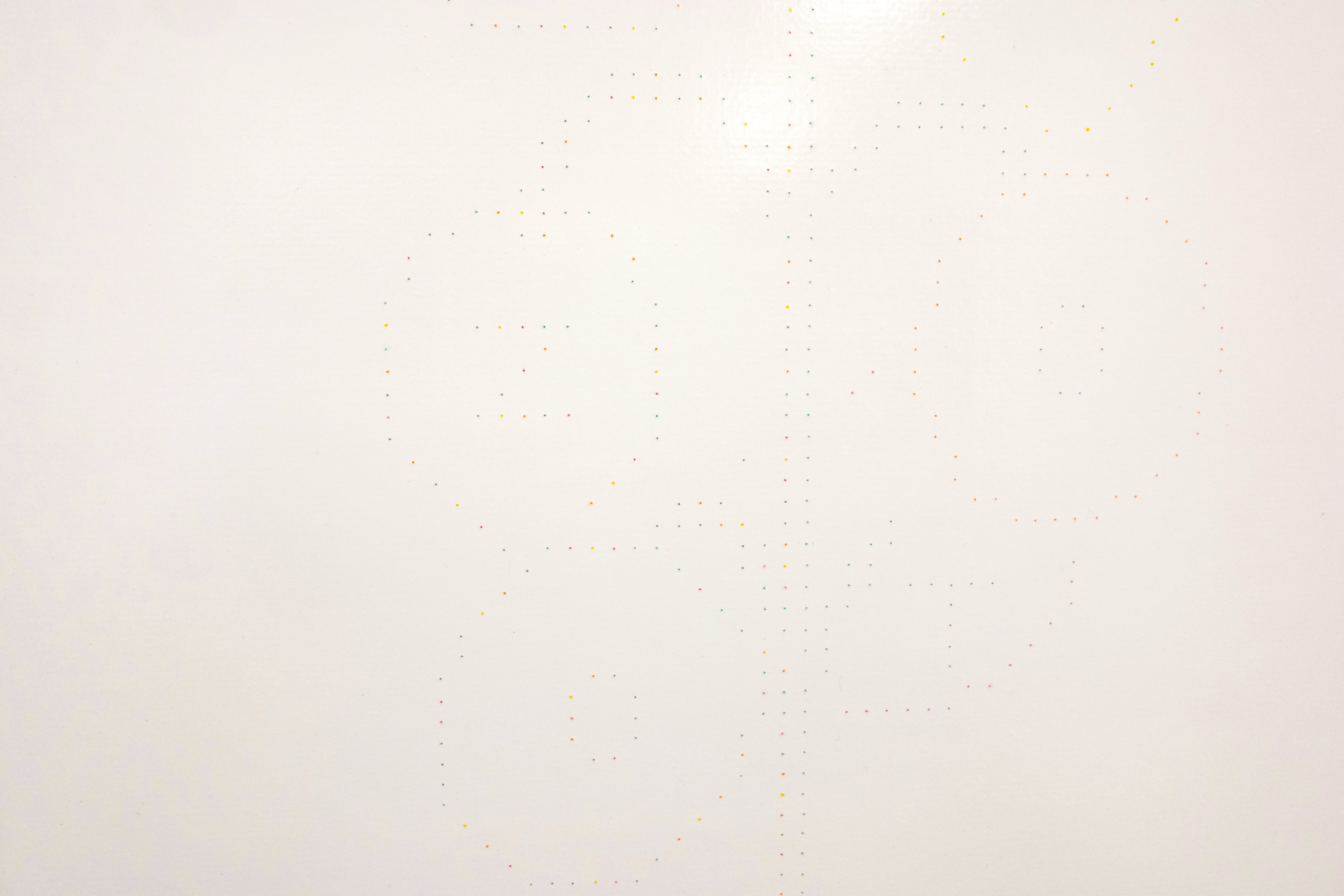
Squinting, things that weren’t visible to the naked eye gradually begin to emerge.
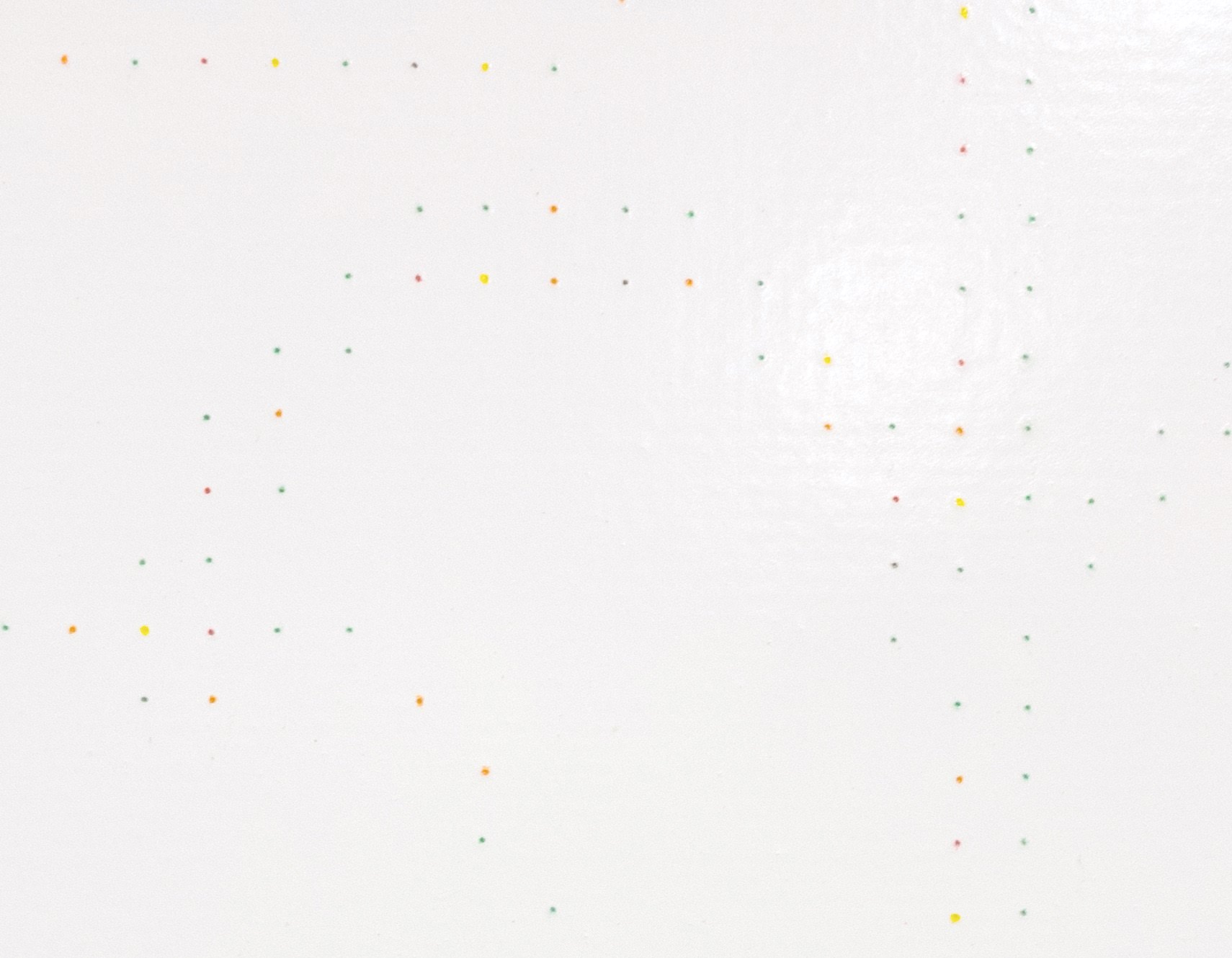
This is precisely what “dot painting” is. Even at this magnification the colors are evenly arrayed. An incredible level of craft. It was only after asking the gallerist what the image depicts that I finally understood. The artist’s own statement below should make it clear.
______________________________________________________________________
Kazuhiro Nomura
Dot PaintingThe same image is depicted across every work in this series, composed of extremely small color dots — 76 red, 84 black, 87 yellow, 112 orange, 262 green, for a total of 621 dots (from just 1 m away they blend into the background and become invisible). These color dots are laid out on lattice points, spaced neither too far apart nor so close that they merge (dot pitch in the tableau-format works: 2.5 mm).
The motif is a plant: a single straight stem shoots upward, from which six branches — three to the left and three to the right — arc outward, each ending in fruit. On each branch hang two fruits from among tomato, orange, and lemon (one of each of the three varieties on each side of the stem, arranged top / middle / bottom — from top on the right: lemon, orange, tomato; likewise from top on the left: tomato, orange, lemon), rendering a heavily-laden plant.
The prototype for this motif was discovered on the bay window of an apartment building in a downtown district of Düsseldorf, Germany. It was presumably from an Asian household. Add a brown flowerpot to the image above, and restrict the fruit hanging from each branch to a single variety (planters with just tomato only, orange only, lemon only, or apple only did exist), thereby ratcheting up the symmetry — the mental image is a kitschy PVC free-standing object (about 30 cm), whose festival-colored inflection is impossible to conceal.Standing before the primed canvas, one of the four halves of this image — the top half, the bottom half, the left half, or the right half — is chosen (all one can say about the criterion is: it depends on the mood). On the un-chosen half, the dots making up each tomato are red, and likewise the dots for the oranges and lemons are their own local colors — orange and yellow. The stem and branches, accordingly, are green. On the chosen half, however, that dominance by local color is released, and a marbled dot arrangement is decided ad hoc for each work (for example, at what should be the red-dot positions of the tomatoes, black, yellow, orange, or green dots may find their way in).
It is like reaching into a box whose contents you cannot see and pulling out colored balls (with the rule that once a ball is drawn it is not returned): the total number is fixed, the color varieties are fixed, and the proportions among them do not change — you leave the placement to chance. If the left half is chosen, then always 42 red, 32 black, 33 yellow, 42 orange, and 121 green dots are placed randomly within the fixed grid positions (probabilistically, it is unlikely for the same work — with every color dot in the same position — to appear twice; each work is assigned a serial number in its title or name).The row of numbers along the bottom shows the total number of dots of each color present on this surface, together with the number of dots needed to indicate that total, broken down by color. This is not subject to the half-and-half rule; it is identical across every work.
The letters visible inside each fruit are the initials — T for tomato, O for orange, Z for lemon (= Zitrone in German). On the un-chosen half, black dots are used for these.Kazuhiro Nomura
— Excerpted from the HARMAS GALLERY website —
How many times does Eve eat the apple?
These works — including this tableau format on a white-primed canvas with dots in five colors, but also the drawing format (on paper or tracing paper) and the mural format (directly on the wall) — the dot-painting series, when it began in 1989, had “Wie oft isst Eva den Apfel?” (German; the Japanese equivalent is the same as the title above) added to their titles.
First “Wie oft isst Eva den Apfel?” and then a serial number. Incidentally, works with red or green priming have also been produced — 8 and 1 respectively (with a red ground, naturally, the red dots become invisible). Tableau and drawing formats are 260 × 195 mm (the tableau version has an additional 30 mm), the mural format is 1310 × 990 mm (dot pitch: 10 mm). The goal was to make 500 in total.In my own case, someone might point out that many of my other works also concern women (indeed, I’ve used Licca-chan dolls, skirts, single earrings, women’s shoes; I have works with women’s names as titles, others where male names have been changed to female ones, and works dealing with women’s breasts). Even so, it isn’t quite that I especially worship the female. My own sex is male, and so, in that sense, this may be a rephrasing of “an existence set apart from me — the other” (what other thing could I have chosen instead that would have been fitting? And to add another point — when confronted with my installations, viewers have often mentioned the youthfulness of the imagined artist behind them, meaning uncertainty of age, and further, of gender and nationality. I too was surprised). So it isn’t literally about actual women — rather, this yearning toward such an existence has been the driving force (if I am to be called a worshipper of women, then transforming myself into the woman must have been the true impatience).
Even if it originally came from within me, when I first meet it face to face, is it not still something I do not know — something that can only be received as an encounter with the other? Something strange has appeared. At the very least, I can never think, “this came from me” (if that were what one thought right away, then it would not be the other. Staged; already known?). The other can only appear from the outside, and only suddenly — like a flying fish leaping into a boat at sea, or like a road accident encountered head-on.That apple, marked with a definite article, of course points to the very fruit of knowledge from Eden itself (given that Eve appears, this is unavoidable). But it also invokes the expulsion from paradise — the great shift in the human condition — and thus allows the act of eating that apple to encompass and represent all the transformations that have unfolded within human ways of life ever since. How many times does Eve eat the apple? From now on, too? These are, at once, words of challenge directed at the future. And also: an acknowledgment that this has not yet been sealed shut? And it had to be the other — a woman, Eve — who eats that apple (only if she is the one can the eating of that apple be first). Eve becomes the collective name of humans capable of enacting that transformation.
That other lures a person toward the maimed.
Kazuhiro Nomura
— Excerpted from the HARMAS GALLERY website —
The artistic dimension and level are so high that I couldn’t grasp them immediately, but encountering a wide variety of works is the pleasure of contemporary art.