The exhibition “The Lineage of Eccentrics: Miraculous World of Edo Painting” will be held at the Tokyo Metropolitan Art Museum (Ueno, Tokyo) from Saturday, February 9 to Sunday, April 7, 2019.
The Lineage of Eccentrics: Miraculous World of Edo Painting
Nearly half a century ago, in 1970, the art historian Nobuo Tsuji wrote “The Lineage of Eccentrics.”
Introduced in that book were paintings that had never before been gathered together in books or exhibitions — works that broke free of convention, took the viewer by surprise, and drew them into an extraordinary world with free-spirited, bold imagination.
This exhibition brings together eight painters in total: the six featured in “The Lineage of Eccentrics” — Iwasa Matabei, Kano Sansetsu, Ito Jakuchu, Soga Shohaku, Nagasawa Rosetsu, and Utagawa Kuniyoshi — plus Hakuin Ekaku and Suzuki Kiitsu.
The newly published “New Edition: The Lineage of Eccentrics,” released to coincide with the exhibition, can be found here.
Highlights of the Exhibition
The highlights of this exhibition can be summarized in the following three points.
[1] Signature masterpieces by all eight Edo-period eccentric painters, gathered in one place!
Signature masterpieces by eight painters — Iwasa Matabei, Kano Sansetsu, Hakuin Ekaku, Ito Jakuchu, Soga Shohaku, Nagasawa Rosetsu, Suzuki Kiitsu, and Utagawa Kuniyoshi — are gathered together.
The show traces the lineage of painters who expressed their singular, unbound individuality.
[2] Look out for newly discovered and first-time-shown works
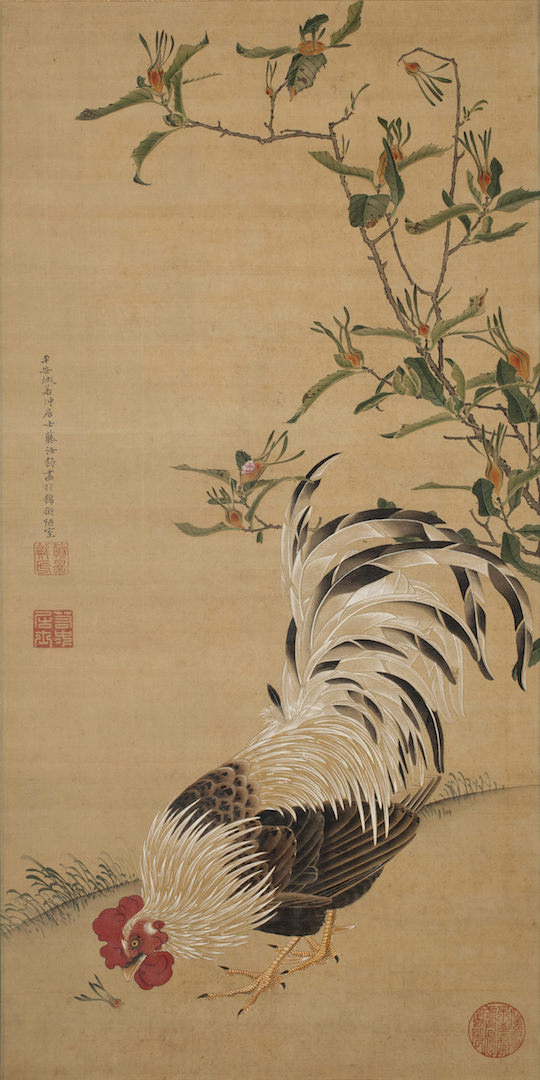
Numerous newly discovered works and pieces shown for the first time will be on display, including Jakuchu’s “Rooster and Gardenias” and “Rooster Screen Album,” and Rosetsu’s “Monkeys and Persimmons.”
[3] Many works loaned from overseas, including a first-ever homecoming
Masterpieces by Jakuchu, Rosetsu, and Kiitsu from the celebrated Price Collection will be shown.
And Kiitsu’s “One Hundred Birds and Beasts” from the Catherine and Thomas Edson Collection in the United States will make its first homecoming.
Featured Works
Ito Jakuchu
Born the eldest son of a wholesale greengrocer in Kyoto, at age 40 he handed the family business over to his younger brother and devoted himself to painting. Over roughly ten years starting in his early forties, he completed the three-panel “Sakyamuni Triad” and the thirty scrolls of “Colorful Realm of Living Beings,” donating them to Shokoku-ji Temple. Skillfully blending realism and fantasy, he left behind a vast and varied body of individualistic work — from bird-and-flower paintings executed with dense color and meticulous detail, to ink paintings that made free use of gradation and displayed his mastery of brushwork.
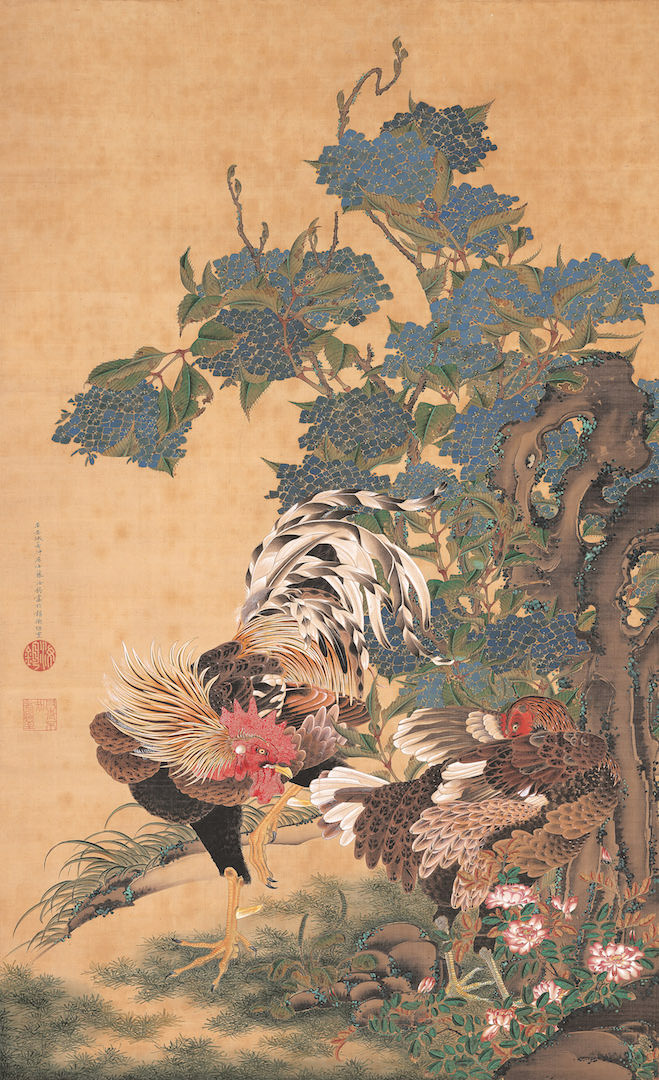
Etsuko and Joe Price Collection, USA
Hydrangeas rendered with two different shades of ultramarine, and a rooster and hen closely observed from ones the painter himself kept.
There is a comparable work in the “Colorful Realm of Living Beings” series, but this one precedes it. Mr. Price acquired the piece in the 1960s.
.jpg)
.jpg)
An elephant crouches down and lifts its trunk high, while a whale breaches the surface and spouts a vigorous jet. The king of the land and the king of the sea seem to be exchanging salutes. Recently rediscovered in an old family collection in the Hokuriku region, the work is now housed at MIHO MUSEUM.
mid-Edo period (18th century), private collection
*First-time public display.
Discovered in the course of research for this exhibition, the work was held by the Otani family of Higashi Hongan-ji Temple until 1927 (Showa 2). Its somewhat hesitant style, subdued palette, and the calligraphic form of the signature suggest it is a rare early work from the artist’s thirties.
Soga Shohaku
Born into a merchant family in Kyoto, Shohaku wandered through Ise and Harima before settling in Kyoto after age forty. Even among the geniuses of the 18th-century Kyoto art world, he was drawn to the most extreme, violent forms of expression.
In his late twenties he claimed direct descent from the Muromachi-period Soga school and took the Soga surname for himself.
He studied Chinese-style painting and often depicted traditional themes such as Chinese immortals and sages, but his renderings are wildly original, brimming with madness, sometimes grating on the viewer’s nerves and pulling them into a whirlpool of chaos.
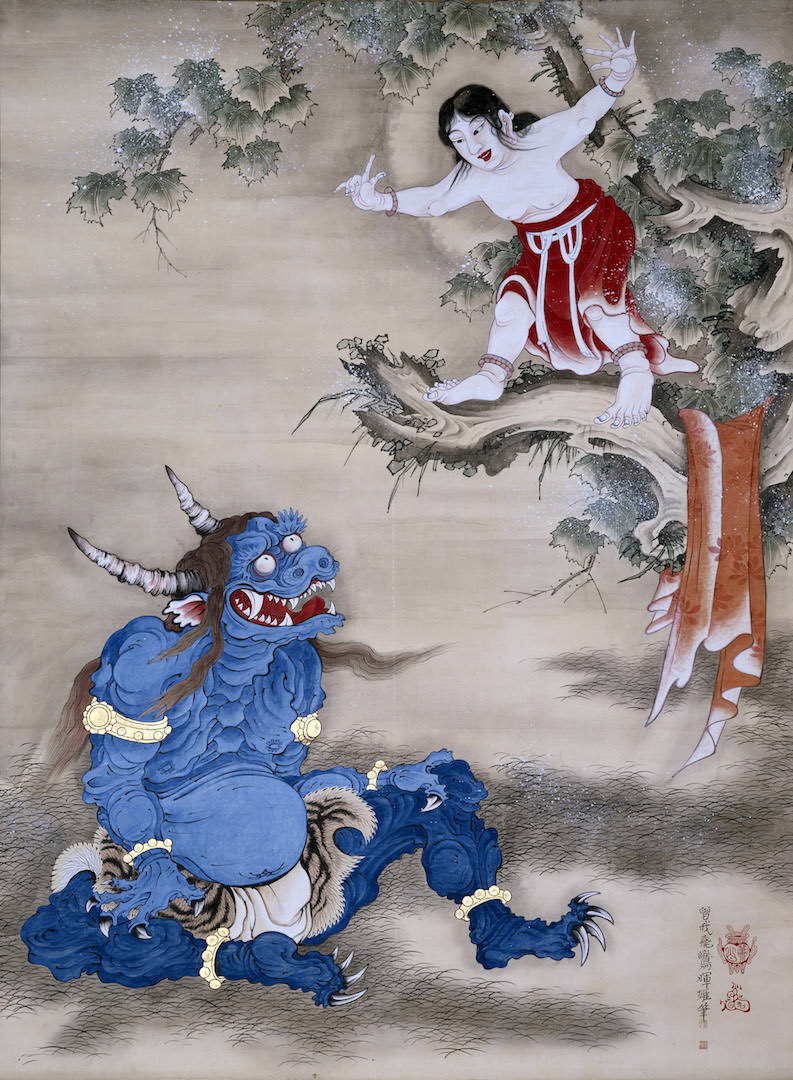
The scene depicts a moment when Sakyamuni, in a previous life, was training as a young Brahman ascetic on the snowy mountain, and Indra, disguised as a demon, tested his commitment to his practice.
The harsh contrast between deep blue and crimson is visceral. It is thought to have been made around the same time as the “Immortals” screens, when Shohaku was around 35.
.jpg)
Meiwa 1 (1764), Agency for Cultural Affairs, Important Cultural Property [Display period: March 12 – April 7]
.jpg)
Meiwa 1 (1764), Agency for Cultural Affairs, Important Cultural Property [Display period: March 12 – April 7]
Across the pair of six-panel screens, four figures are placed on each side, making eight enigmatic immortals in total.
Grounded in ink but overlaid with garish color, the psychedelic surface generates an extraordinary dissonance.
Nobuo Tsuji’s encounter with this bizarre work was one of the catalysts that led him to write “The Lineage of Eccentrics.”
Nagasawa Rosetsu
Born the son of a low-ranking samurai in Sasayama, near Kyoto, Rosetsu studied under Maruyama Okyo.
While most of Okyo’s disciples faithfully followed the sketch-based style their master had established, Rosetsu carved out his own artistic terrain with bold compositions and a brilliantly free brush, leaving behind many individualistic works full of entertainer’s playfulness.
.jpg)
Etsuko and Joe Price Collection, USA
.jpg)
Etsuko and Joe Price Collection, USA
A white elephant on the right screen and a black bull on the left are placed in mirrored contrast, each large enough to spill beyond the six-panel screens. Commonly called “Black and White.” On the bull’s back perch two crows, and a white puppy nestles against its belly, layering the composition with a double contrast of black and white, large and small — a work full of delightful surprises.
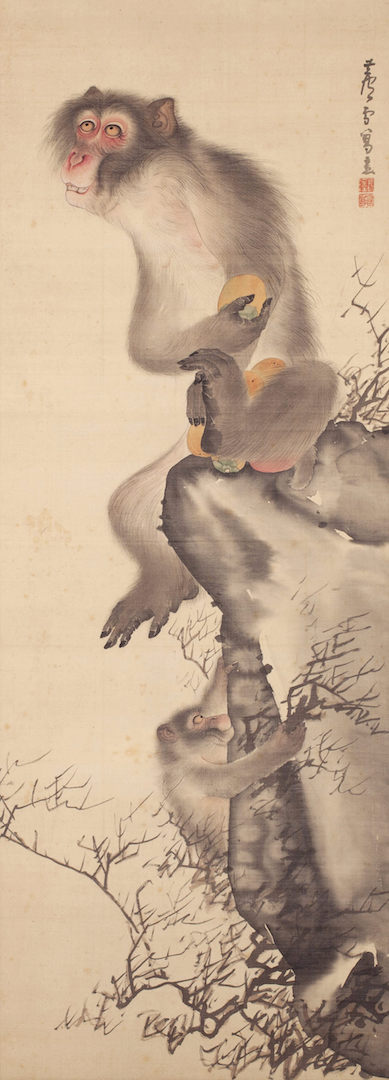
*First-time public display.
Listed in a 1915 (Taisho 4) auction catalogue, the work was rediscovered in the course of research for this exhibition. A monkey clings preciously to a persimmon fruit atop a rock, while a young monkey desperately scrambles up after it. The comically deadpan expressions are Rosetsu the entertainer at his very best.
Iwasa Matabei
Born as a son of the warring-states lord Araki Murashige, after his clan’s downfall he took his mother’s surname “Iwasa” and began his career as a painter in Kyoto.
He later moved to Kitanosho (present-day Fukui City), spent more than twenty years there, and in 1637 (Kan’ei 14) was ordered to produce the wedding trousseau for Chiyohime, daughter of the third shogun Tokugawa Iemitsu. He then moved to Edo, where he ended his eventful life.
A perfect master of both yamato-e and Chinese-style techniques, Matabei possessed a distinctive sensibility that belonged to no school, and he exerted a strong influence on later painters.
.jpg)
early Edo period (first half of the 17th century), Shizuoka, MOA Museum of Art, Important Cultural Property [Display period: February 9 – March 10]
Hakuin Ekaku
Zen priest known as the reviver of the Rinzai school. Born in Hara-juku in Suruga Province (present-day Numazu City), he took the tonsure at the age of fifteen.
Even in the Zen school, which teaches “not to rely on words,” Hakuin left behind an enormous number of Zen paintings and calligraphies.
Not the work of a professional painter but produced as a means of conveying Buddhist teachings, his seemingly humorous, light-hearted yet bold paintings and calligraphies became a catalyst for the 18th-century Kyoto eccentrics such as Shohaku, Rosetsu, and Jakuchu.
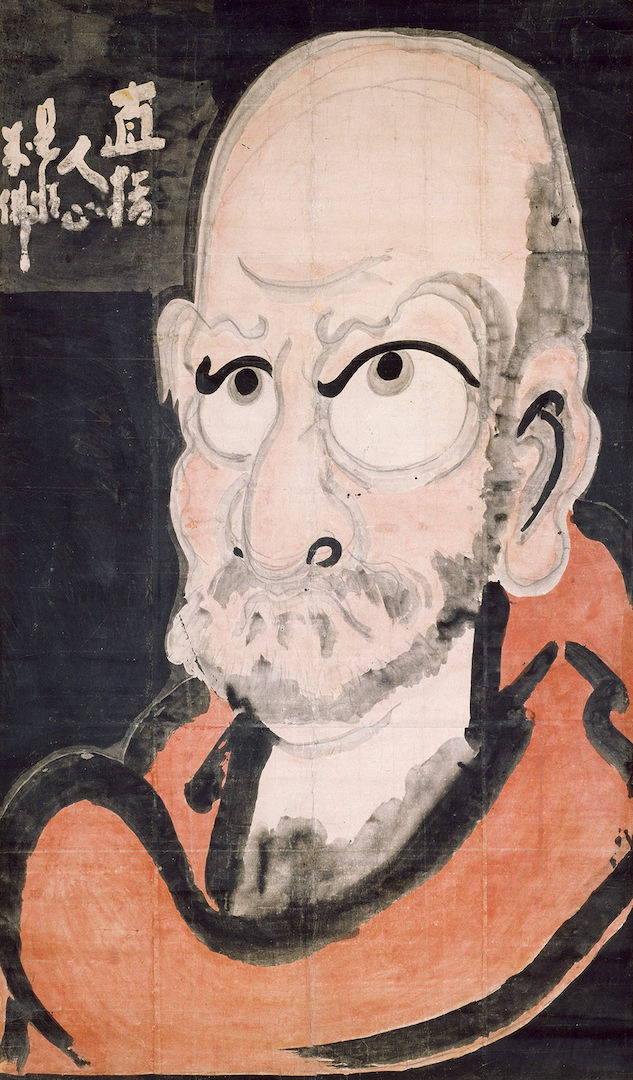
Edo period (18th century), Oita, Manju-ji Temple
Commonly called “Red Daruma.” Judging by the style, it is thought to be one of Hakuin’s very last works. That an artist past eighty could still produce something on this scale — nearly two meters tall — testifies to Hakuin’s undiminished vitality. Leaving preparatory lines visible and repeatedly retracing strokes, he overturns conventional brushwork with strikingly fresh expression.
Suzuki Kiitsu
As the faithful disciple of Sakai Hoitsu — the founder of the Edo Rinpa school, who himself deeply admired Ogata Korin — Kiitsu often produced works on his master’s behalf. After Hoitsu’s death, he leaned increasingly toward a highly individual style. His approach of artificially reconstructing natural motifs stands apart from Hoitsu’s elegant depiction, and his eccentric sensibility has been rapidly re-evaluated in recent years.
.jpg)
Tenpo 14 (1843), Catherine and Thomas Edson Collection, USA
.jpg)
Tenpo 14 (1843), Catherine and Thomas Edson Collection, USA
*First homecoming.
Returning from America for the first time, this is one of the works that best represents Kiitsu’s eccentric imagination. With extraordinarily fine brushwork, he depicts a great variety of birds and beasts. The ambition of trying to portray every living creature was very likely inspired by Jakuchu.
Kano Sansetsu
Born in Hizen Province in Kyushu, Sansetsu entered the studio of Kano Sanraku of the Kyo-Kano line around age sixteen, and later became his adopted son-in-law. He left many paintings for the great temples of Kyoto, including Myoshin-ji. He reinterpreted traditional subjects through his own lens and is known for his rational, geometric compositions that emphasize verticals, horizontals, and isosceles triangles.
“Honcho Gashi,” the first substantial book of painters’ biographies compiled in Japan, was completed by his son Kano Einou based on Sansetsu’s draft.
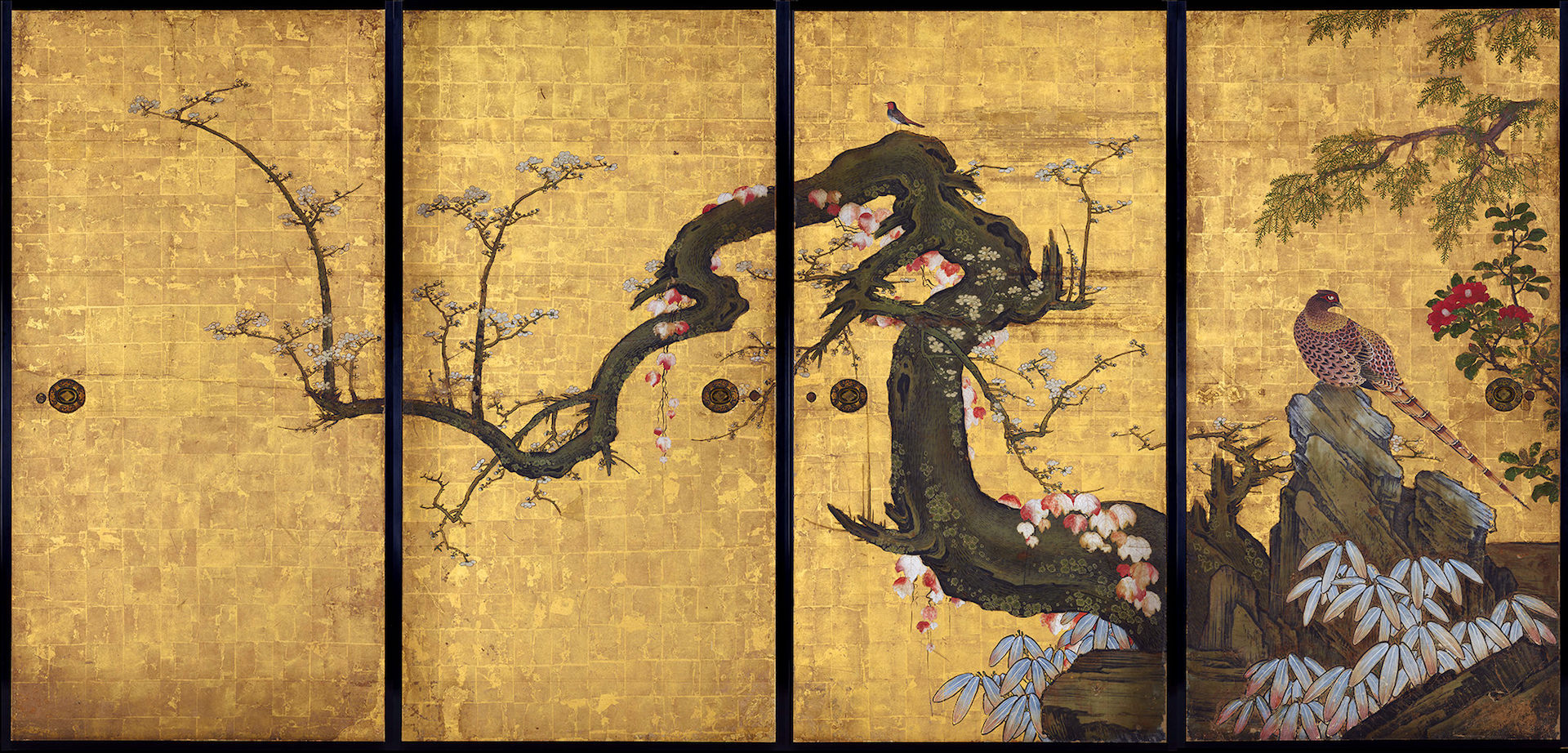
The trunk of a single ancient plum bends into a U shape, then twists and turns violently as it stretches to the left. Red and white ivy wind around the trunk, and a small bird perches among the branches. The sparse plum blossoms and background covered entirely in gold leaf make this fusuma work a symbol of Sansetsu’s cool, calculated sense of form.
Utagawa Kuniyoshi
Born in Hongin-cho, Edo. He rose to fame in the late Bunsei era with his series “Popular Suikoden: 108 Heroes.”
Alongside Kunisada for actor prints and Hiroshige for landscapes, he became the leading warrior-print master of his day. He absorbed a modern, imaginative sensibility into his caricatures, beauties, and Western-style landscapes, while in actor prints and satirical images he slipped past the shogunate’s censors with witty compositions that won broad popular support.
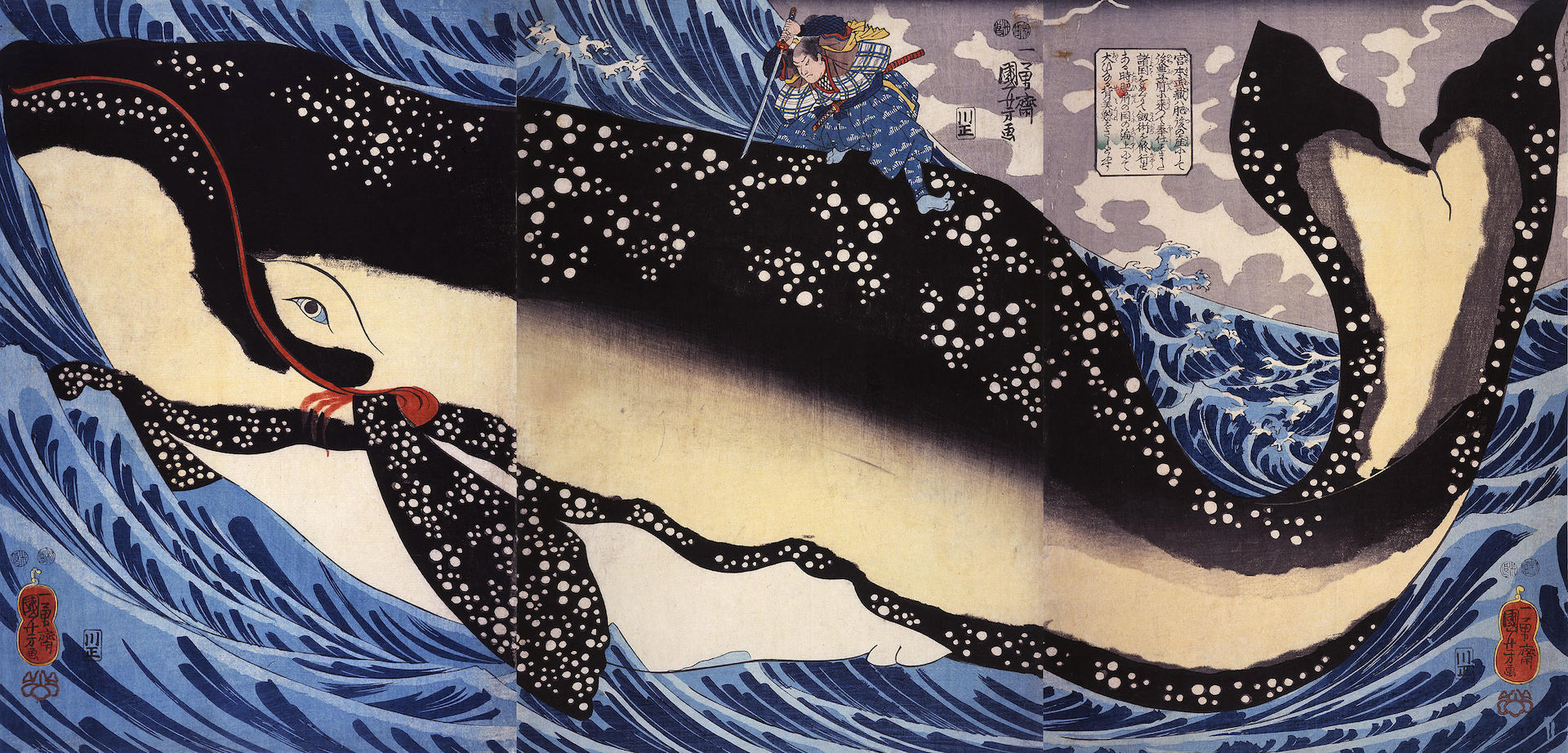
Based on the legend of the early-Edo swordsman Miyamoto Musashi slaying a whale, this bold composition fills a three-sheet triptych with a giant whale. A definitive example of “Kuniyoshi the warrior-print master.”
Details
The Lineage of Eccentrics: Miraculous World of Edo Painting
Dates: February 9 (Sat) – April 7 (Sun), 2019
Venue: Tokyo Metropolitan Art Museum, Special Exhibition Gallery
Closed: Mondays, February 12 (Tue) *Open on February 11 (Mon, holiday) and April 1 (Mon)
Hours: 9:30 – 17:30 (last entry 30 minutes before closing)
*Extended hours: Fridays, March 23 (Sat), 30 (Sat), and April 6 (Sat), 9:30 – 20:00 (last entry 30 minutes before closing)
Admission: Adults 1,600 (1,400) yen; university and vocational school students 1,300 (1,100) yen; high school students 800 (600) yen; ages 65 and over 1,000 (800) yen
*Prices in parentheses are for advance and group tickets. Group discount applies to groups of 20 or more.
*Free for junior high school students and younger
*Free for holders of a Physical Disability Certificate, Ai-no-Techo (intellectual disability certificate),療育手帳, Mental Disability Health and Welfare Certificate, or Atomic Bomb Survivor’s Health Certificate, plus one accompanying person
*February 20 (Wed) and March 20 (Wed) are Silver Days, with free admission for those aged 65 and over. Crowding is expected on these days.
[Inquiries]
TEL: 03-5777-8600 (Hello Dial)