Tomoko Konoike “Hunter-Gatherer”
“Hunter-Gatherer,” a solo exhibition by Tomoko Konoike, one of Japan’s leading contemporary artists, is currently on view at the Akita Museum of Modern Art.
Akita is Konoike’s hometown, and this is said to be her first solo exhibition in the prefecture.
Three years on from her 2015 show “Primordial Violence” (touring: Kanagawa Kenmin Hall, The Museum of Modern Art, Gunma, and the Niigata Bandaijima Art Museum), this is her next major exhibition. From Yokote in Akita, she plunges deep into the topography and climate of “the Ou Mountains, the spine of the Japanese archipelago.”

Back: Tomoko Konoike, “Fur Curtain,” 2015
Front: Pierre-Auguste Renoir-Rodin, “The Age of Bronze” (collection of the Akita Museum of Modern Art)
Since “Primordial Violence,” the focus of Konoike’s practice has been on “borrowing perspectives other than human.” Looking at our own human existence from there is an attempt to shift the viewpoint of art itself — a viewpoint that, over a history longer than that of cave paintings, has always been human-centered.
This exhibition brings together many new works, including an 8 m wide and 6 m tall carving (relief painting), the fur mountain range “Dream Hunting Grounds” made from Asian black bears hunted this year in Tohoku and Hokkaido and other works the audience can touch directly, and a video of the artist wearing a bearskin and paddling upstream on the winter Ani River. Also on view together is the project she began after the earthquake in various regions, “Storytelling Table Runner” — 130 textile-and-story works.
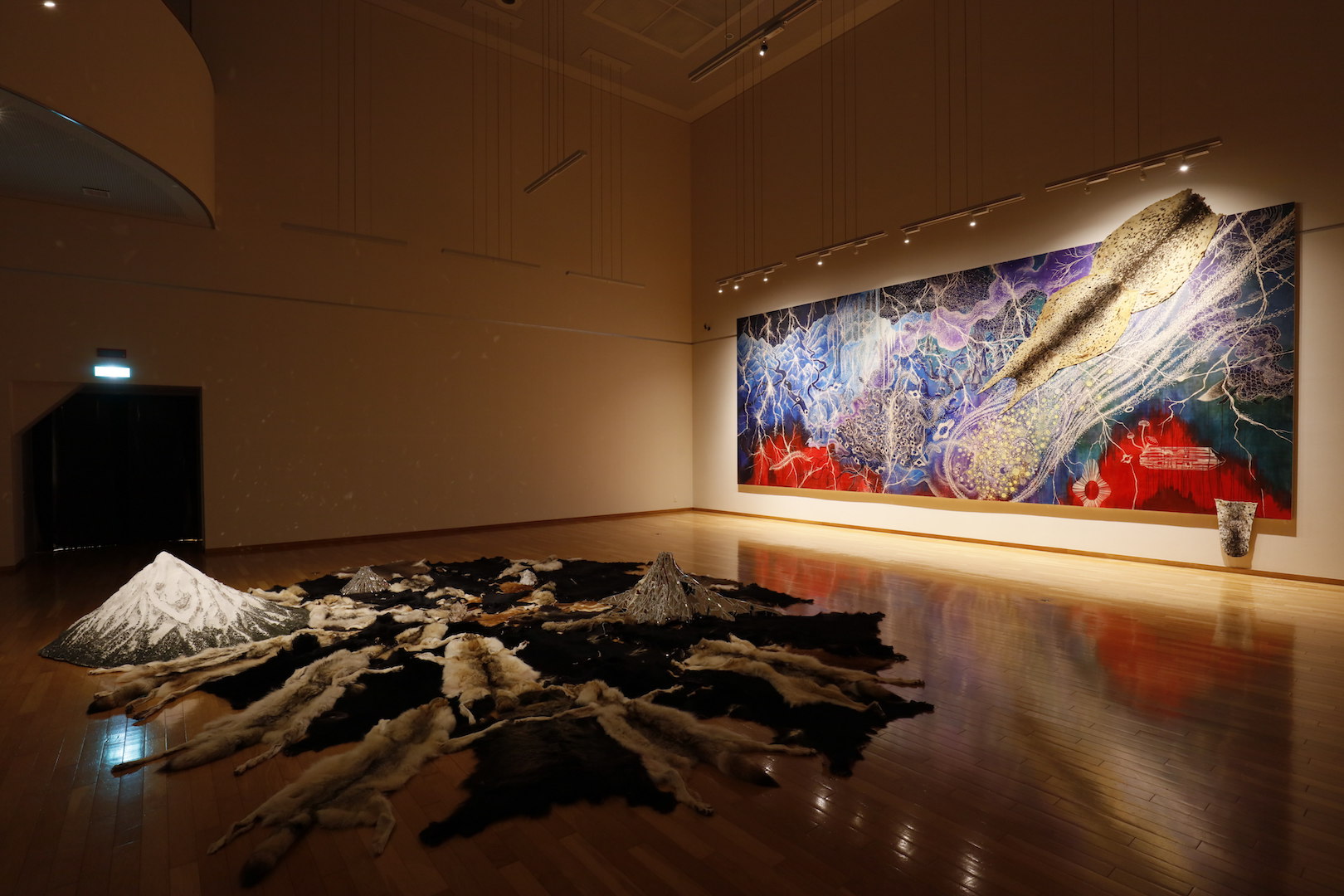
Hunter-Gatherer
I am always thinking about energy.
Whether painting or sculpture, in any act of making, the moment materials and thoughts once scattered draw close to completion, the world snaps shut, turns conservative, and begins to stabilize. So in my case, I deliberately drive a foreign-feeling fissure into the nearly-finished piece to destabilize it, throwing the balance dramatically off. In drawing, I add lines I know are in the way, or wipe out important passages, or flip the drawing upside down — merciless things that ruin the work. Because the moment I do that, an explosive energy erupts from deep within the piece to fill that unevenness, breaking through the current stable dimension and trying to transform itself. This gamble of making repeats every time; through the energy conversion, the work gains further intensity and moves toward completion.
It is like a hydroelectric dam, and it happens daily in my working process.At the same time, over the past few years I have been, like a colonial plunderer (or perhaps like Cruella de Vil), purchasing Asian black bears, Ezo shika deer, seals, and other animals that had been culled as pests in Tohoku and Hokkaido, and sending them to tanneries to be turned into pelts. The wolves I obtained earlier were among those mass-culled in Mongolia.
“Tanning” is the process of carefully preserving the animal’s outer skin and fur while scraping off the inner fat with a scraper, washing it many times with chemicals, and finishing it into a hide. Through this, the raw smell of blood disappears, and the material can be touched pleasantly in everyday life. Early taxidermy was made by stuffing straw into the pelt. To reproduce, on a dead animal, a surface just like it had when alive must have felt like magic. This act of “re-presentation (appearing once again)” operates at the root of every kind of making that humans do. And to gaze at a lifeless taxidermied form as though it were alive — to gaze at the illusion of having eternally, universally possessed something that has died — is something we humans seem to love beyond all measure.To break through that obsession of the eye, for me it was, after all, the act of making that was needed. Sometimes I make alone, sometimes with others — this “making” takes many forms.
“Making” is a wonderful word: it can be exchanged, endlessly, for “crying,” “eating,” “moving,” “listening,” “lying,” “touching,” “falling,” and so on. In response, my body too began to seek new materials, and paper and paint gave way to earth, animal hide, fur, house doors, thread and cloth, letters, dandelion seeds, souvenirs, crates for packing artworks, cosmetics — every kind of matter became a material. So too was the small bird’s nest a neighborhood child brought home: a delicate form woven of palm fiber and sphagnum moss — a bird’s act of making. The human distinction of “who (which animal) made this” started to feel meaningless.Also, because I move across the earth for long stretches for shooting and exhibitions, my body constantly feels the resistance of the wind, and even my body itself has become a kind of vehicle for movement. When the display was complete — an owl-moth kite pasted onto fur, a small mountain hut on a sled, video of paddling a canoe up the winter Ani River — I realized for the first time that I had been making tools for my own movement. Once that happens, even song becomes a vehicle: eyes stick to the tip of the voice, running along the slopes of frost-covered trees, watching the scenery.
As the exhibition drew near, working frantically and trying to gulp down a sandwich, I bit my own right index finger by mistake with astonishing force. I injured it and couldn’t hold a carving knife for a whole week. But more than that, feeling an animal-like terror at my own teeth, and being unable to recover from that shock for a while — for me, that too was one of the forms of “making.”Since starting to use fur in my works, I have also come to know that so many animals are now descending on inhabited areas in search of food that the culling on those mountains cannot keep up. This is a scene one can hardly call “humans in control of nature.” When it comes to violating borders, the other party — as fellow animals — is one step ahead of us.
We want to cull anything that invades human territory; and yet we ourselves want to step into that dangerous other-world called nature — to touch it, to smell it, to eat it, to become one with it. Perhaps that is because at the border where different kinds come into contact, friction is inevitable, and both sides draw their energy from it — a “tangible sense of surviving.” Killing a bear, and eating a bear, is one such thing. My making, too, is no longer an abstraction called self-expression; it is unmistakably a real conversion of energy. And this desire to keep violating the border has not stopped since the birth of humankind.Right behind Yokote City, where this exhibition is being held, stand the Ou Mountains. Since I was small I have been intimate with the mountains that form this range through skiing and other pursuits. The Ou Mountains, running like a spine through northern Japan, still contain rare and rich mountain landscapes surrendered to the flow of primeval nature, and I have often heard tales from stream-climbing masters who were captivated by them. Also, when you cross the harsh mountain pass from the Iwate side on the Kitakami Line and arrive at Yokote Station, you see just how deeply this town sits at the border between deep mountains and plains. The view of nature held by people whose immediate hinterland is the other-world of mountains is surely quite different from that of people who have long lived in vast plains.
Taking this mountain range as my cue, I decided to think about energy from there. First, I need to turn my viewpoint — which had been facing the city — all the way around toward the mountains, and to borrow eyes other than the ones humans have preferred. That is a world where every sensation of the body precedes present-day human language. It may even be good to close, for a moment, eyes that have relied too much on vision. There, past methods of “handling” an unknown nature through tourism or development no longer work. The Ou Mountains seem to be telling us, from behind, to briefly set aside the prefectural border of “Akita” that people drew, and even the framework of “Tohoku” or “Japan,” to abandon our attachments toward each other, and to look at the terrain. This connects, too, to the cultural systems and artistic structures — museums, art museums as public sectors that officially certify what we call “beauty” or “treasure.” Because the audience we are now imagining is no longer only human.Culture, as humans have built it, is a development of the archetype called the hunter-gatherer. Hunting game in mountain and sea; gathering wild vegetables, vines, and seashells; combining the two skill sets — that is how we have walked forward. I would further extend the interpretation: the hunter, through “tools,” drags fragments cut out of the natural world into the human world; the gatherer collects those fragments and “shapes” them anew. Bringing back game, cooking it in a pot, turning it into a meal; gathering motifs from a landscape and composing them onto the picture plane of a painting; a machine assembled from components in a PC — all of these apply. Rice cultivation, which came later from the continent, accumulated the knowledge and data of hunting and gathering, and went on to conduct “production.”
But if we merely go on applying and customizing this hunter-gatherer, making will forever develop only in the direction of “dragging things into the human world.” How to dismantle and transform that “archetype” — that, I think, is the role art is now being asked to play. One way to begin is with the simple statement: do not continue easy application and customization. To do so, we must not cling to existing art, and while borrowing many perspectives other than the human, we still — as humans — need to open up a human viewpoint.Now, having finished installing the works, I find myself, as usual, wanting to destabilize the space again. I am already tired of a completed venue. A place needs the violence that stirs up energy. And the “completion” of an exhibition is only an interim marker of convenience. By the audience, at any moment, the completion of the work in front of them is violated, broken, transformed. Maker and viewer are exchanging limbs and eyeballs with each other in turn, dissolving into one another — that is how we are, right here, now.
Tomoko Konoike
Furusato Support Discount
The writer lives in Tokyo. We booked our tour using this “JAL Furusato Support Discount.”
JAL Furusato Support Discount
If you use Akita Airport as your outbound arrival and stay in Yokote City or Misato Town, “5,000 yen (per person)” will be subsidized from your travel fee.
*This program is implemented via subsidies from Yokote City and Misato Town.
Eligible period: departures from Monday, May 14, 2018 through Friday, November 30, 2018
Eligibility: passengers using Akita Airport for the outbound leg of a round-trip JAL Group domestic flight
*Bookings where the departure and arrival airports differ cannot be made.
One or more overnight stays at designated lodging facilities “in Yokote City or Misato Town” required
*If your reservation includes lodging outside Yokote City or Misato Town, it will not qualify for the subsidy.
Applying the discounted tour brings the one-night-two-day tour price to a bargain “22,000 yen” even on weekends.
This is a rare opportunity — for those who can adjust their schedule before the run ends, we strongly recommend considering it.
Overview
Tomoko Konoike “Hunter-Gatherer”
Venue: Akita Museum of Modern Art
Dates: Saturday, September 15 — Sunday, November 25, 2018 (72 days). 9:30 a.m. — 5:00 p.m. (last admission 4:30 p.m.)
*Open every day during the run
Admission: General 1,200 yen; high school/university students 800 yen. Half price for holders of a disability certificate and one companion.
*Visitors with visual impairments are welcome to touch the works.
Organizers: Tomoko Konoike Exhibition Executive Committee (ABS Akita Broadcasting System, Akita Museum of Modern Art)
Support: Yokote City; Yokote City Board of Education; Akita Sakigake Shimpo; Kahoku Shimpo; Yokote Kamakura FM; FM Yutopia; FM Hanabi
.jpg)