Beyond the End: An Art History of Ruins
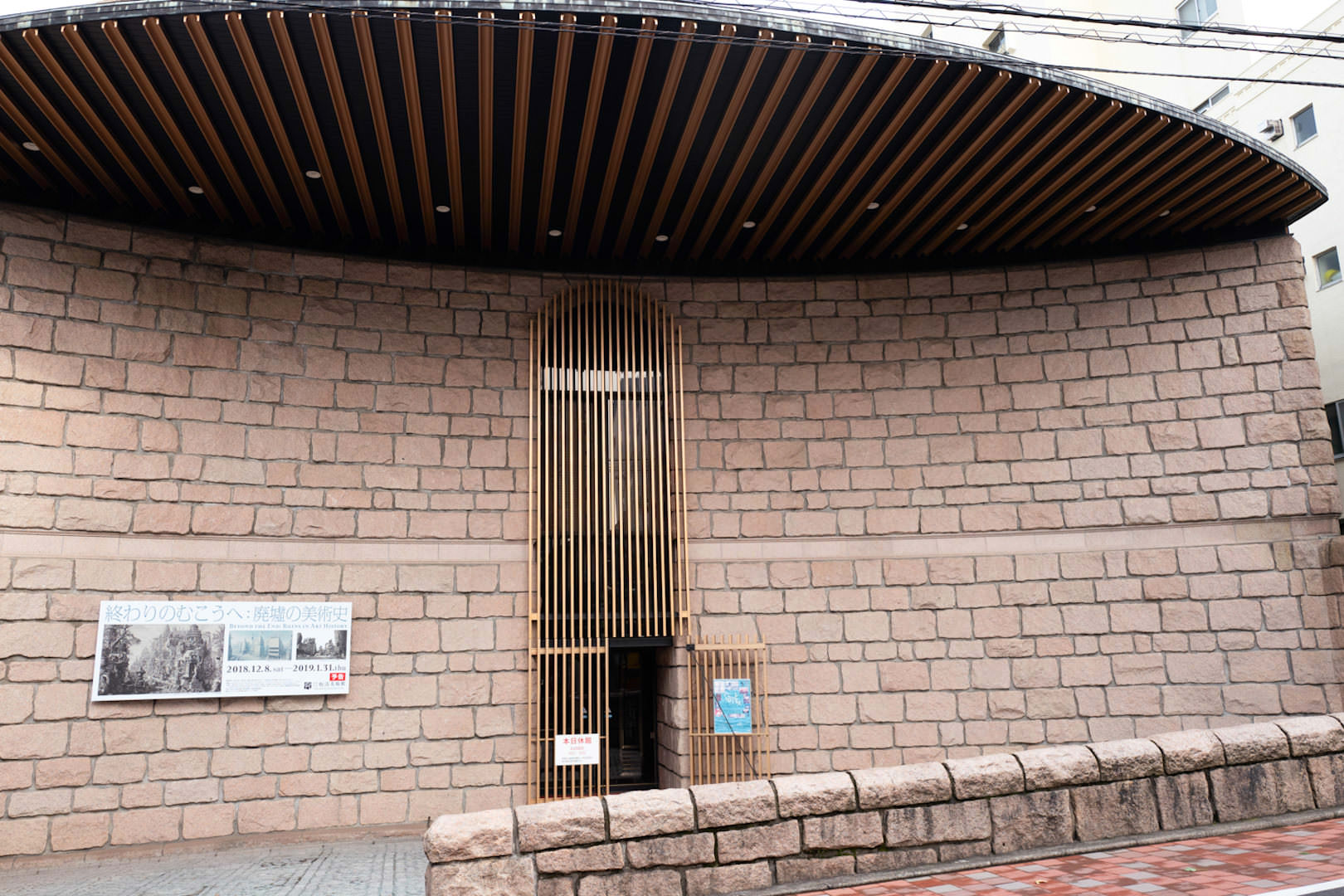
“Beyond the End: An Art History of Ruins”, currently on view at The Shoto Museum of Art, is approaching the end of its run.
I attended Minoru Nomata’s artist talk held during the exhibition period.
The talk took place on January 19, 2019. Because the content was so valuable, I would like to leave a record of it here as a special report.
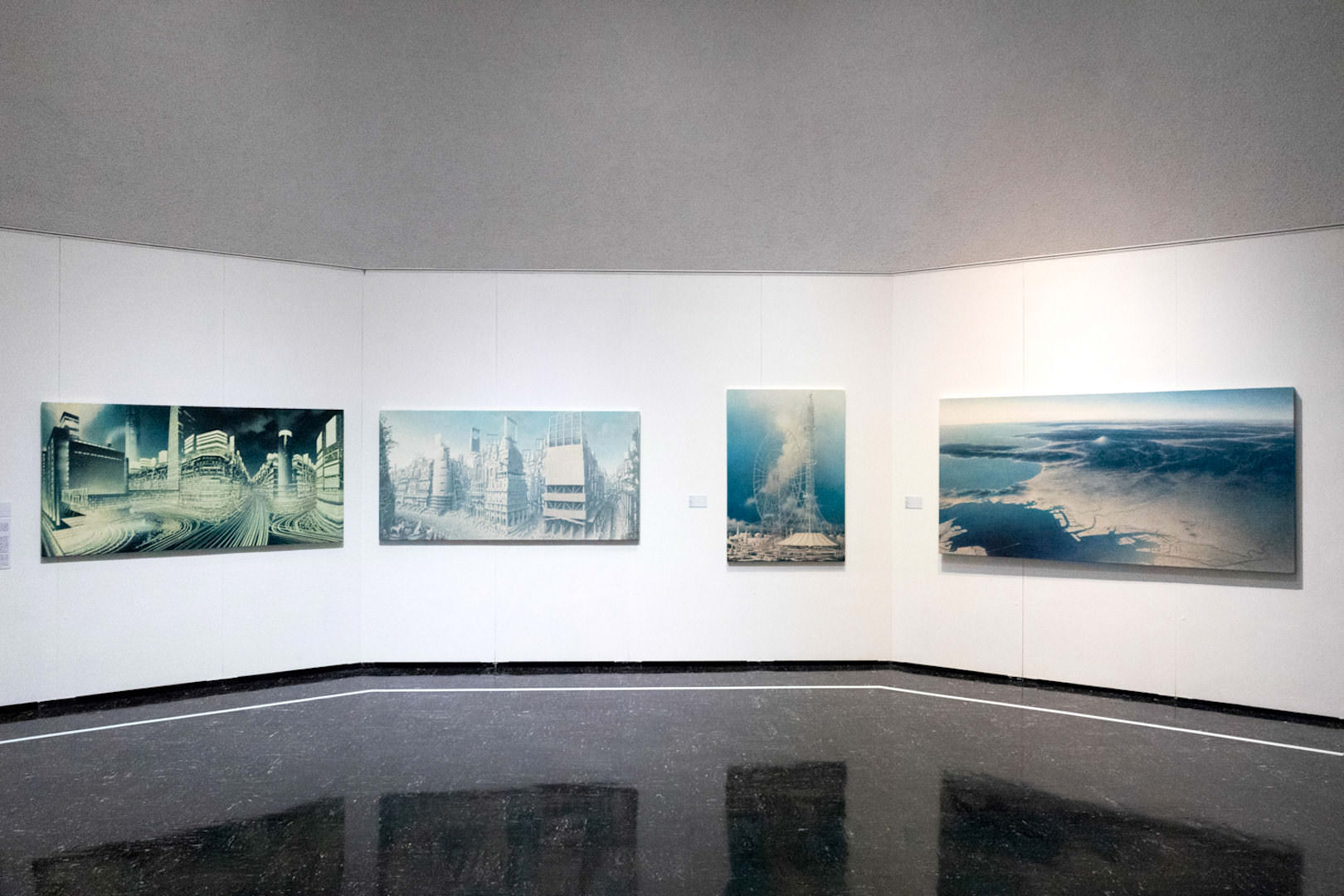
Minoru Nomata
Minoru Nomata has developed a body of work around motifs of imaginary architecture that he himself has envisioned.
His work was chosen as the main visual for “Beyond the End: An Art History of Ruins”, and the overwhelming worldview of his art continues to captivate viewers.
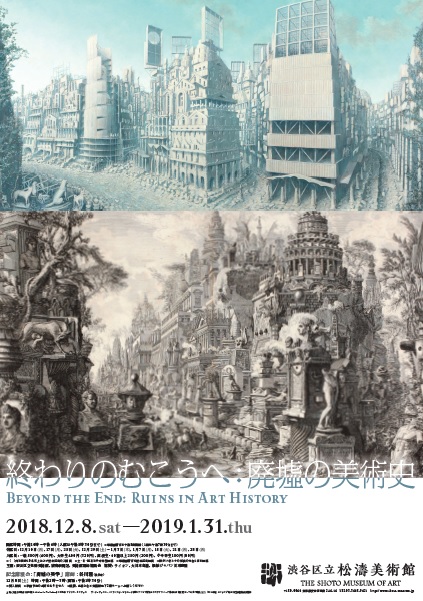
Top: Minoru Nomata, “While Waiting at the Crossing”
On the day of the artist talk, distribution of numbered admission tickets began 30 minutes before the start time. A crowd of hopeful attendees had already lined up, and all the tickets were gone in a matter of moments – a testament to Nomata’s popularity.
Artist Talk “Imagine”
The talk took the form of a self-narrated presentation, unfolding as a chronological look back at Nomata’s career from childhood on.
Minoru Nomata’s family home is in the Higashiyama area of Meguro Ward, not far from Shibuya where the ruins exhibition is being held. Growing up there, he has witnessed the changes of the urban landscape firsthand throughout his life.
He passed his childhood and youth in the middle of the high-growth era, in a city that was always full of energy, with almost no opportunity to touch nature.
“In my mind there is no such word as ‘ruin’ – past, present, and future intersect at once.”
Perhaps this is the perspective on the city cultivated by someone who grew up in one of Tokyo’s core urban-planning zones.
New buildings are always going up; construction is repeated over and over in different parts of the city.
《交差点で待つ間に》-2013-年-アクリル、カンヴァス -撮影:木奥恵三-cMinoru-Nomata .jpg)
Photo by Keizo Kioku (C)Minoru Nomata
“My family ran a dyeing shop, so I was constantly surrounded by color. Because I grew up in a very Japanese world, I longed for Western-style spaces.”
After graduating from Tokyo University of the Arts, Nomata joined the advertising agency McCann Erickson. While working as a designer in the corporate world, he continued making his own art. He would come home from work and paint until three in the morning, night after night.
《波の花》 2013-年 .jpg)
Photo by Keizo Kioku (C)Minoru Nomata
Nomata’s paintings unfold into imaginary structures and worlds that do not exist in reality.
“My motifs are things I cannot reach – the things I long for or want.”
After he left the company, filling a scrapbook edge-to-edge with clippings became his source of ideas.
By stuffing the pages without any particular meaning or connection, he came to realize that past, present, and future were all contained there together.
《イマジン-1》 2018年.jpg)
Photo by Keizo Kioku (C)Minoru Nomata
“There are devices embedded inside my paintings. One is time; the other is presence. They give the work a roundabout quality, so that it may look like architecture, or like a ruin.”
The scrapbook practice that he still keeps up settles into a kind of notebook when the clippings are pasted in; after some time passes, looking back at them lets him notice things he had not before.
“Friends often ask me about this, but I’ve never drawn people. Since there are buildings in the paintings, it wouldn’t be strange for people to be there too.”
He consciously avoids including any human figures among the clippings he pastes into the scrapbook. He says that if a figure enters, it feels like an impurity has been mixed in and gets in the way.
“I interpret time as depth. In painting, creating depth is what gives birth to time, and to the traces and presences it leaves behind. I am very conscious of ‘time plus presence.'”
By including this indirect quality in his work, he says he infuses the paintings with a scent.
《イマジン-2》.jpg)
Photo by Keizo Kioku (C)Minoru Nomata
The Q&A brought a wide range of questions from the audience, showing just how much interest there is in Nomata’s work.
“There are no tricks in the making. I draw the underdrawings in pencil and revise them over and over, working steadily. Well – it’s hard work. There’s no secret. (laughs)”
Looking at the works again after the talk, I felt an even stronger awareness of presence and time – a shivering sensation almost stirred up from within. I felt once more the sheer strength of Minoru Nomata as an artist.
As for the exhibition title, “Beyond the End: An Art History of Ruins”, the curator in charge said that after “An Art History of Ruins” was set first, they were searching for words that would deepen it, and drew inspiration from “After the Future” – the chapter title of the catalogue for Minoru Nomata’s 2010 solo exhibition at The Museum of Modern Art, Gunma – which led to “Beyond the End”.
The exhibition runs through January 31, 2019. I highly recommend a visit.
Overview
“Beyond the End: An Art History of Ruins”
Venue: The Shoto Museum of Art
Dates: Saturday, December 8, 2018 – Thursday, January 31, 2019
Admission: General 500 (400) yen, University students 400 (320) yen,
High school students and those aged 60 and over 250 (200) yen, Elementary and junior high school students 100 (80) yen
* Figures in ( ) are for groups of 10 or more and for Shibuya Ward residents
* Elementary and junior high school students free on Saturdays, Sundays, holidays, and during summer vacation
* Free for Shibuya Ward residents every Friday
* Free for visitors with disabilities and one accompanying person
Closed days: December 10 (Mon), 17 (Mon), 25 (Tue), December 29 (Sat) – January 3 (Thu), January 7 (Mon), 15 (Tue), 21 (Mon), 28 (Mon)
(Some works will be rotated during the exhibition period)
Organizers: The Shoto Museum of Art, The Yomiuri Shimbun, The Japanese Association of Museums
Sponsors: Lion, DNP Dai Nippon Printing, Sompo Japan Nipponkoa
Artist Talk
Saturday, January 19
Minoru Nomata (participating artist, professor at Joshibi University of Art and Design)
“Imagine”
15:00-16:00 (doors open at 14:30), capacity 80
* Numbered admission tickets distributed at the 1F lobby from 14:30