Oscar Oiwa “Journey to the Light”
It has been announced that a solo exhibition by Oscar Oiwa will be held at the 21st Century Museum of Contemporary Art, Kanazawa.
This large-scale solo exhibition features more than 60 works centered on recent pieces, in addition to a monumental drawing rendered across a 27-meter wall.
Exhibition Overview
Oscar Oiwa has vividly depicted contemporary society through radiant, luminous colors and dynamic spatial compositions, at times woven with criticism and humor. Born in 1965 in São Paulo, Brazil, to Japanese parents, and continuing his practice as he moved between Tokyo and New York, Oiwa’s works hold in coexistence the perspective of a person going about daily life and a somehow objective, bird’s-eye viewpoint.
Taking as themes the cities and societies he inhabits, as well as environmental issues, he freely combines photographs, printed matter, and images found on the internet, giving rise to a distinctive worldview that shimmers between reality and fiction, the artificial and the natural, light and shadow.
This exhibition approaches Oiwa’s vision through more than 60 works centered on recent pieces, along with a drawing rendered on a 27-meter wall at the 21st Century Museum of Contemporary Art, Kanazawa. As a guest artist, composer Chad Cannon is invited to attempt a fusion of paintings and a majestic symphony inspired by the artist’s works. The “light” that Oiwa has sought within his paintings while traveling the world will remind us of hope that lies beyond the complexities of living in the present.
The exhibition is organized into the following six chapters, joined by the monumental 27m drawing.
Chapter 1: New York City Enveloped by Waves
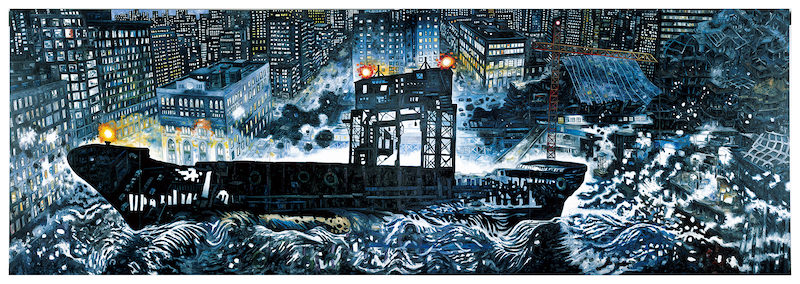
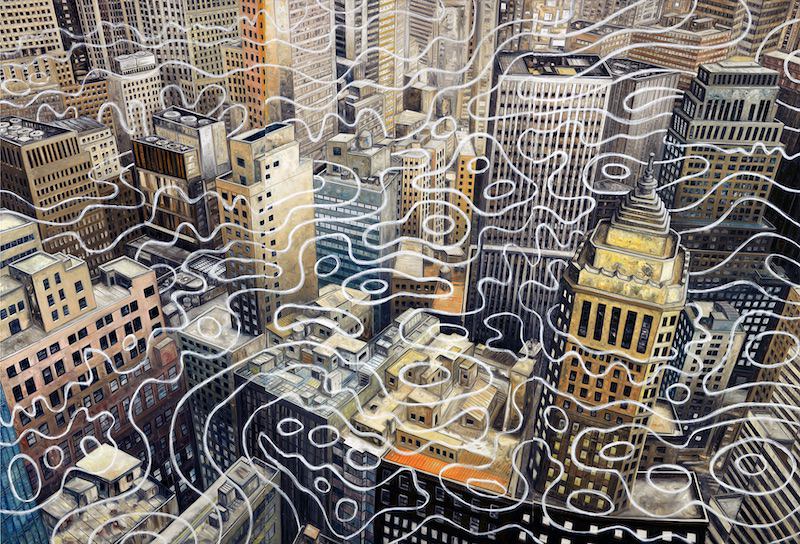
Having lived in New York since 2002, Oiwa leads a regular, salaryman-like life—commuting to his studio by subway every morning, working until evening, then returning home to sit at his computer and work again at night. The “World Wide Web Wave” series is one in which Oiwa captures the New York in which he lives from a bird’s-eye view, overlaying it with an image of the invisible radio waves that flow through the city. In “Ghost Ship,” which takes as its motif a ruin remaining along the Hudson River, an enormous ship floating on the waves emerges against the backdrop of nighttime New York.
Chapter 2: America Unbound
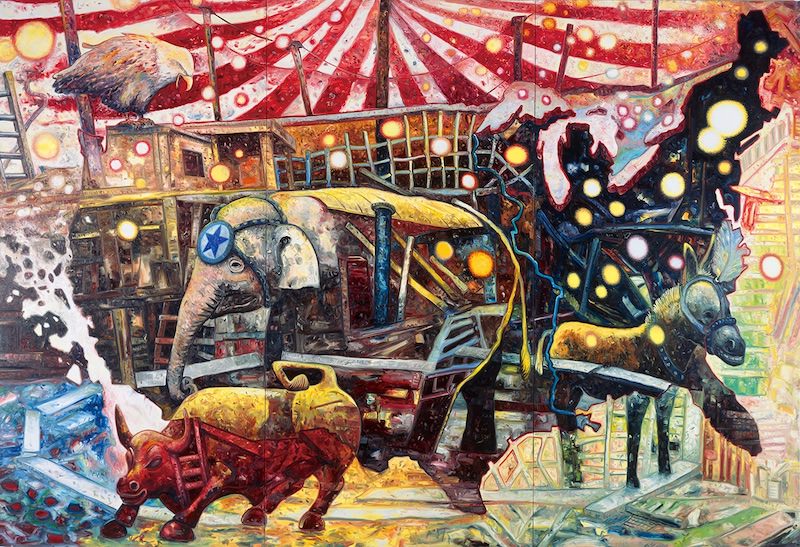
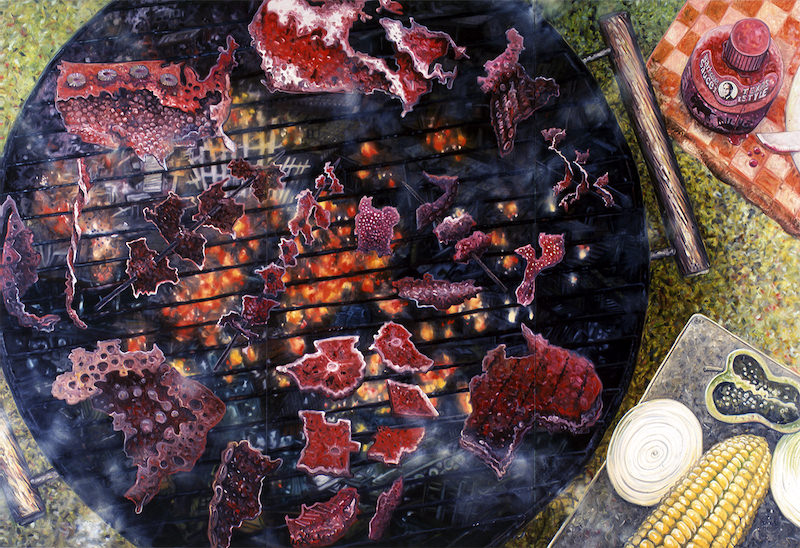
2002, the year Oiwa moved to New York, was the year following the September 11 attacks, and despite the peace of daily life, America had begun wars in Iraq and Afghanistan. After that came the Lehman shock, and although “hope” briefly seemed visible with the birth of the Obama administration, the launch of the Trump administration has plunged America into upheaval. Watching these circumstances, Oiwa seems to be drawing out the political and social confusion through familiar subjects such as barbecues, circuses, and dreams.
Chapter 3: A Traveler’s Life
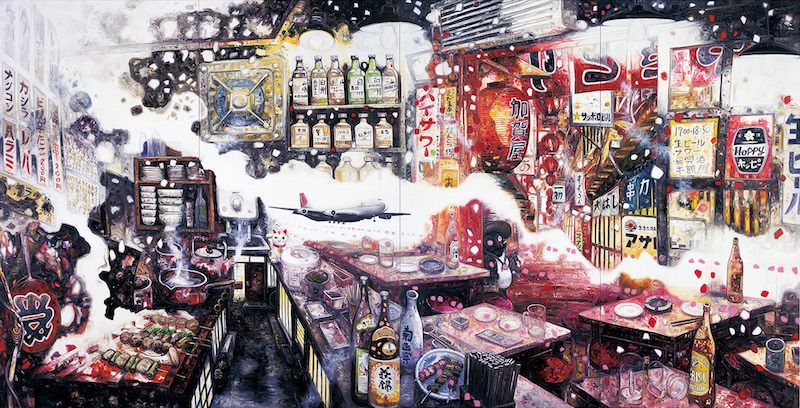
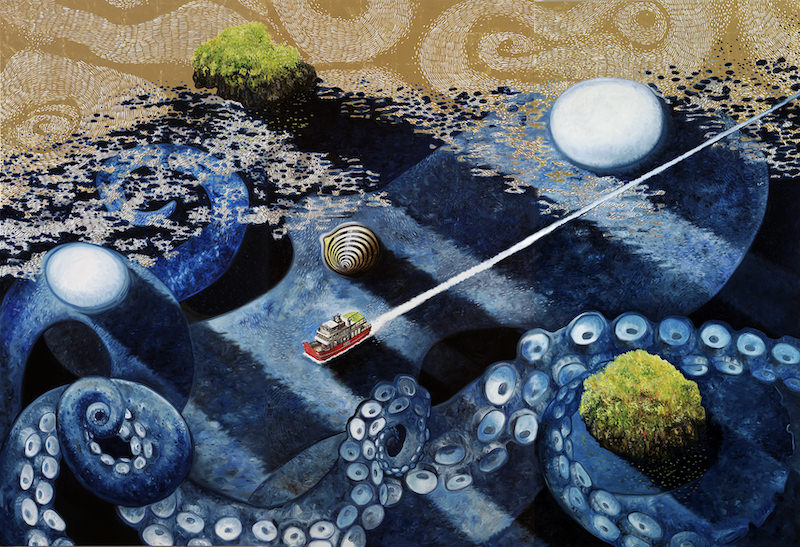
Between his birthplace of São Paulo, Tokyo where he lived for eleven years from 1991, and New York where he later settled, Oiwa’s life spent moving around the world can be called a journey in itself. And the landscapes and motifs he saw in each of these places have found their way into his works. Various places—Kita-Senju, retaining the atmosphere of a Showa-era downtown neighborhood; Ogijima, floating on the Seto Inland Sea; and various Asian countries—are depicted with a touch that carries a sense of nostalgia. Numerous charming drawings also color scenes from this traveler’s life.
Chapter 4: A World That Doesn’t Go Well
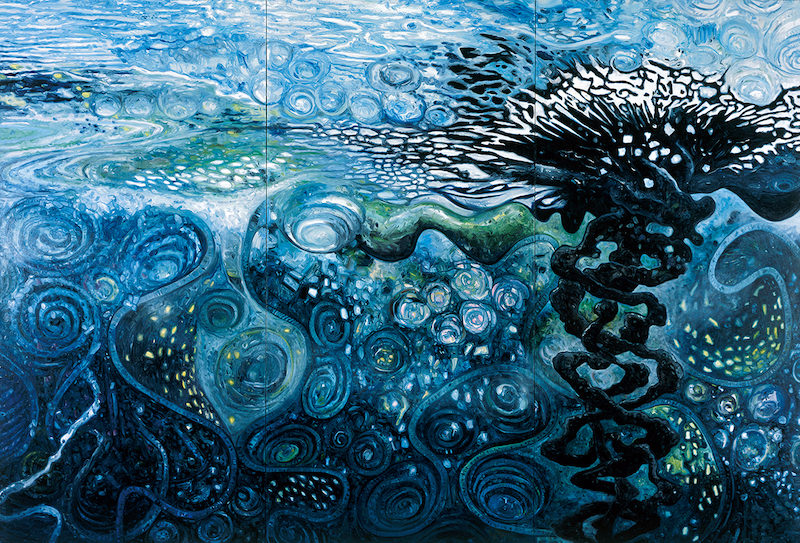
Having witnessed a world that doesn’t go well ever since his boyhood in São Paulo, Oiwa continues to make work while facing environmental problems such as air and marine pollution, as well as the absurdity of natural disasters. Even when handling weighty themes, the pictures—alive with vivid colors and a sense of light—seem to harbor a faint hope. In this chapter, a fusion of paintings and a majestic symphony born of composer Chad Cannon’s inspiration from Oiwa’s works is also attempted.
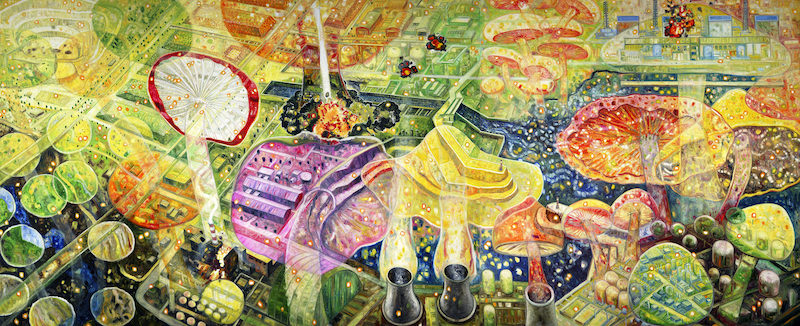
Chapter 5: Toward the Light
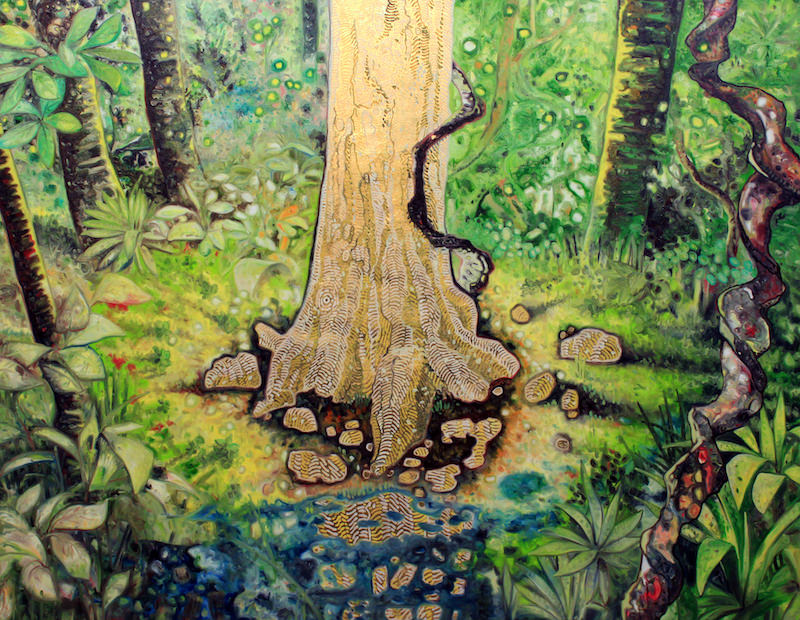
In Oiwa’s work, “light” is the greatest theme. Focusing on the two types of cells in the human retina—cone cells, which allow color and form to be clearly distinguished under strong light, and rod cells, which allow the shape of objects to be made out in dark places but not their color—Oiwa devised a way of showing paintings using the latter. Paintings made with various mediums for expressing light—foreign gold leaf, foreign silver leaf, glitter, and LED lights—will be viewed in a dimly lit gallery.
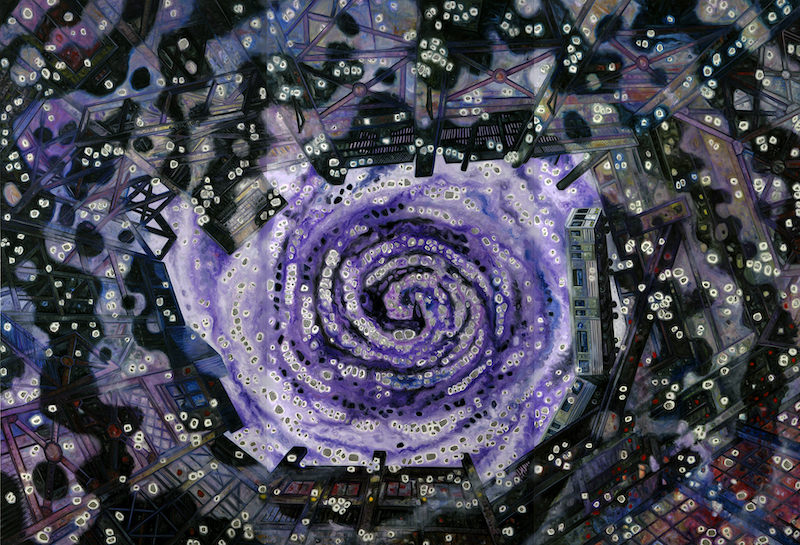
Chapter 6: With Hope
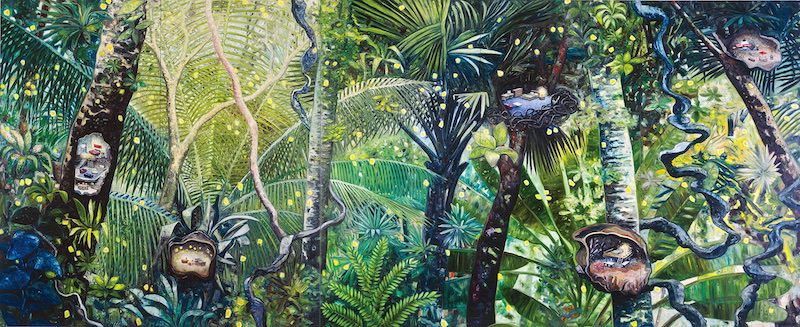
Bringing the exhibition to a close is a group of works filled with light in greens, blues, and yellows. Their settings vary—the Amazon rainforest, rivers of São Paulo, forests impossible to place—yet in every work, a soft light that seems to envelop the viewer pours down. The new work created for this exhibition, “Journey to the Light,” may be said to be a magnificent pictorial embodiment of Oiwa’s own words: “If you want to become happy, it is important to cultivate a light within yourself that you can aim for.”
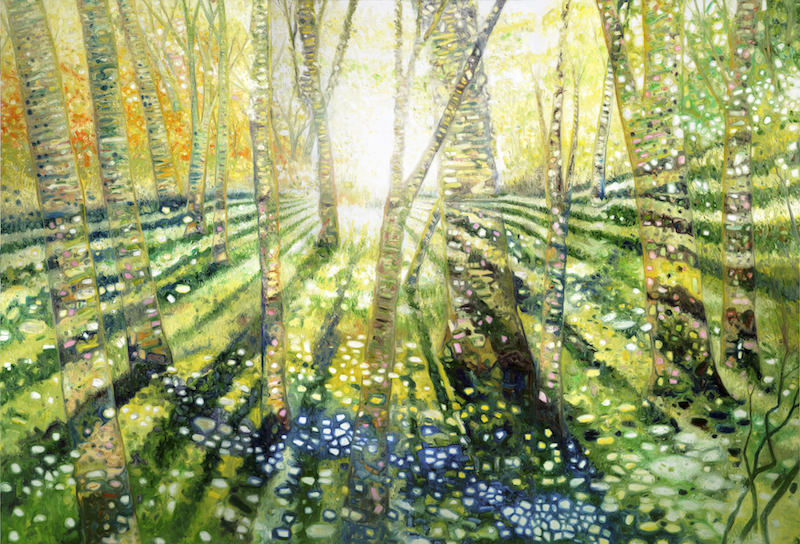
New drawing “Forest” rendered on a 27-meter wall
Oscar Oiwa has previously undertaken large wall drawings at the Setouchi Triennale (Ogijima in 2010, Ibukijima in 2013, Shodoshima in 2016), the Brazilian Embassy in Japan (2017), and Japan House São Paulo (2018). This time, on a monumental wall of the 21st Century Museum of Contemporary Art, Kanazawa measuring 4.5 meters tall and 27 meters wide, he will produce a drawing on the theme of “forest” over roughly two weeks.

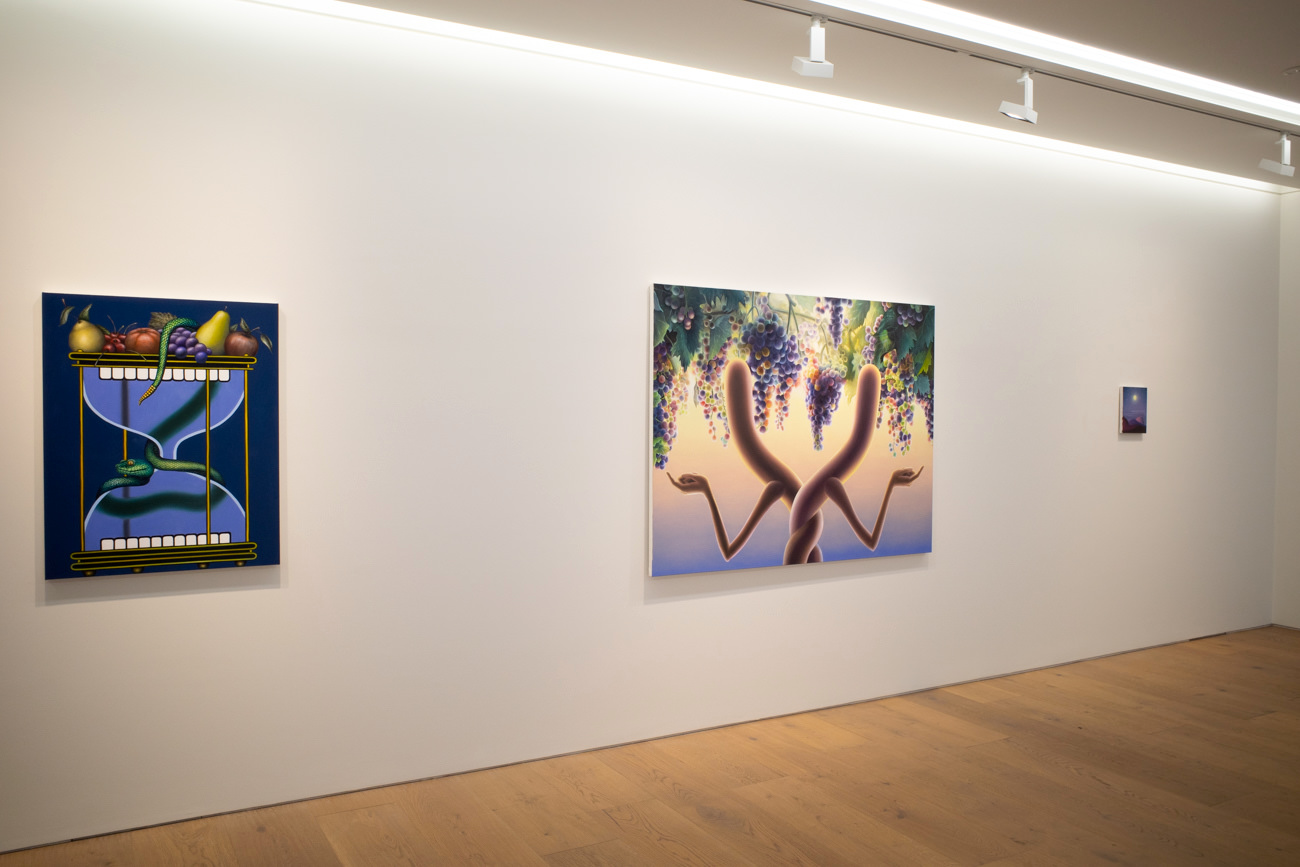
Oiwa’s works, rendered on large canvases that let you steep in their worldview, offer their own particular pleasure.
Images of other works have also arrived, and this is set to be an outstanding opportunity to take in a great many works all at once.
Oscar Oiwa Profile
Born 1965 in São Paulo, Brazil. Graduated from the School of Architecture and Urbanism at the University of São Paulo in 1989. In 1991, he moved his base of activity to Tokyo. In 1995, he resided in London as an artist-in-residence at Delfina Studio Trust. In 2001, he received grants from the Asian Cultural Council and the John Simon Guggenheim Memorial Foundation Fellowship, and in 2002 he moved his base to New York, where he currently resides.
Major exhibitions include the 21st Bienal de São Paulo (1991), “Garden of Eden” (The Ueno Royal Museum EXTRA, 1998), “Oscar Oiwa: Dreaming World” (Museum of Contemporary Art Tokyo, 2008), “Oscar Oiwa” (Museu Nacional de Belas Artes, Brazil, 2011), and “Beyond the End: A History of Ruins in Art” (The Shoto Museum of Art, Shibuya, 2018).
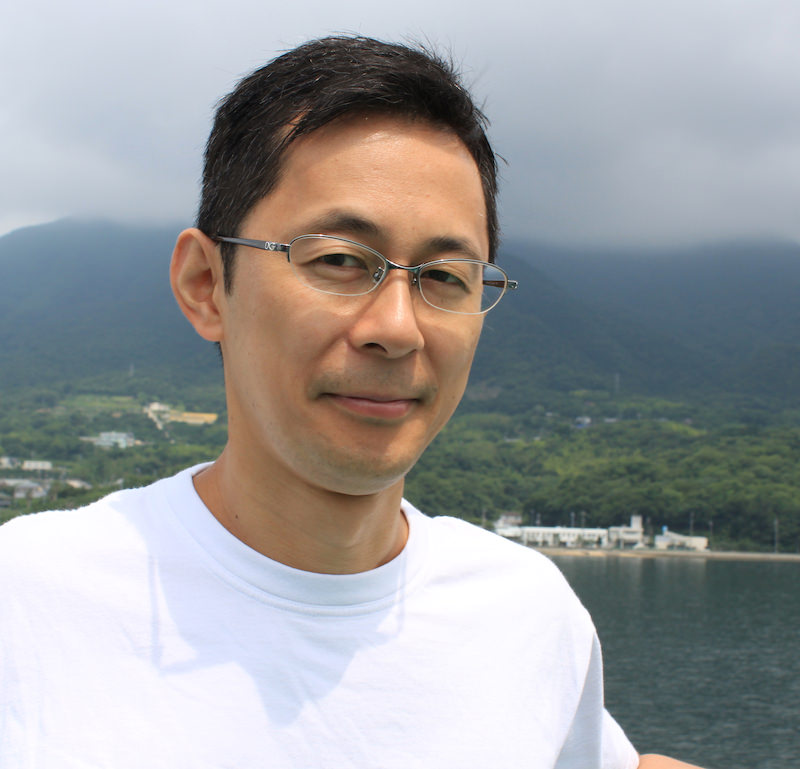
Oscar Oiwa continues to show works in various places, including his recent participation in Art Fair Tokyo 2019, and this will be his long-awaited museum solo exhibition. Something to look forward to!