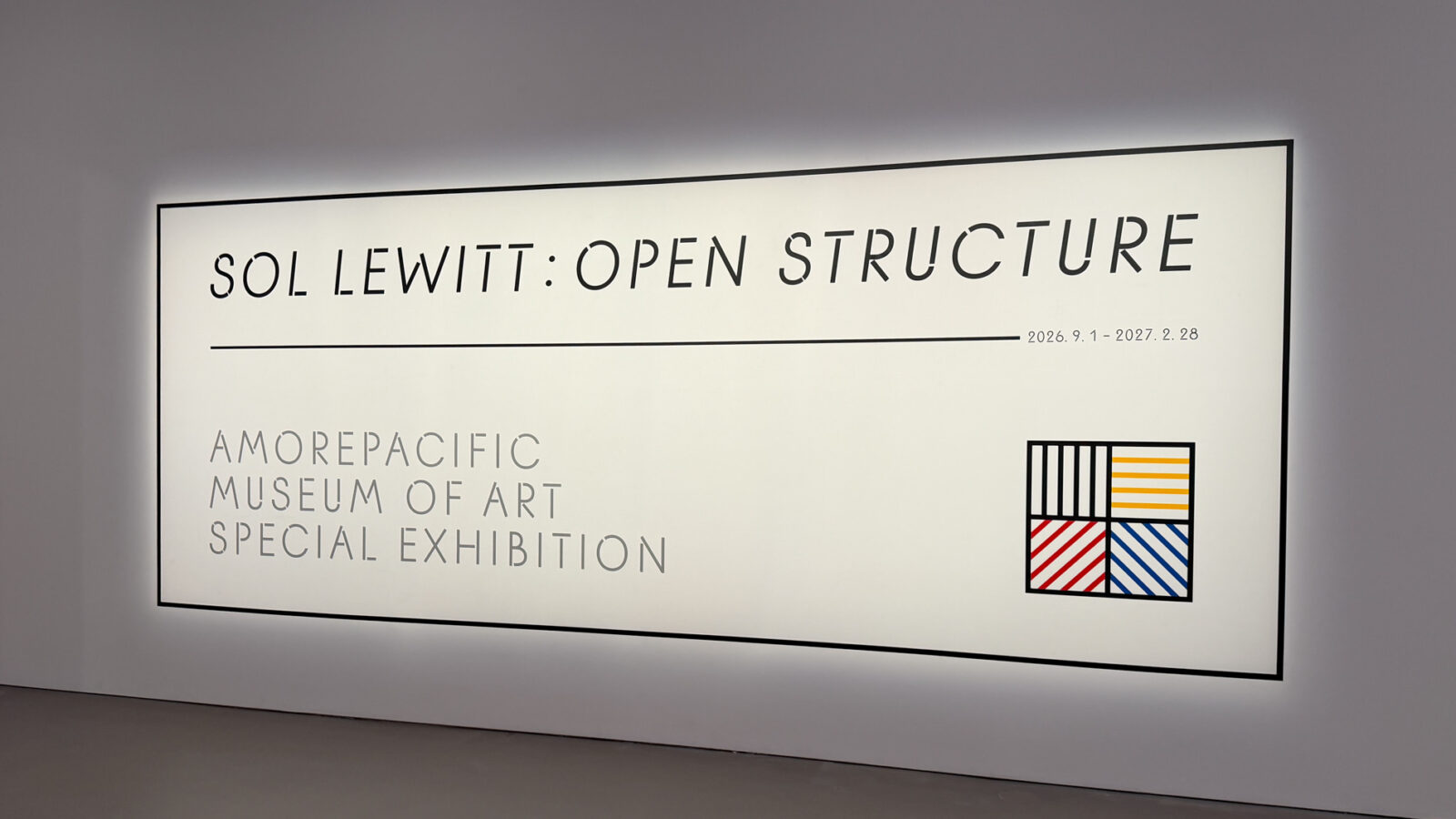
I am in Seoul for the run of Frieze Seoul and Kiaf. One floor below ground in the Amorepacific headquarters in Yongsan, I saw Sol LeWitt: Open Structure. It is the first large-scale Sol LeWitt solo exhibition in Korea.
The exhibition travels here from the Museum of Contemporary Art Tokyo.
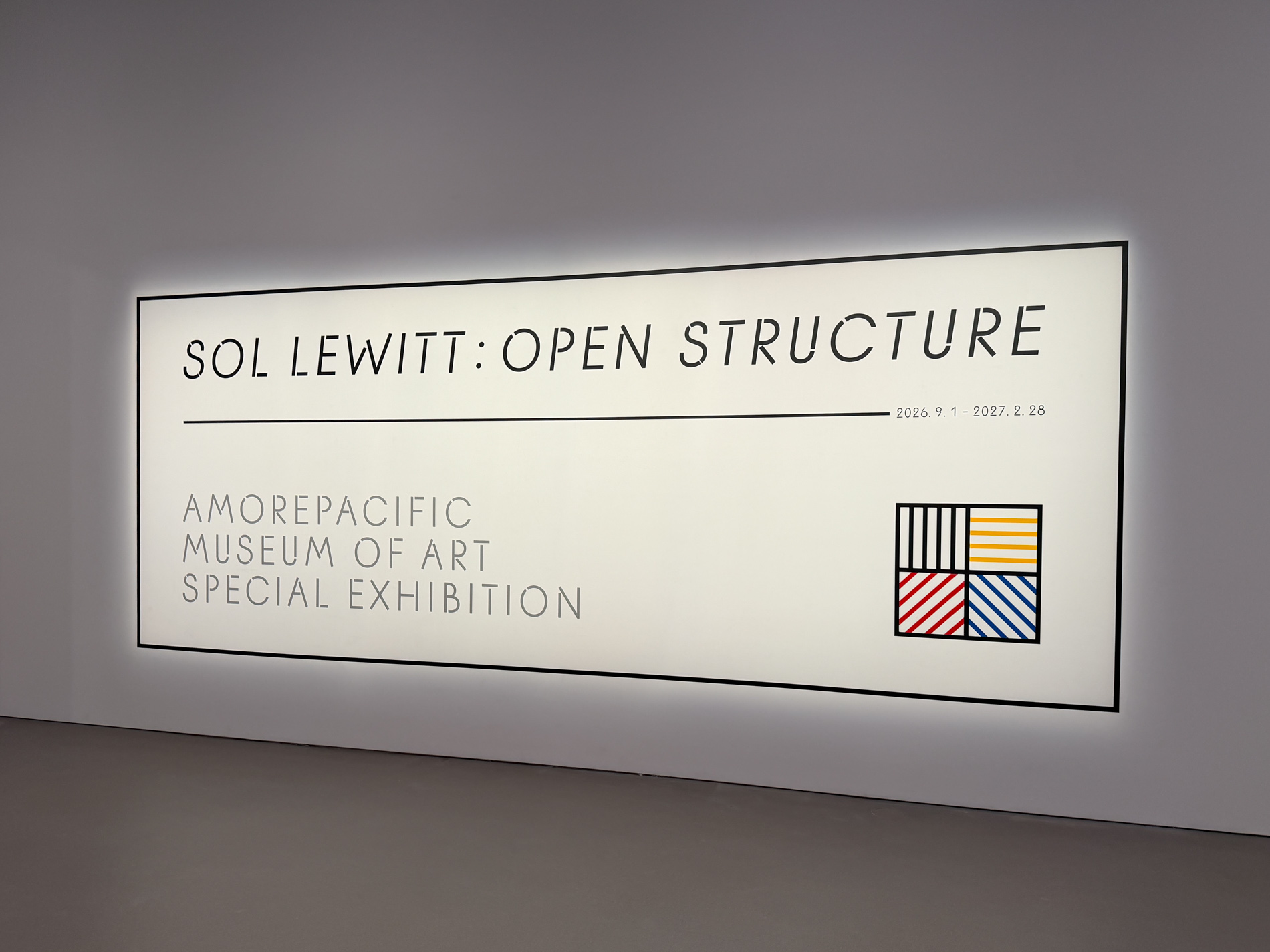
“Sol LeWitt: Open Structure” at the Museum of Contemporary Art Tokyo ran from 25 December 2025 to 2 April 2026, the first full-scale LeWitt exhibition at a public museum in Japan. The Seoul exhibition is its travelling version, and the wall drawings have grown from six in Tokyo to thirteen (45 works in total are announced for Seoul).
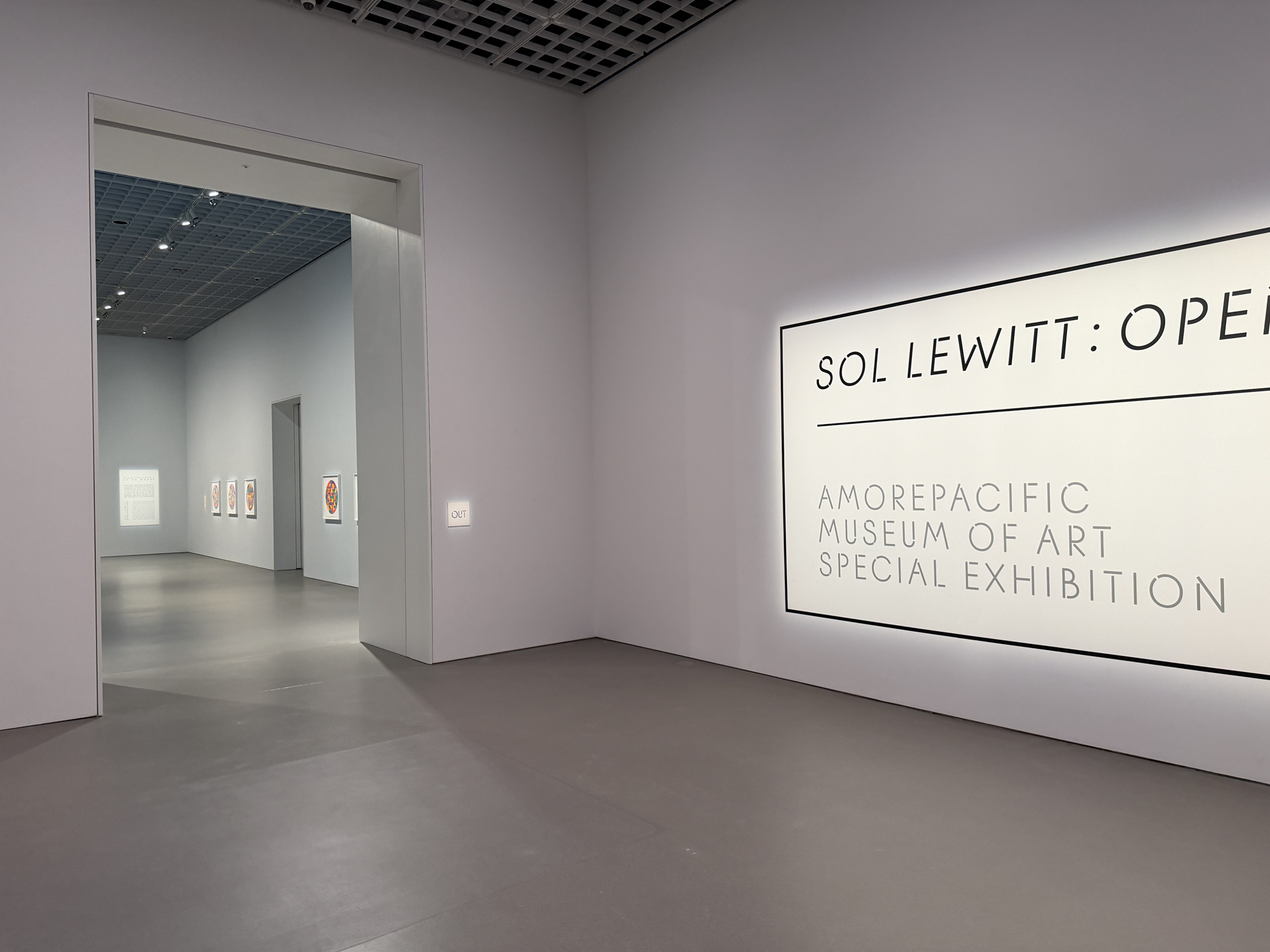
Exhibition Room 1: System and Structure
The exhibition is built around two themes. The wall panel reads:
EXHIBITION ROOM 1 ── SYSTEM AND STRUCTURE
According to the panel, a system for LeWitt is not a rule that fixes the form of a work in advance. It is a way of setting the conditions under which an idea can become a work.
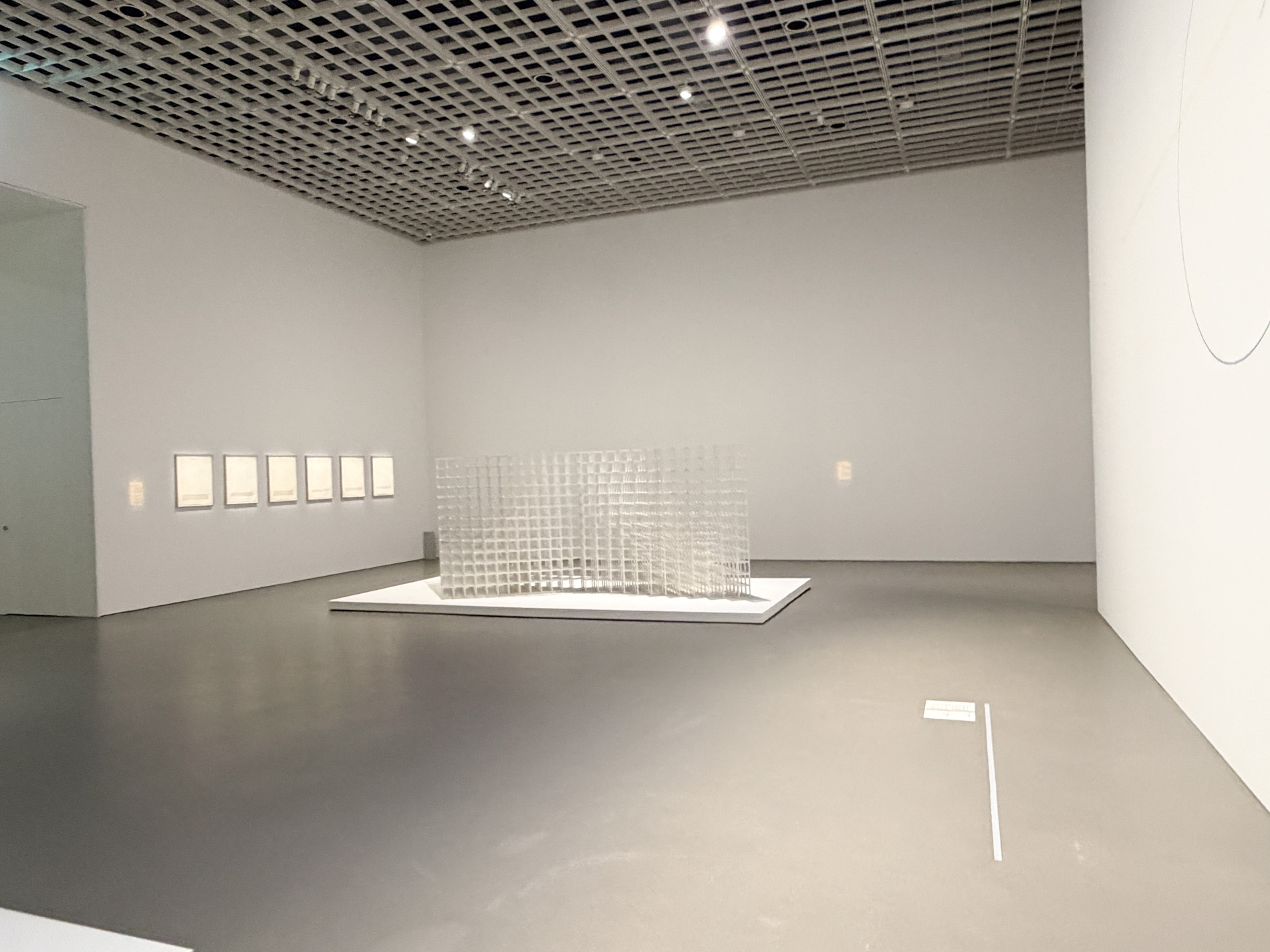
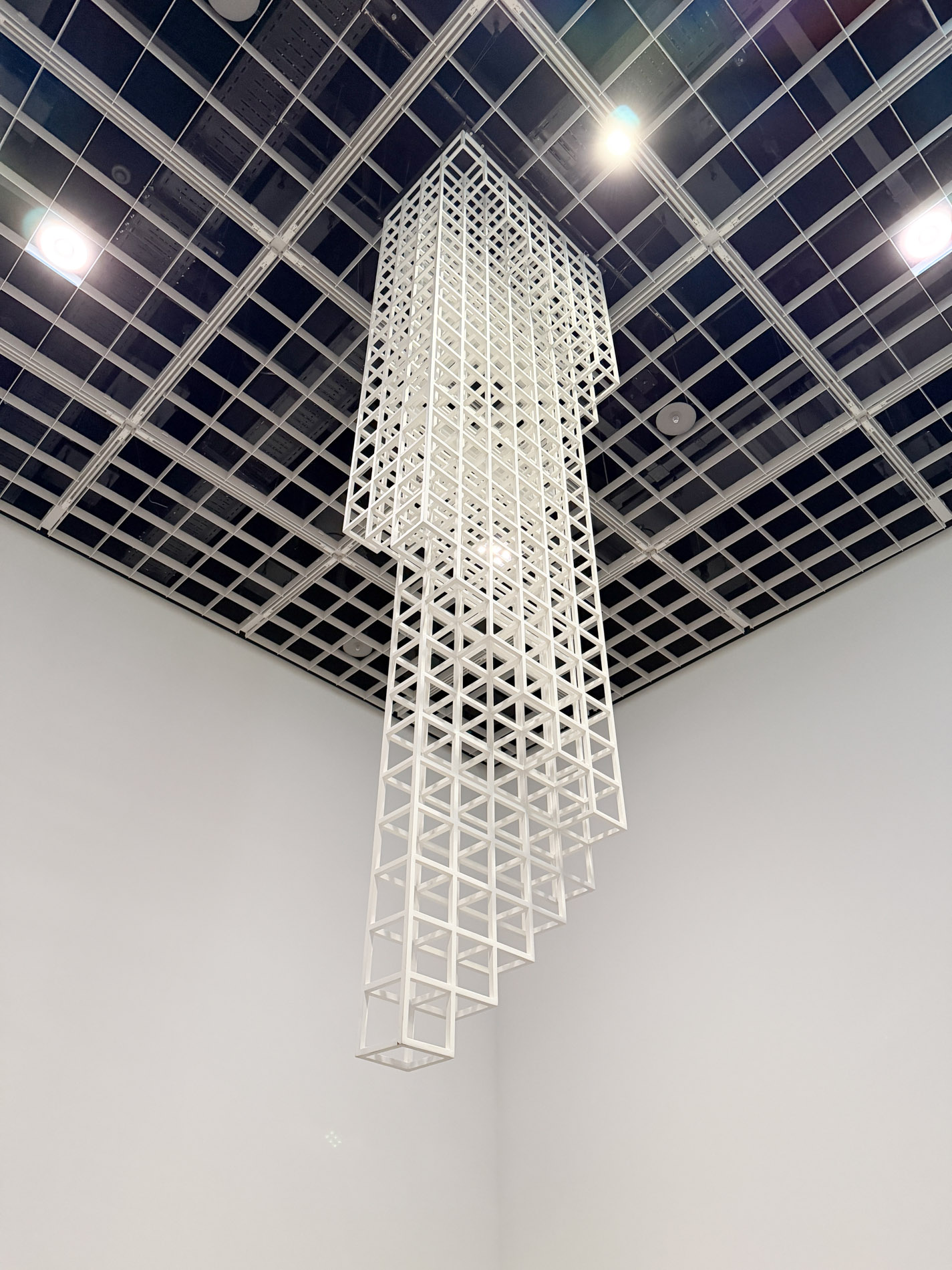
LeWitt chose the cube because it is “relatively uninteresting”. Of all solids it appeals least to the emotions, and because everyone already knows the shape, it does not make the viewer ask what it is. The less the form asserts itself, the more the rule that arranges it comes into view. That is what makes it usable as a unit.
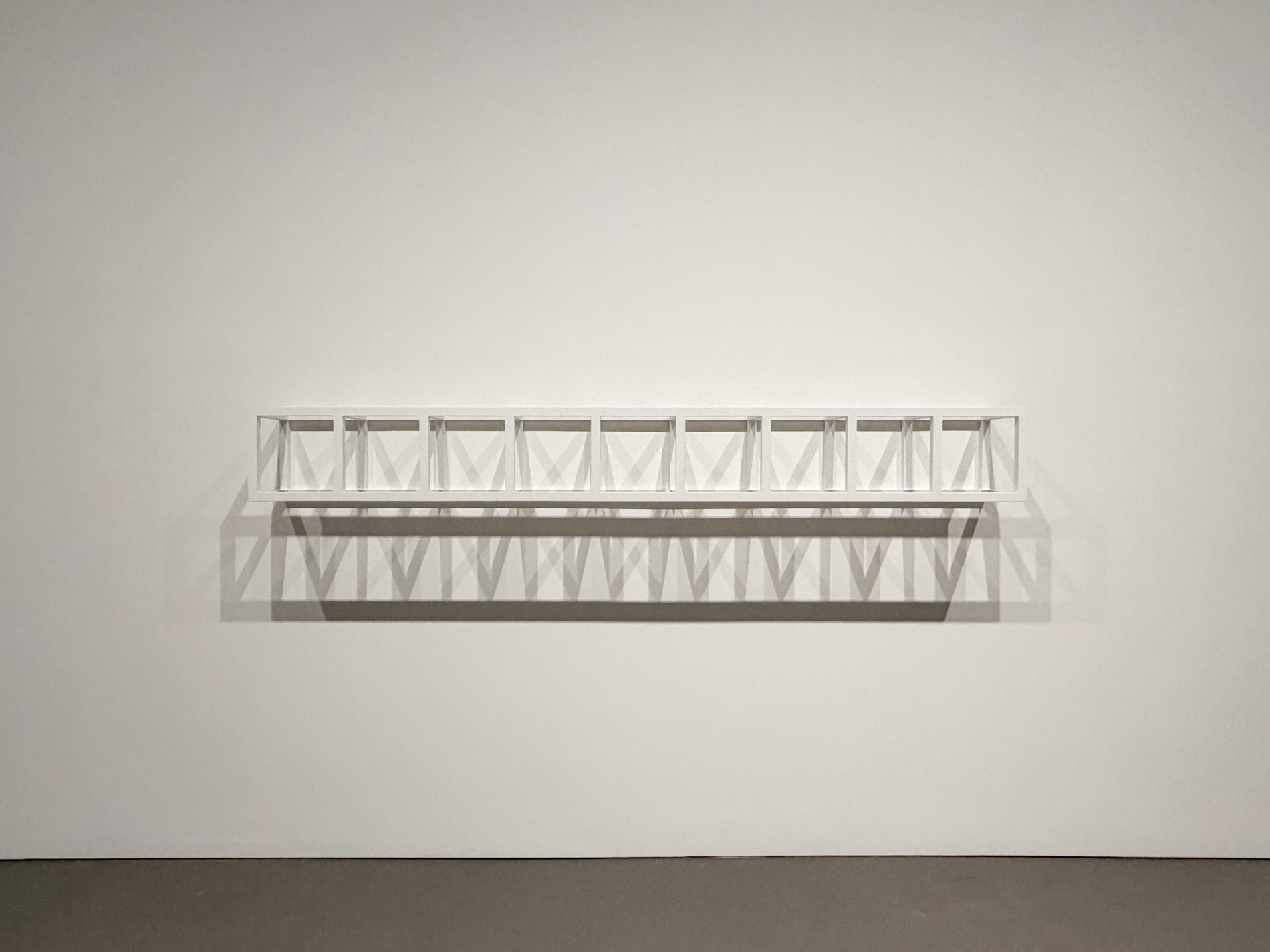
There is another direction in which LeWitt puts the cube to work: Incomplete Open Cubes (1974). A cube has twelve edges. He took them away one at a time, going as far as he could before the form stopped standing up as a solid, and counted any two arrangements that coincide under rotation as one. Carried through to the end, the rule yields exactly 122 variations. The cube is no longer a finished form but a starting point for running a rule all the way out.
Instructions written on the wall in pencil
This wall states the thinking behind the exhibition as plainly as anything in it.
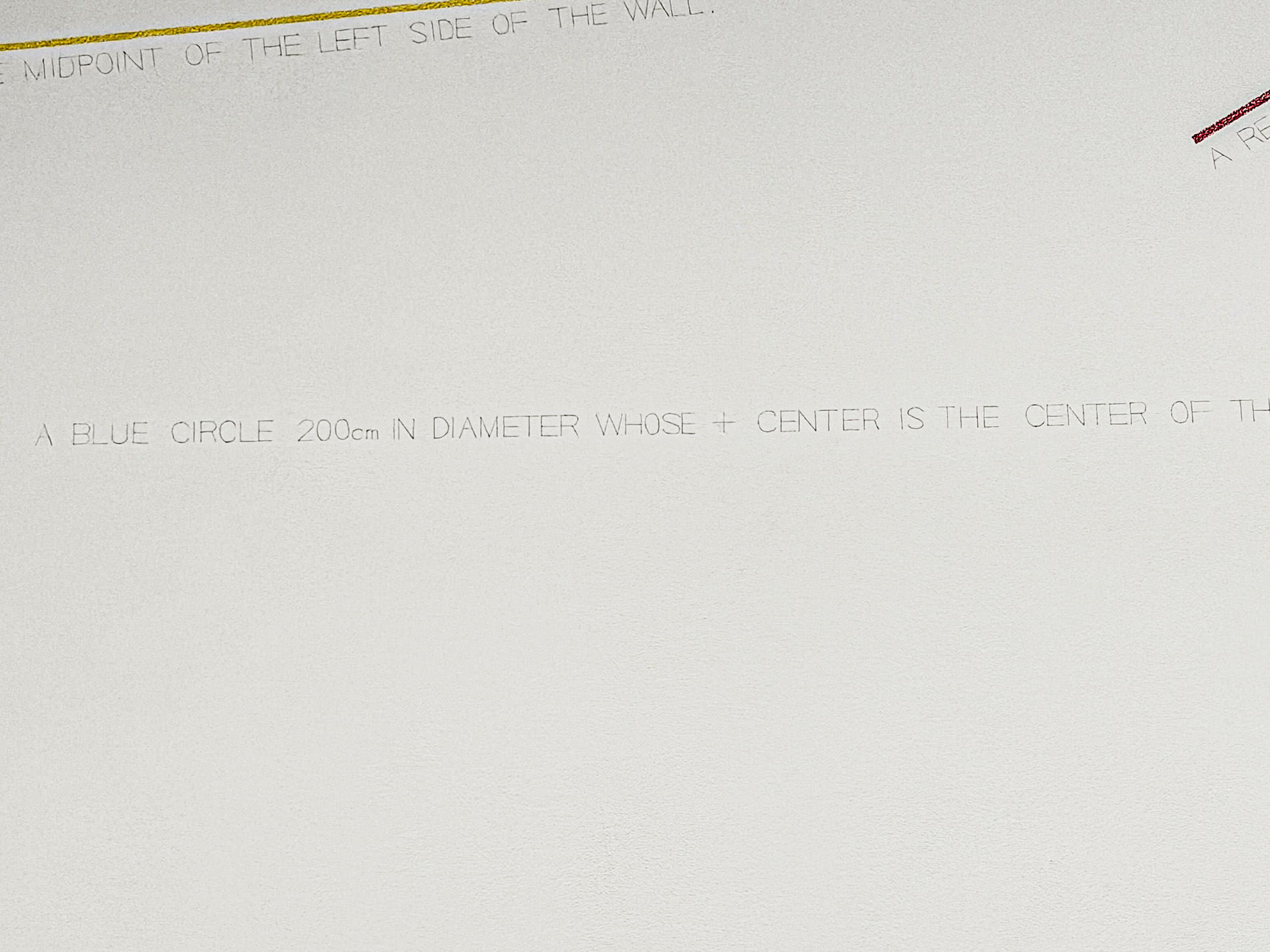
Handwritten English is drawn on the white wall in pencil.
A BLUE CIRCLE 200cm IN DIAMETER WHOSE CENTER IS THE CENTER OF TH…
…E MIDPOINT OF THE LEFT SIDE OF THE WALL.
(The two lines are one continuous sentence, broken here where the photograph cuts off.)
What is written on the wall is not an account of the drawing but the method of drawing it. Where to place a blue circle 200 centimetres across, where to draw the red and yellow lines: the sentence decides, and the drawing that follows it appears on the same wall.
In this period LeWitt specified position using reference points that belong to one wall alone: its corners, its edges, its centre. The same instruction therefore yields different margins and a different appearance whenever the wall changes.
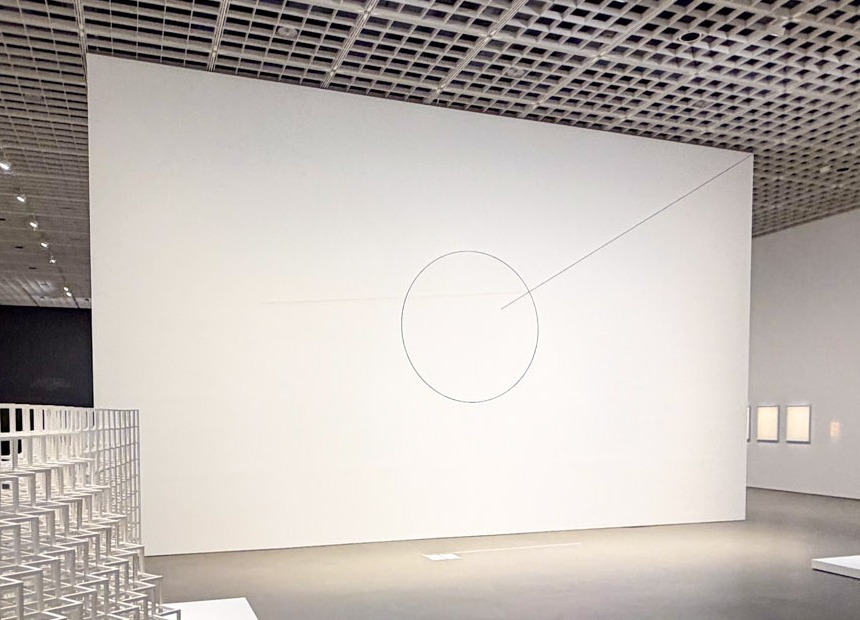
We normally assume that a text placed beside a picture explains the finished picture. Here it is the other way round: the text comes first and the picture is its result. The caption, too, noted that the instruction is inseparable from the work. Language fixes the size, becomes a form, and is drawn by someone’s hand. That sequence remains visible on the surface of the work.
In his 1967 Artforum essay “Paragraphs on Conceptual Art”, LeWitt wrote that the idea becomes a machine that makes the art. Here that machine itself appears on the wall, as a sentence.
#283 was shown in Tokyo as well, as was Wall Drawing #1164 in Seoul. The same instruction has been drawn again, on a different wall, by different hands.
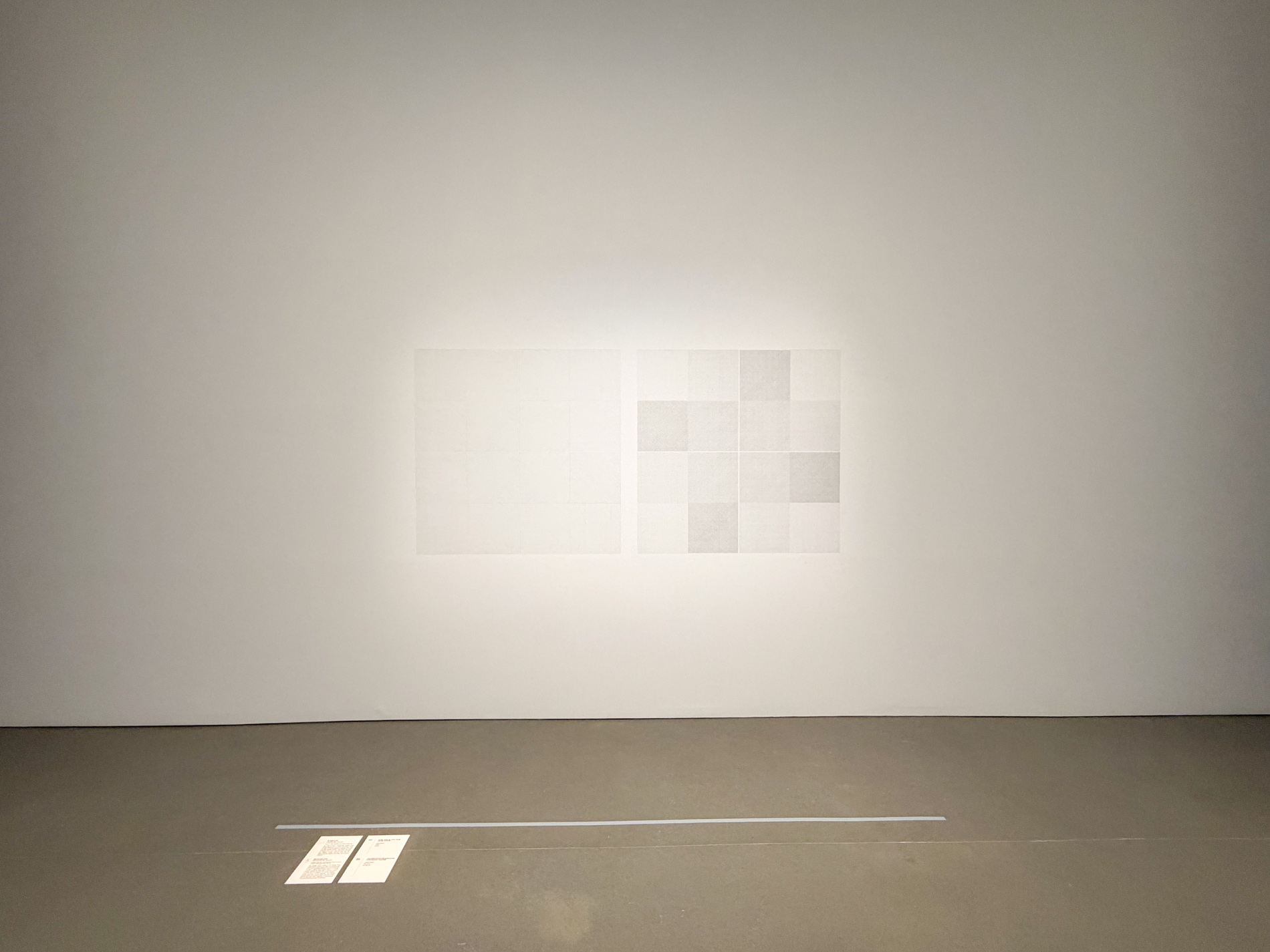
Exhibition Room 2: Seriality — the artist as a clerk cataloguing the results
EXHIBITION ROOM 2 ── SERIALITY
The second theme is the series. According to the panel, this was the approach LeWitt arrived at in the early 1960s as the most direct way of giving an idea form.
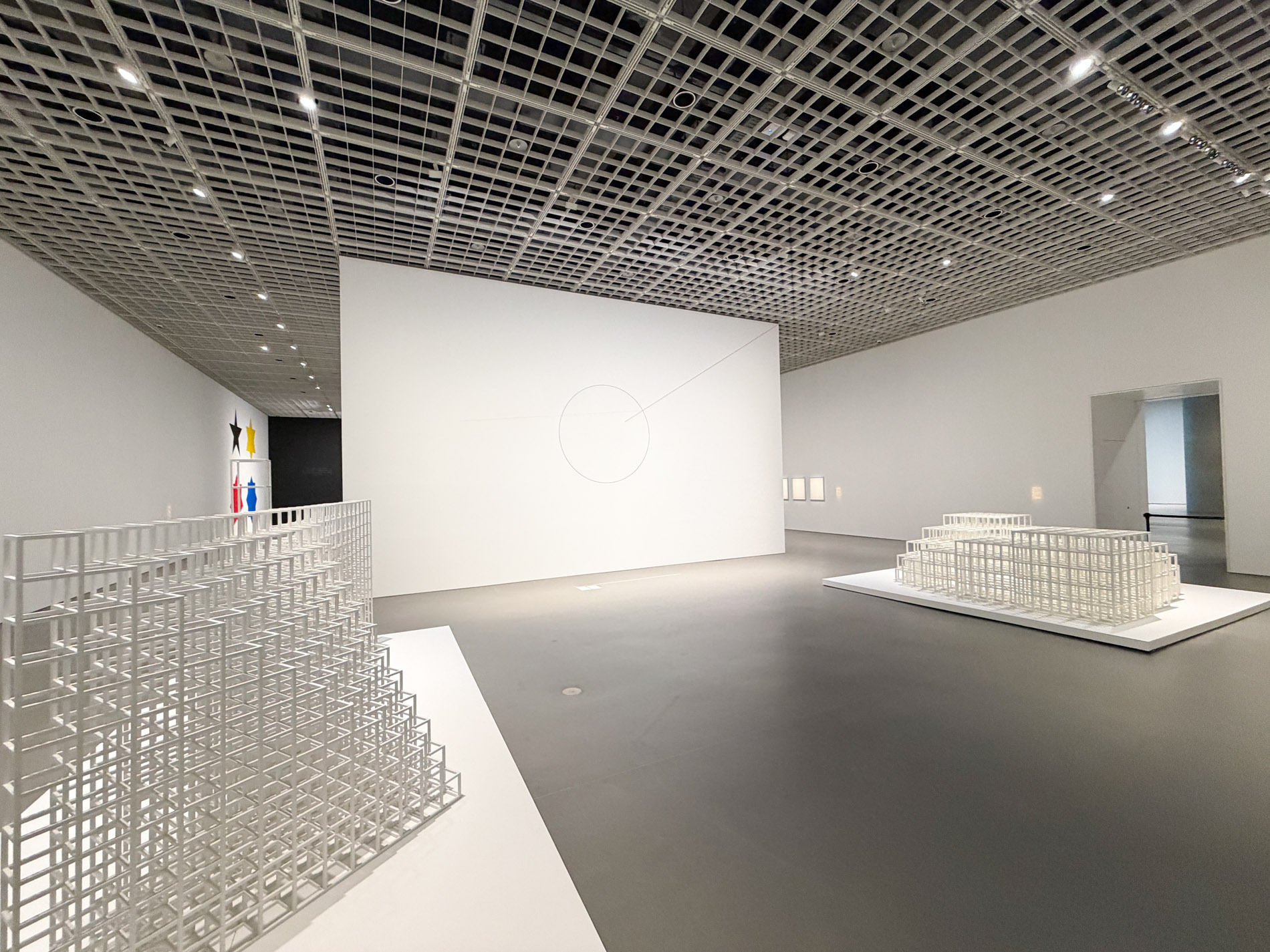
A single work presents a rule once and stops. A series exhausts every form the rule can produce. Lines, directions, cubes, modules: combined by a set procedure, reordered, extended — until not one possible arrangement is left.
At the centre of the room stands Serial Project #1 (ABCD). Open and closed cubes are placed on a grid, each given three heights, and the sets from A to D are worked through in order. The panel notes that from two simple kinds of unit a field of relations arises that neither unit predicts.
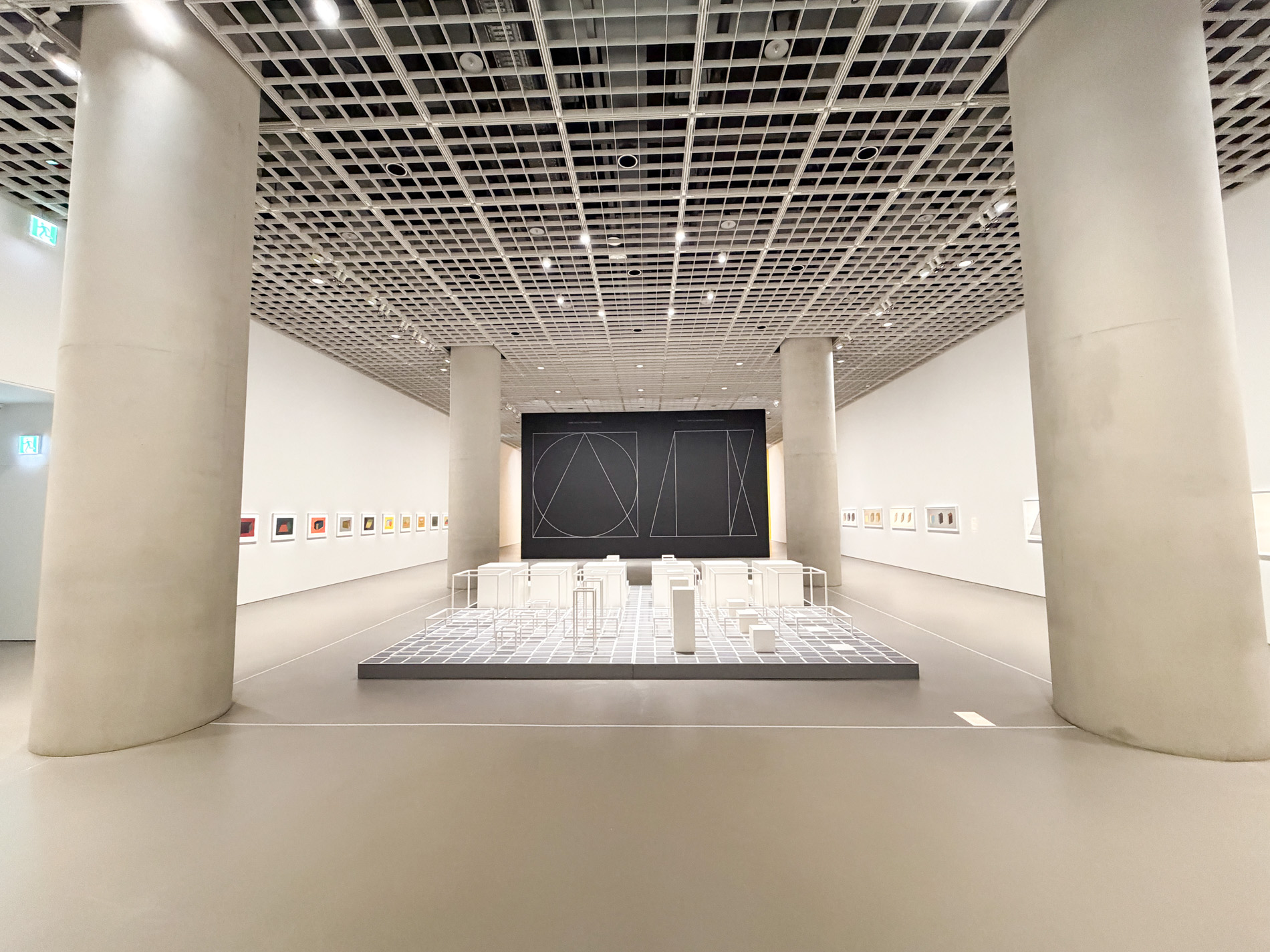
What LeWitt was after was not arriving at one good form. It was the order in which forms come out, the path along which they combine, and every variation the first rule contained from the start. None of the 122 cubes is better or worse than another. The moment one is chosen, it is taste rather than the rule that decides the work. So LeWitt set his own taste and judgement aside. The artist who makes a series is, in his own words, no more than a clerk cataloguing the results of the premise.
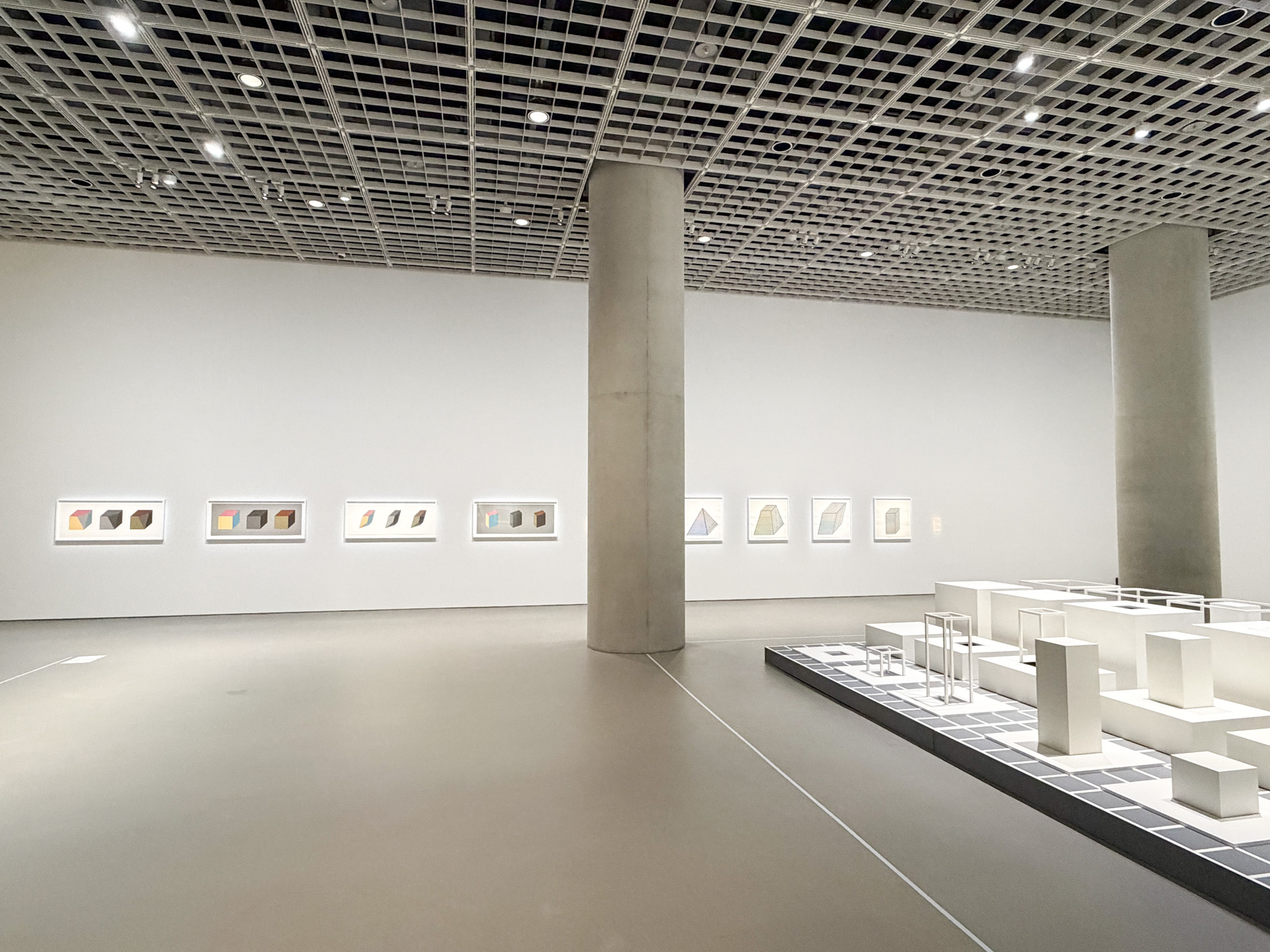
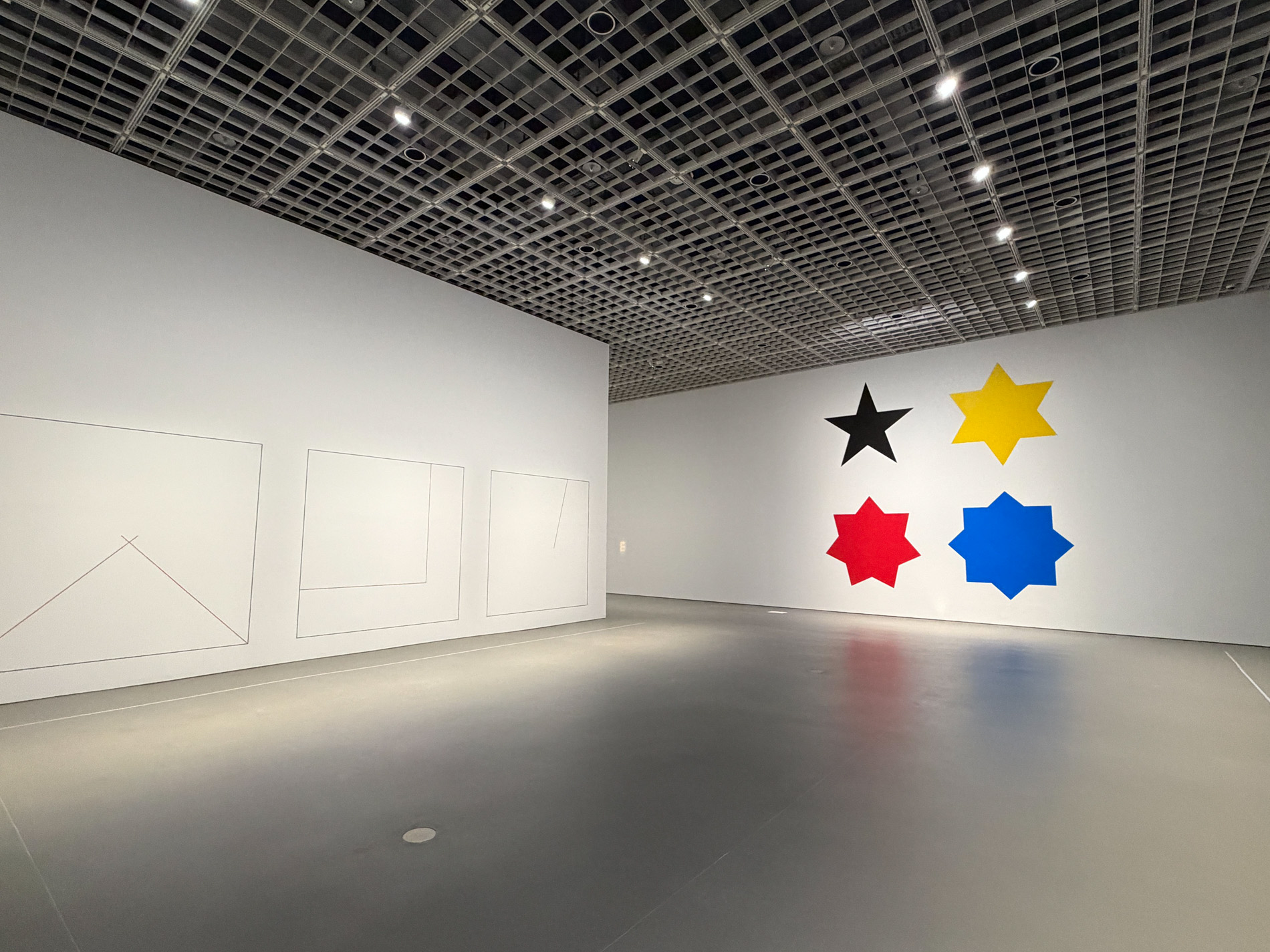
Towards colour
The exhibition opens with the black-and-white structures of the 1960s and unfolds as far as the colour work of the later years.
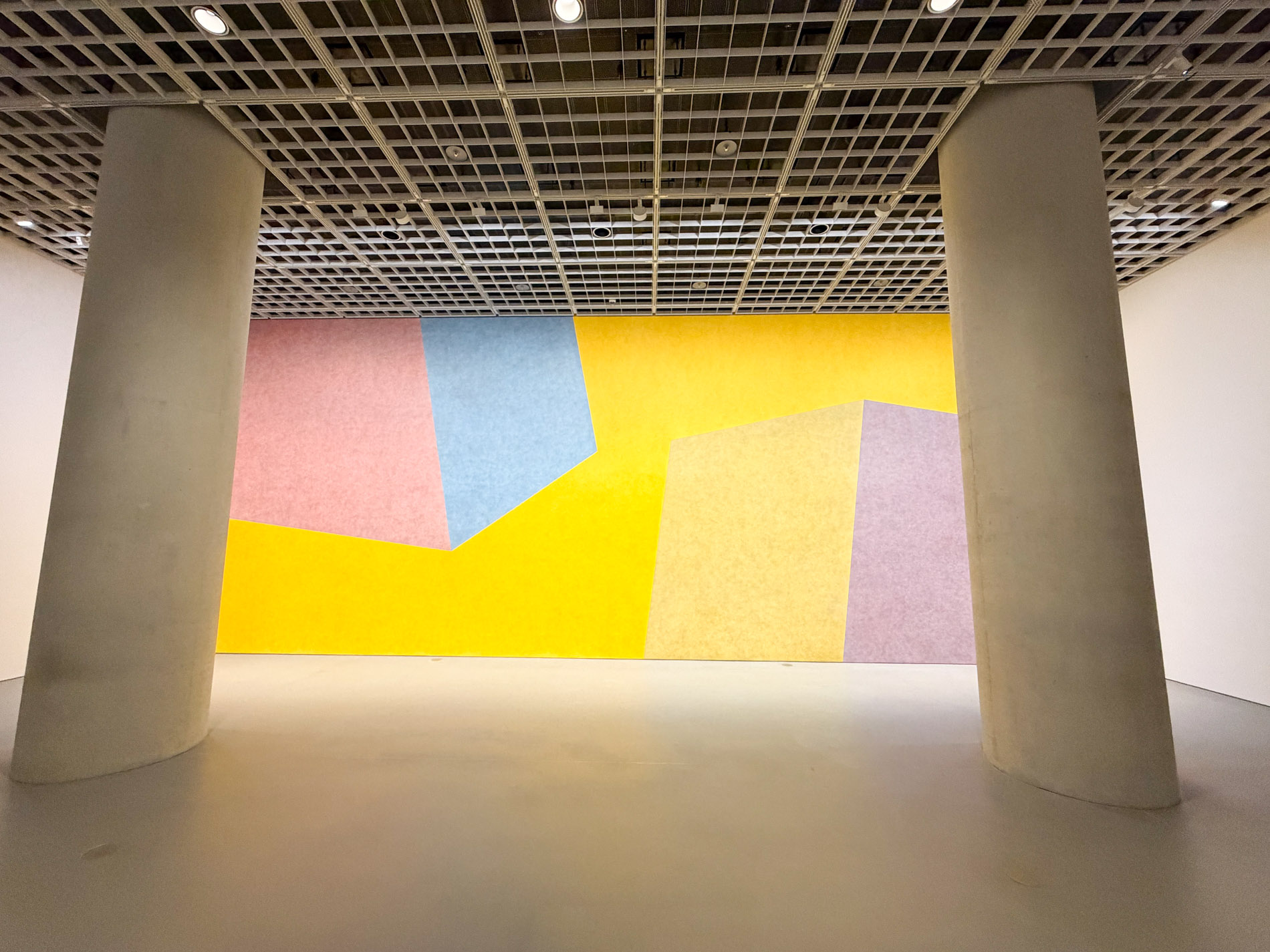
The work belongs to the “tilted forms” series that runs from the late 1980s. The two solids look like cubes, but they have been deliberately turned off the vertical and the horizontal of the grid. That alone is enough to set a figure in motion that ought to be at rest.
A wash is transparent ink thinned with water. Here it is laid over each plane in a fixed order, and where the layers overlap a further colour appears. Simple geometry becomes an image this rich through the layering of colour alone — that is how the caption ended.
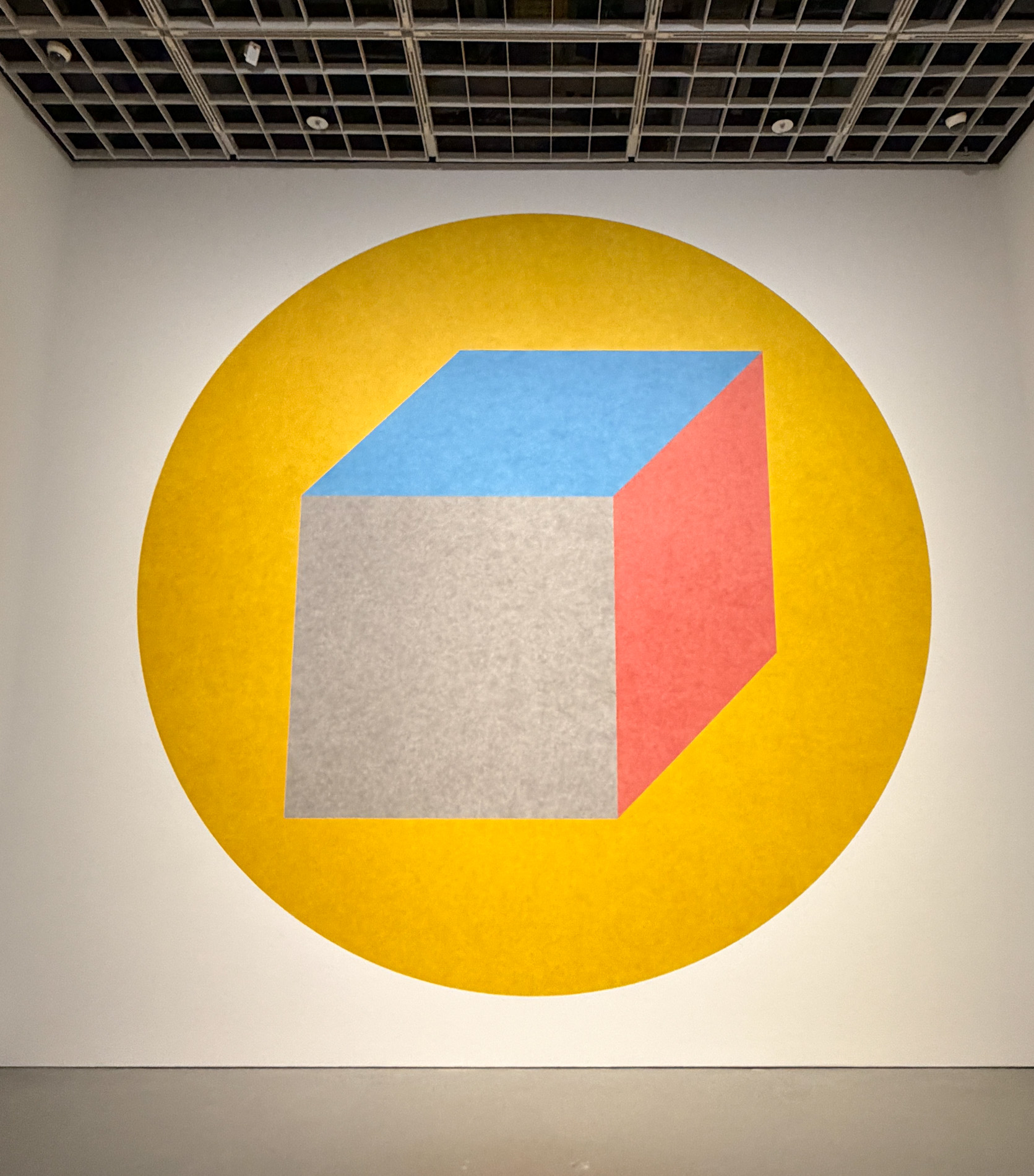
Sixteen names on the wall
There is a large room where yellow-green curves undulate across a blue wall: Wall Drawing #882B (1998), from the Loopy Doopy series LeWitt developed in the late 1990s.
How it is made is the interesting part. Two pencils are taped together and slid across the paper with a twisting motion. The parallel curves this produces are then enlarged to the scale of the wall and realised in acrylic — so the caption explained.
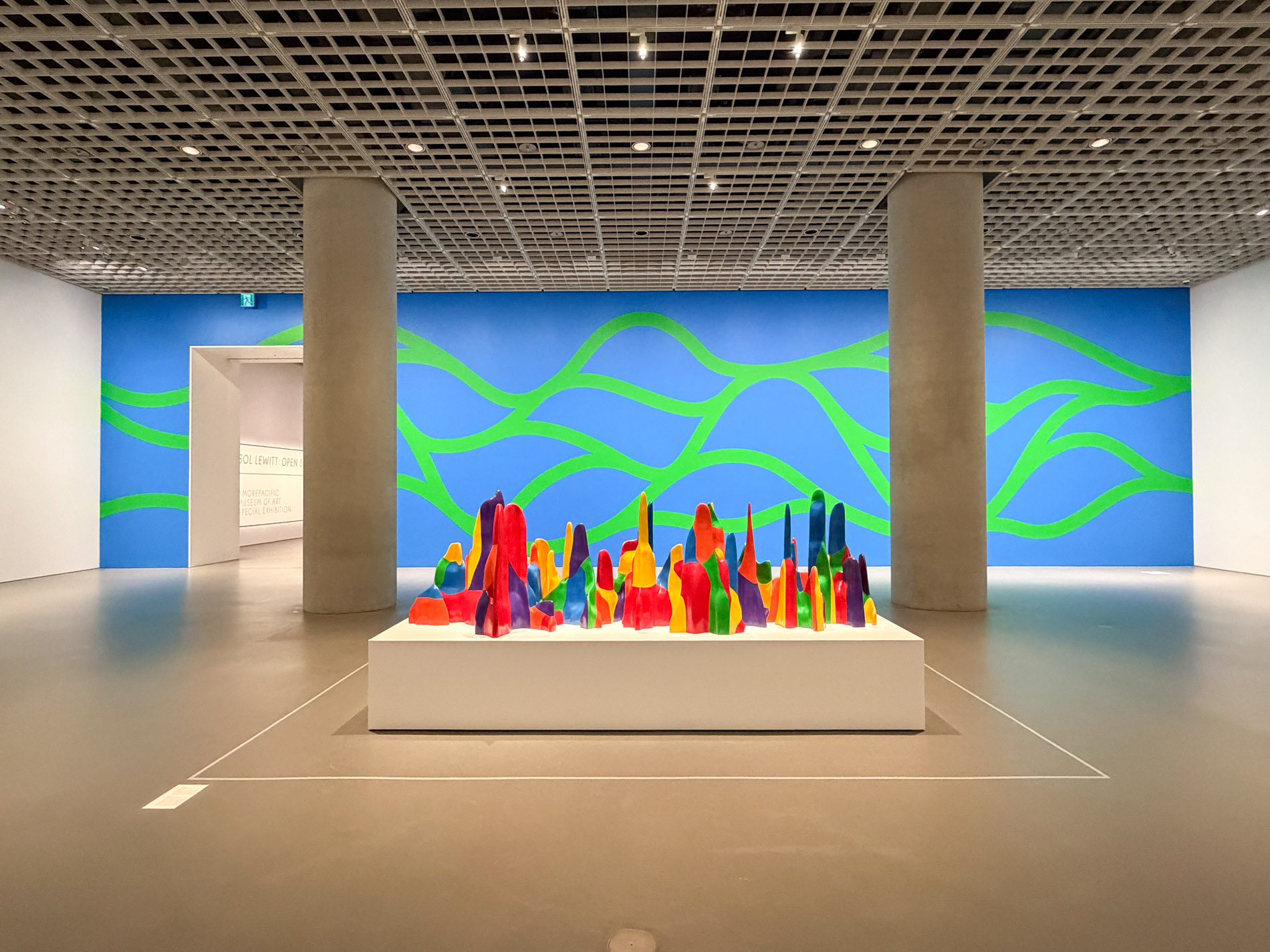
And on the caption plate for this work was the piece of information that stayed with me most.
Below the title and materials there is a field headed Drafts person. It read:
First Installation: October 1998
Current Installation: August 2026
And then sixteen names.
Michael Vedder/Ezoe Yuka/Chaeyoung Baek/Seungwon Eom/Jung Eunji/Oh Yu Jeong/KIM MIN KYUNG/Kim Yeonseo/Han Su Min/Jiyeon Jung/Kim HyoLyn/KIM Seoyeon/Kim Yujin/NA YOONSUN/TAE HAEYOUNG/Yang seo hyun
First installed in October 1998, the work was made again in August 2026 by sixteen pairs of hands. The artist died in 2007. The work goes on being newly born all the same.
Looking down the list, you notice one Japanese name, Ezoe Yuka, among the Korean ones.
The Amorepacific Museum of Art calls this installation team APMA MAKERS. In the museum’s announcement they are 23 APMA MAKERS, made up of students majoring in studio art at universities and graduate schools in Korea. Together with representatives of the LeWitt estate they interpreted the instructions, built up the layers of line and colour, and drew all thirteen wall drawings for this space.
A LeWitt wall drawing exists as a certificate together with the instruction and a diagram. The physical work is drawn on site, painted over when the exhibition closes, and drawn again somewhere else. MOT explained the same method on its exhibition page, noting that the work is painted over once the exhibition ends, and that this prompts a rethinking of assumptions about authorship, uniqueness and material permanence.
The artist panel in the gallery carried a text explaining this arrangement.
His wall drawings are erased when the exhibition ends, but just as a score is played again and again through its performers, they continue to be newly realised from the instructions, even after his death in 2007.
A score and its performers. Printing the names of the draftspersons on the caption is a way of saying who played it.
The hundred-dollar rule
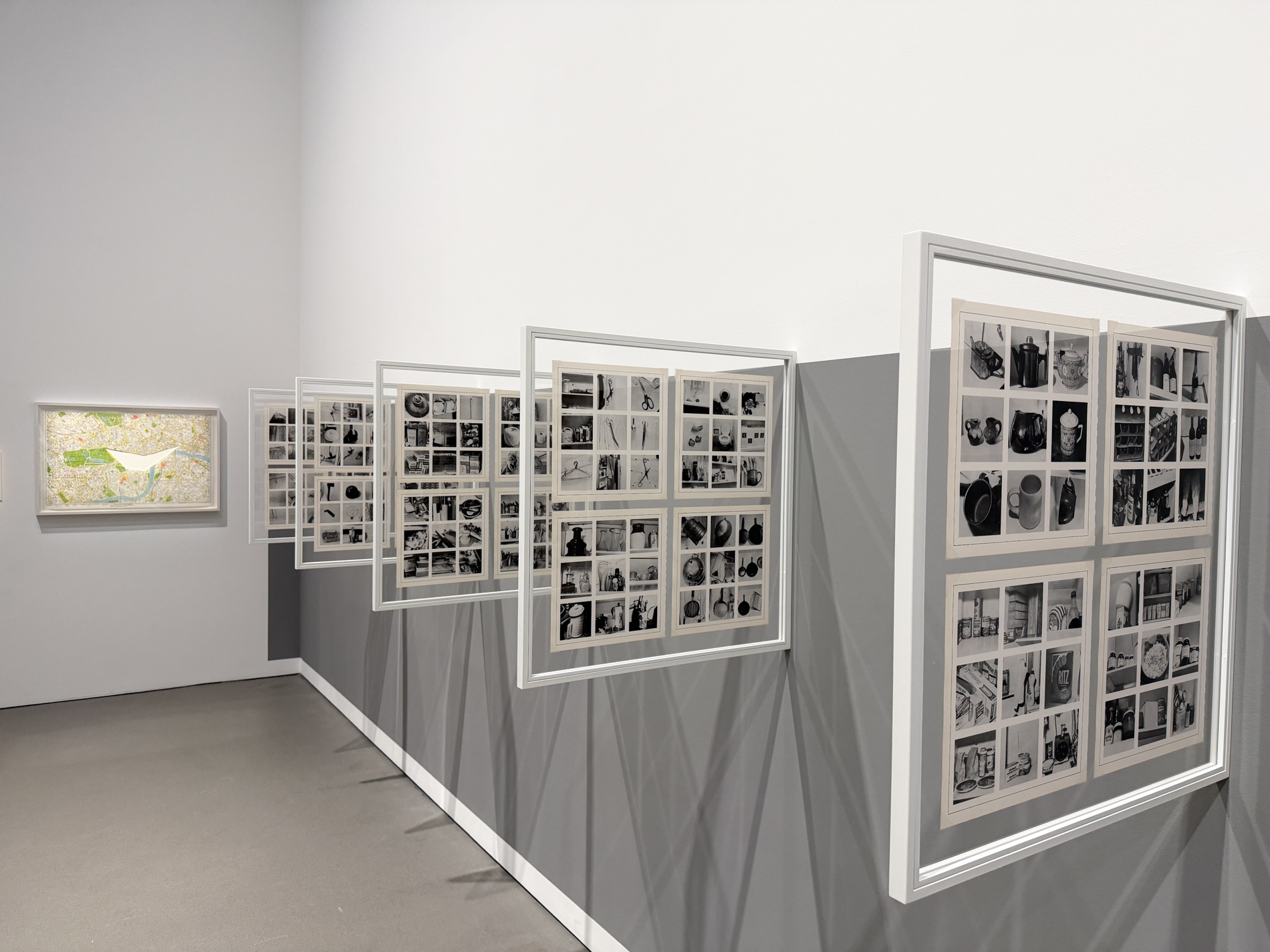
One more story about rules.
Map of London with the Area between Buckingham Palace, Hyde Park Speakers Corner, Trafalgar Square, St Paul’s Cathedral and Westminster Abbey Removed (R715) (1977). A commercially available map of London, with the area enclosed by the five sites named in the title cut away.
With the centre that was supposed to supply the geographical information now blank, the roads and boundaries left behind draw the outline of an absence.
The work is one of more than 800 R drawings made by cutting, folding and tearing, known as the hundred-dollar drawings. LeWitt asked that they be sold for no more than one hundred dollars. The rule was applied not only to how the work was made but to how it circulated.
A corridor of artists’ books
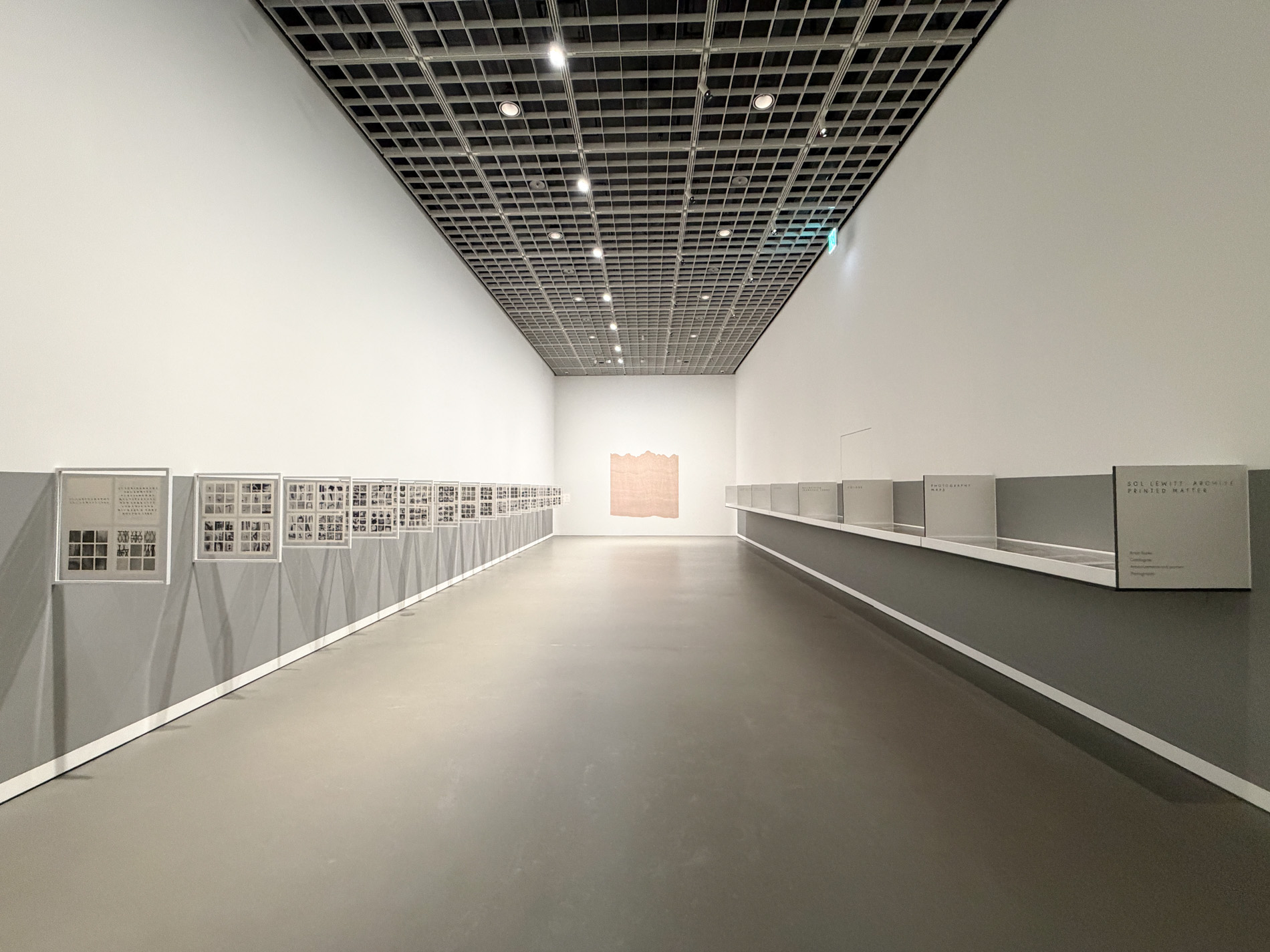
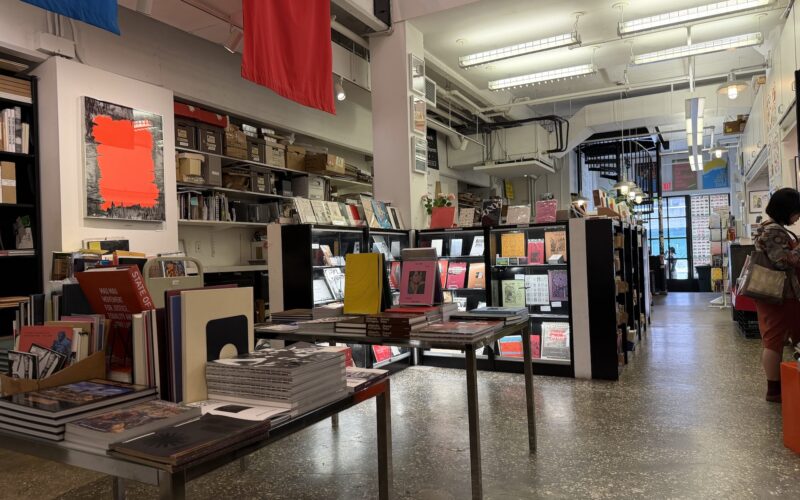
The later part of the exhibition gives an entire narrow corridor over to artists’ books. LeWitt made a great many books in his lifetime, and in 1976 he co-founded Printed Matter in New York with Lucy Lippard and others.
Small-format books along the whole wall, and pages opened inside the cases. The panel in Exhibition Room 2 carried the line wall, paper and architecture change the scale, density and rhythm at which a system appears. Drawing on a wall and printing on a page were not two different jobs for him, but the same logic placed under different conditions.
The Amorepacific Museum of Art
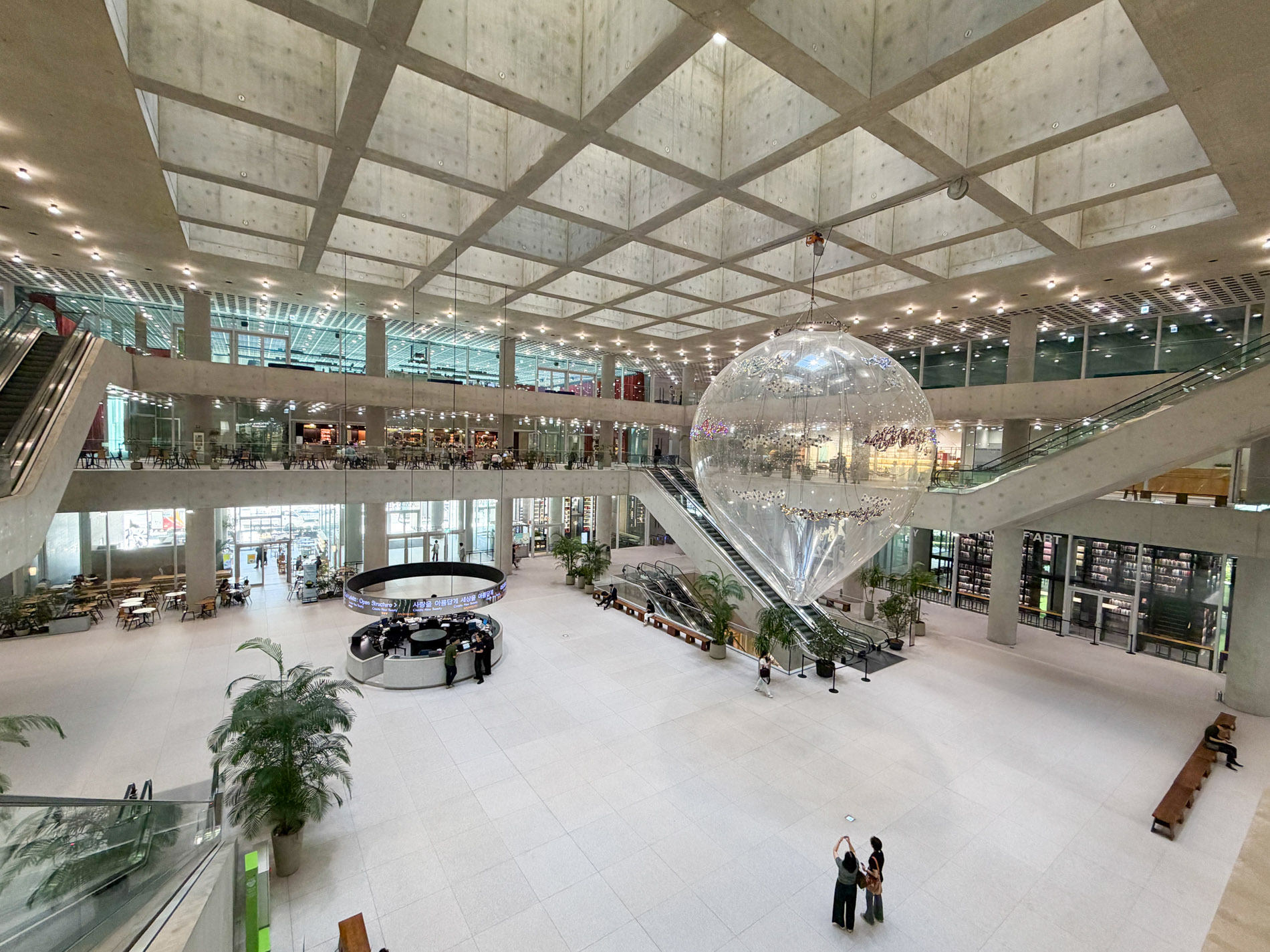
The Amorepacific Museum of Art (APMA) sits one floor below ground in the world headquarters of the cosmetics group Amorepacific. The architect is David Chipperfield; the building was completed in 2017 and the museum opened in February 2018.
The institution itself is older. It grew out of the collection of the company’s founder, Suh Sung-hwan (1924-2003). It opened in 1979 as the Pacific Museum and took its present name in 2009. Crafts and ceramics bound up with women, cosmetics and green tea: a coherent starting point for a museum founded by a cosmetics company.
It also has a record of showing conceptual art. From August 2023 to January 2024 the museum held the first solo exhibition in Korea, and in Asia, of Lawrence Weiner (1942-2021). It was also the first museum solo exhibition after his death.
Weiner too was an artist who used language. But where LeWitt’s text is an instruction that becomes a work only when someone draws it on a wall, Weiner’s text is itself the work; his 1968 Declaration of Intent states plainly that the piece need not be built. Whether it is realised is for the receiver to decide.
Both use language: one says the work must pass through someone’s hands, the other that no hand need touch it. The same museum has now introduced both to Korea for the first time, three years apart.
On view until 28 February 2027
The run is long — some six months, until 28 February 2027. Booking is online and in advance, and admission is KRW 18,000 for adults. Exit 1 of Sinyongsan Station on Subway Line 4 connects directly through an underground passage, so you arrive dry even in the rain.
For anyone who saw the six wall drawings in Tokyo, this is an exhibition about going to confirm that the same instruction has been drawn again on a different wall, by different hands.
What LeWitt left behind was not the work itself but the rule by which the work keeps being made. That rule is still running, one floor below ground in Seoul.