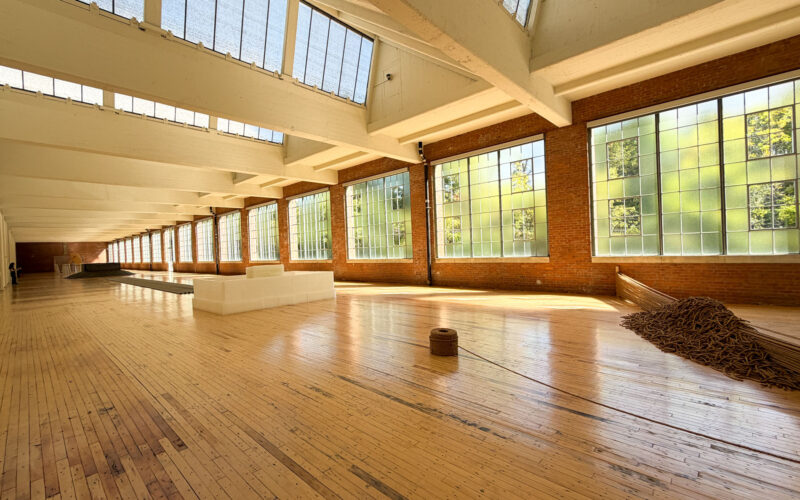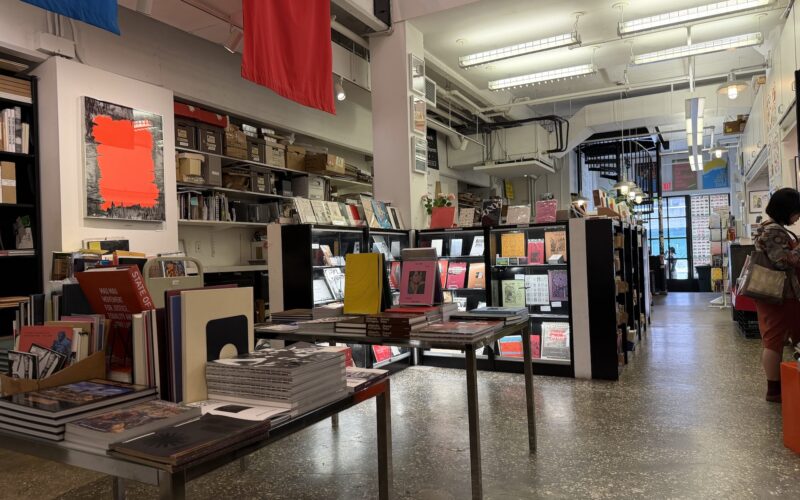
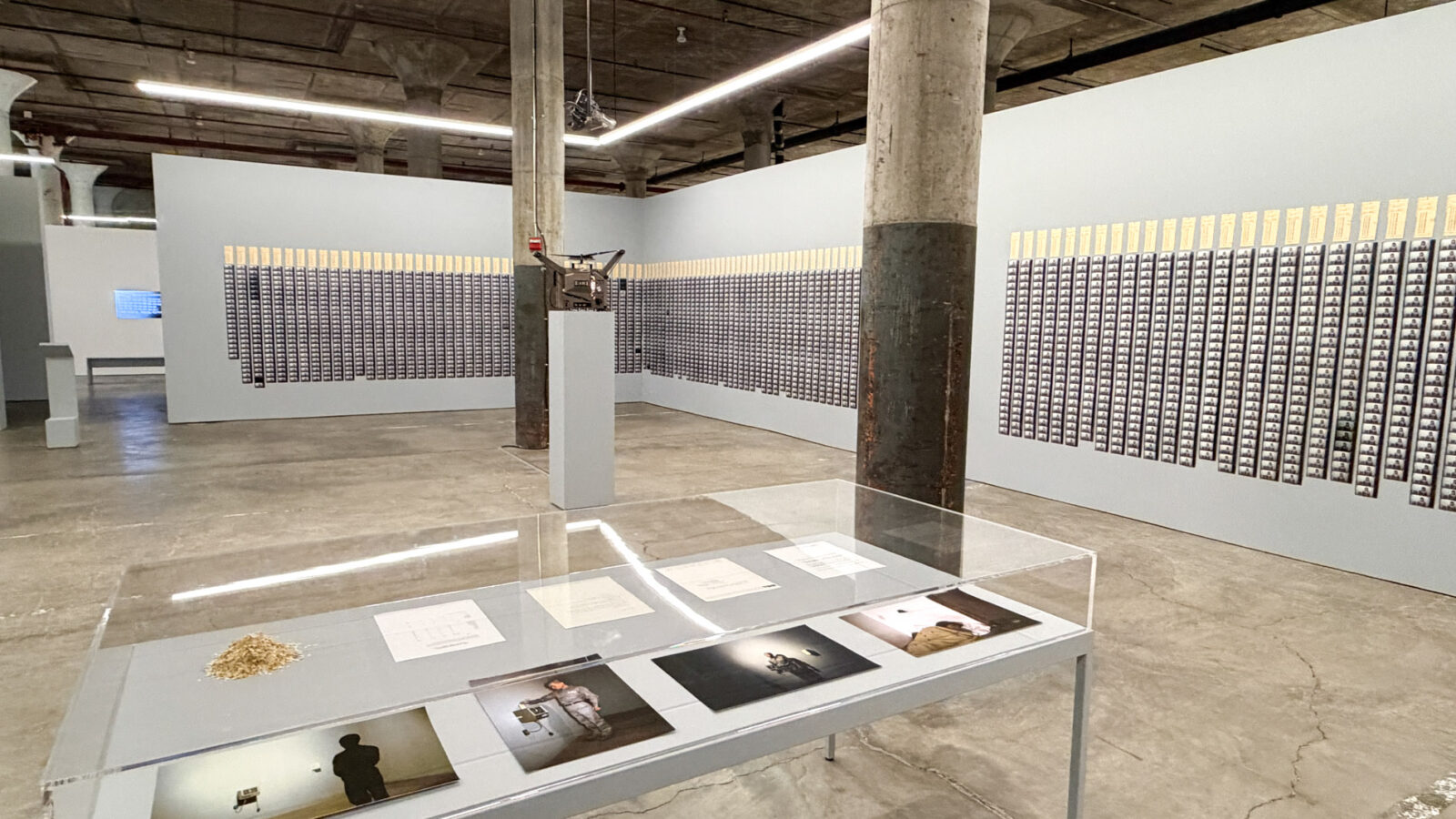
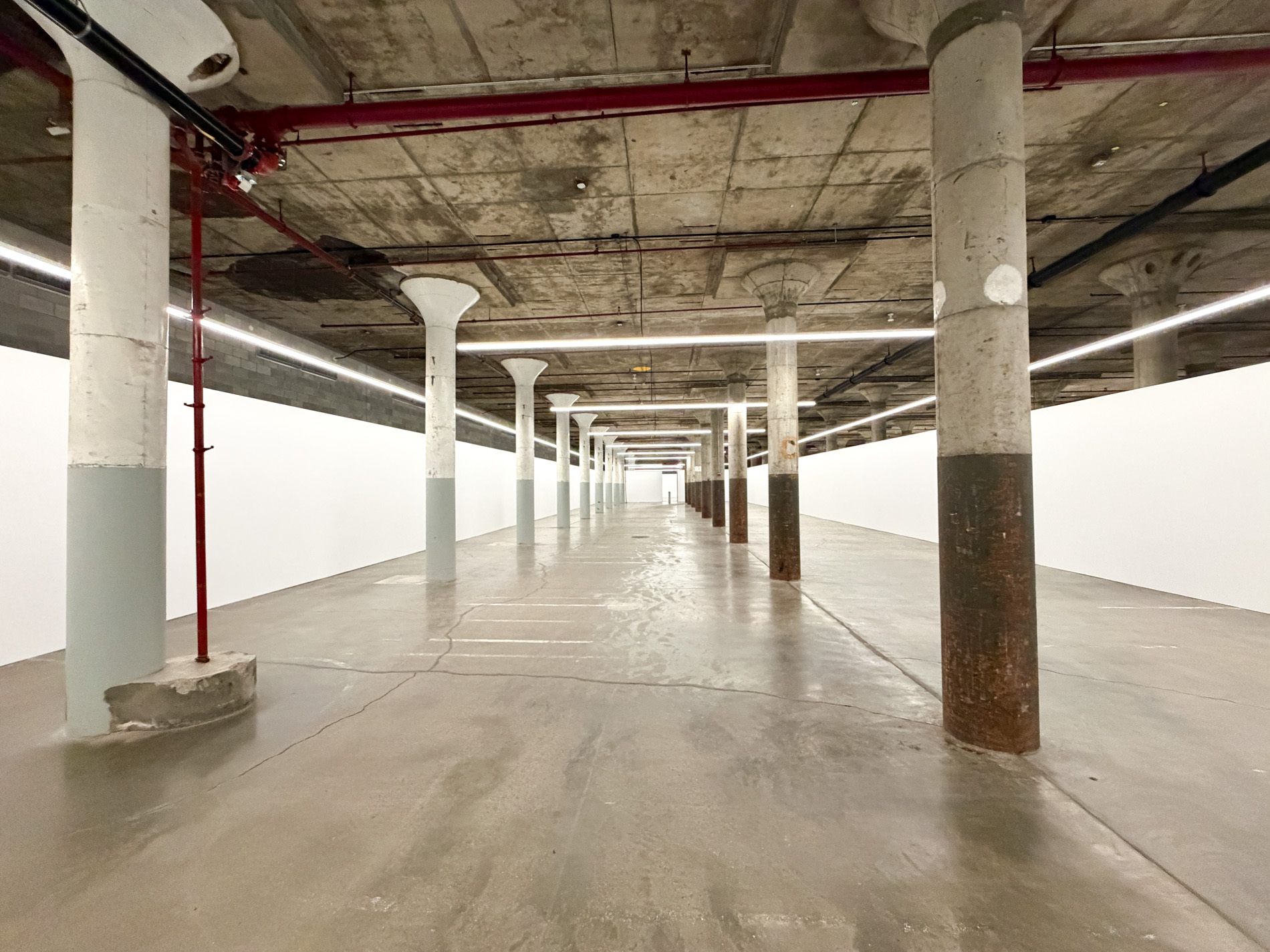
Down the stairs at Dia Beacon, the lower level opens out into some 2,800 square metres of concrete, thick columns running to the far end. At the time of our visit the whole floor was given over to a single artist.
On view is Lifeworks 1978–1999 by the Taiwanese-born artist Tehching Hsieh. It opened on 4 October 2025 and is planned as a long-term display running for about two years.
Tehching Hsieh
Tehching Hsieh was born on 31 December 1950 in Pingtung County, in southern Taiwan. He left high school to paint, and in 1973, after finishing military service, held his first solo exhibition in Taipei. That same year he made Jump Piece, leaping from a second-floor window and breaking both ankles.
In 1974 he crossed to the United States as a crew member on an oil tanker, left the ship near Philadelphia and made his way to New York. For the next fourteen years, until he was granted amnesty in 1988, he lived there without documents.
According to an opening report by the Taiwanese art magazine ARTouch, the artist said in a talk on the opening day that he was working at a Chinese restaurant in SoHo at the time, sweeping the floor after closing and sleeping there. He spent four years thinking before he began work on the first piece.
In 2009 the cage work was shown at the Museum of Modern Art in New York, and in 2017 he had a solo presentation, Doing Time, in the Taiwan Pavilion at the Venice Biennale. He now lives in Brooklyn.
The works on view
On view are six works made between 1978 and 1999. A year living in a cage; a year punching a time clock every hour; a year spent outdoors without going inside; a year tied by a rope; a year with no art at all — these five are known as the One Year Performances. And then the work of a thirteen-year plan, in which he made art but showed none of it.
In 2024 the artist gave Dia eleven works, including these six. This is the first time all five One Year Performances have been brought together in one place, and it is the artist’s first retrospective.
Dia’s text quotes the artist: a year is the time it takes the earth to travel once around the sun.
The model you see first
A long white table stands in a darkened room. It is an architectural model of this very exhibition, which the artist worked out over roughly ten years.
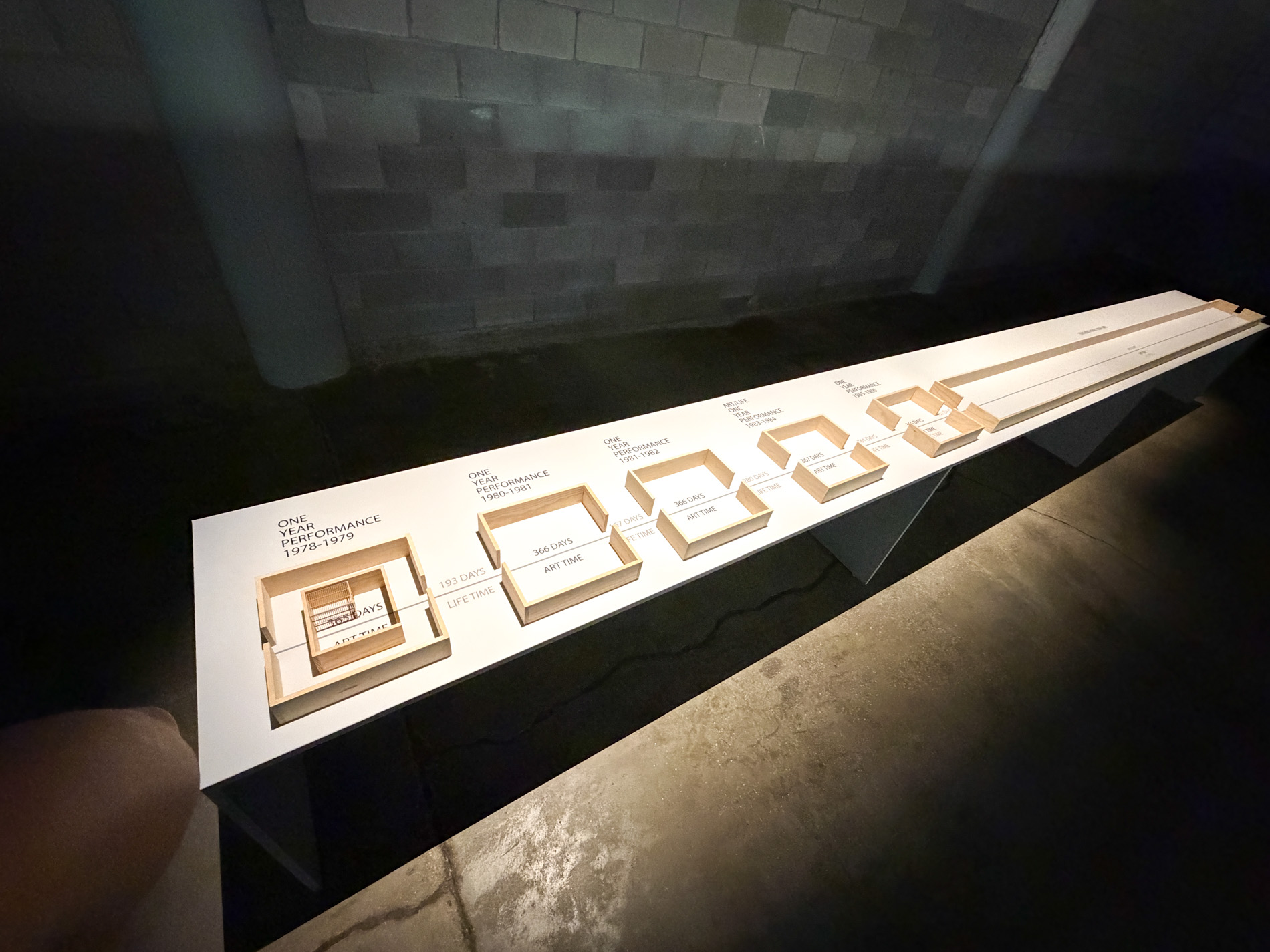
Each room, marked off by a wooden frame, carries the number of days of the work and the words ART TIME. Between the rooms are the days until the next work began, with the words LIFE TIME: 193 days between the first and second works, 167 between the second and third. The wide space opening to the right is the room standing for the thirteen years in which no work was shown.
The galleries themselves are built exactly as the model shows. Each work has a room of the same size, and the passages between rooms stand for the time of living. Visitors walk through the artist’s twenty-one years in order.
Every work begins with a single statement
The first work began on 30 September 1978. At the time he used the name Sam Hsieh. The typewritten STATEMENT reads as follows.
“I, Sam Hsieh, will carry out a one-year performance beginning 30 September 1978. I shall seal myself alone in a cell measuring 11 feet 6 inches by 9 feet by 8 feet. Until I come out on 29 September 1979 I shall not converse, not read, not write, not listen to the radio and not watch television. I shall eat every day.”
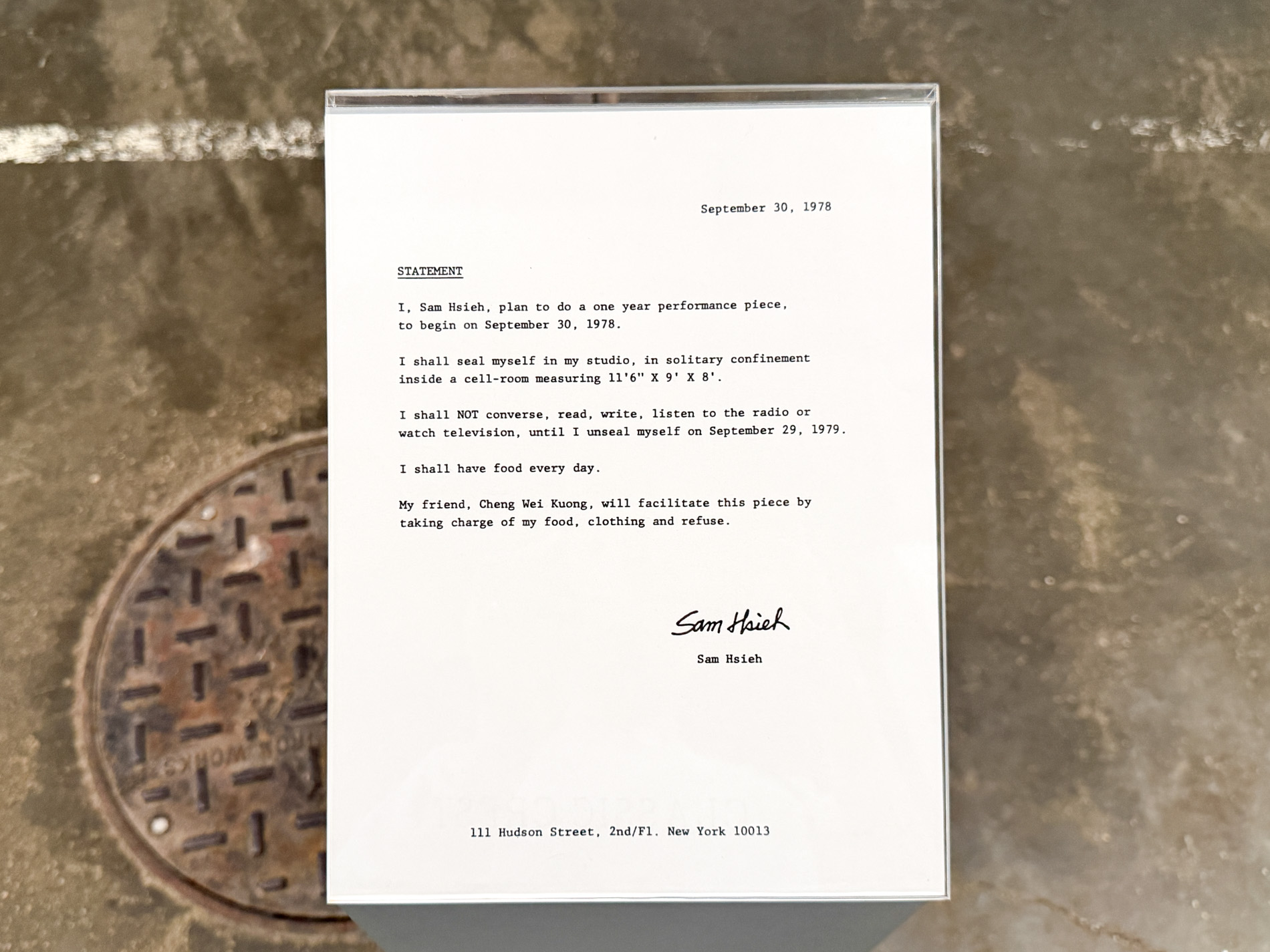
A friend, Cheng Wei Kuong, took on the job of bringing food, changes of clothes and taking away the rubbish. The address below the signature is 111 Hudson Street, second floor, in Manhattan — the artist’s studio at the time.
[1] Cage Piece — a year inside a cage
A cage built from pine bars stands in the gallery. Inside are a bed and a washstand, and the artist spent a year in it.
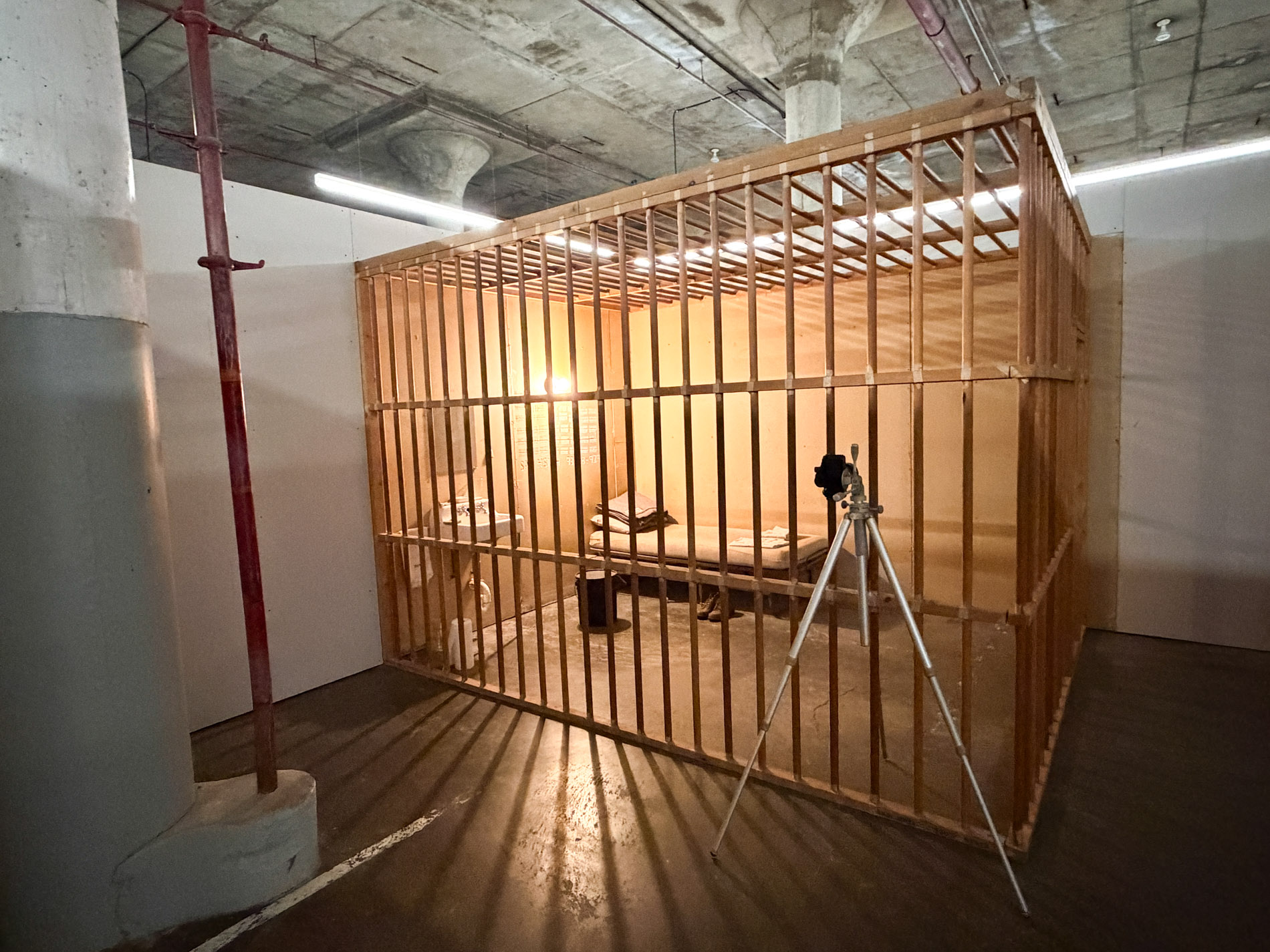
When he entered, the lawyer Robert Projansky was present and applied signed paper seals over every joint of the cage. A certificate confirming that not one seal had been broken a year later is also framed and on view.
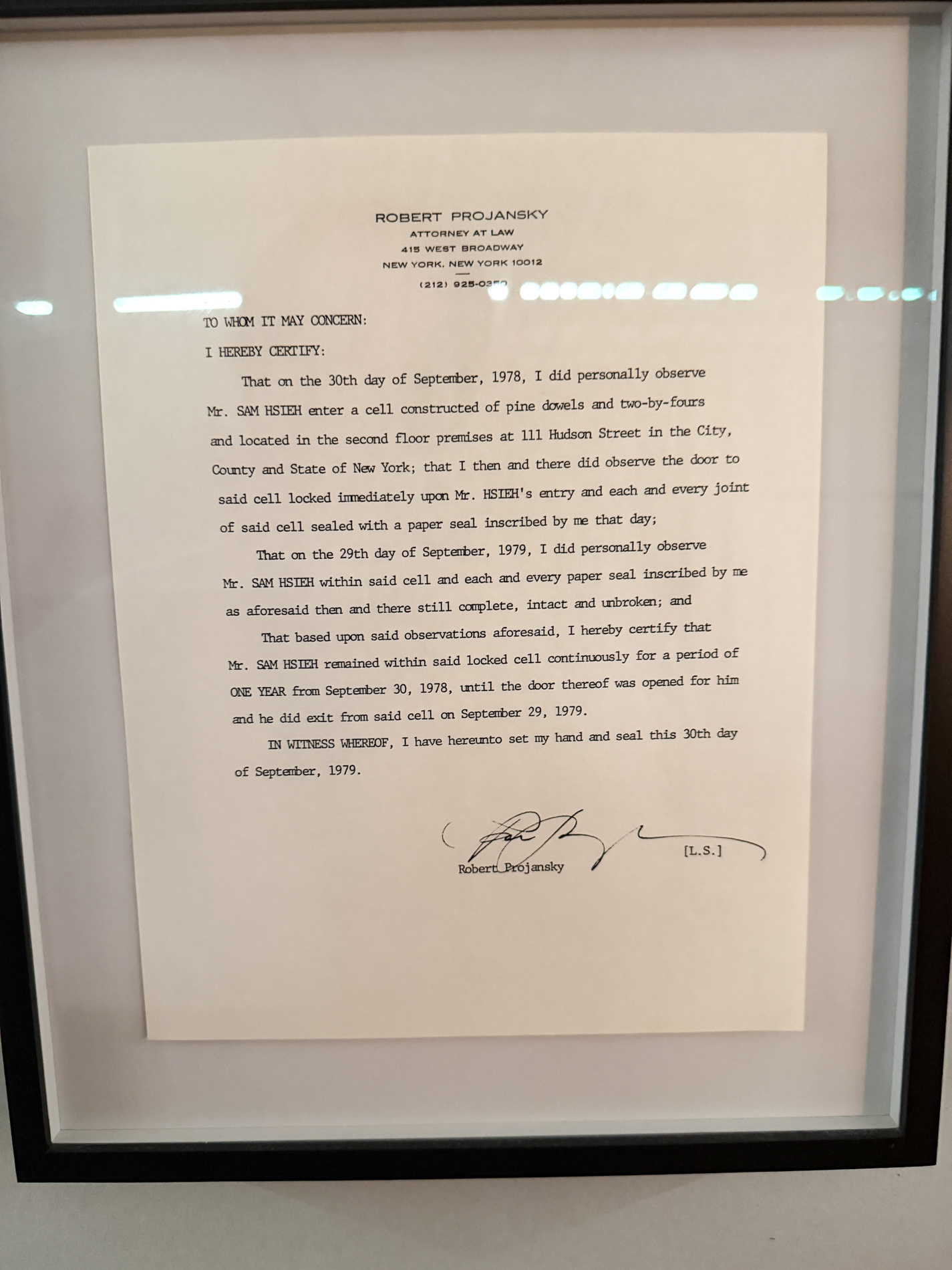
The artist has looked back on that year. After about three months there was almost nothing left in his head to go over again. To keep a sense that he was managing his own time, he cut notches into the wall.
Even when the year ended he could not adjust to the openness outside and lost his sense of balance. He lived on in the cage with the door open for another month, until a place to live was ready.
[2] Time Clock Piece — punching a time clock every hour
The second work ran for a year from 11 April 1980. On the hour, every hour — twenty-four times a day — he pushed a card into the time clock on the wall and photographed himself each time.
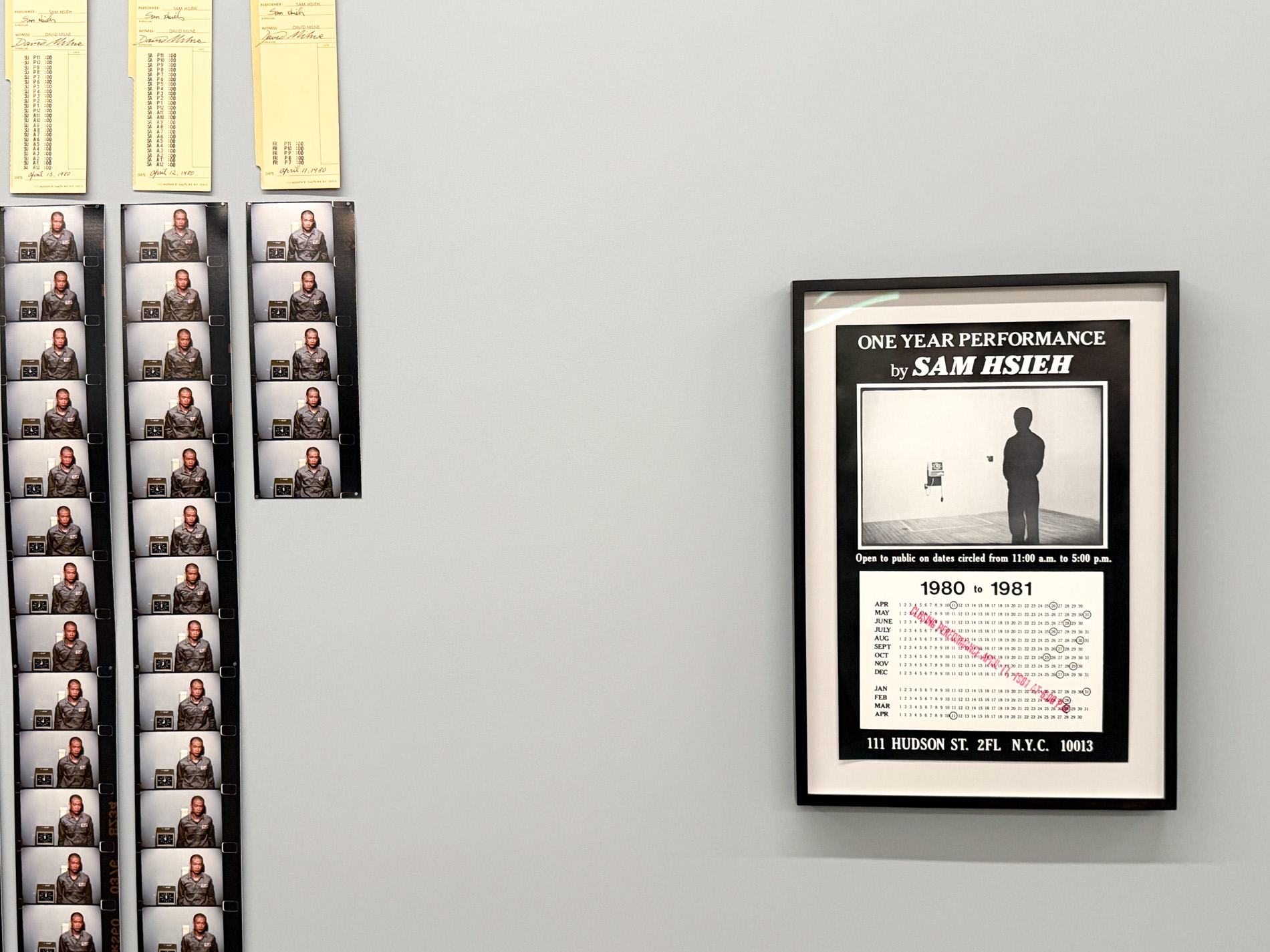
He was to punch the clock 8,760 times over the year, and missed 133 of them. Each time card carries a witness’s signature.
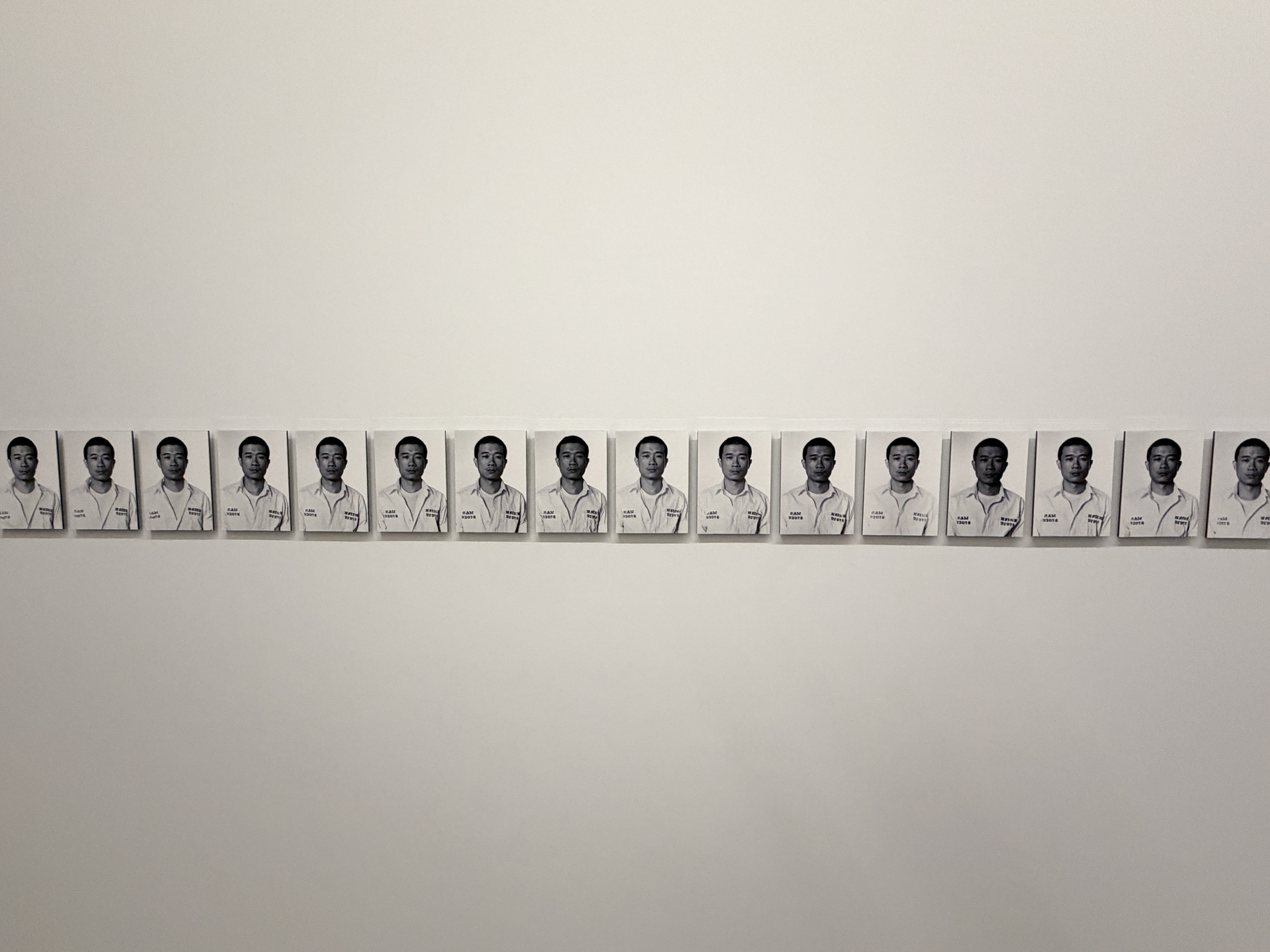
Strung together, a year of photographs becomes a film of six minutes and fifty-five seconds. He shaved his head when he began, so the passing of time can be read in his growing hair.
[3] Outdoor Piece — a year spent outdoors
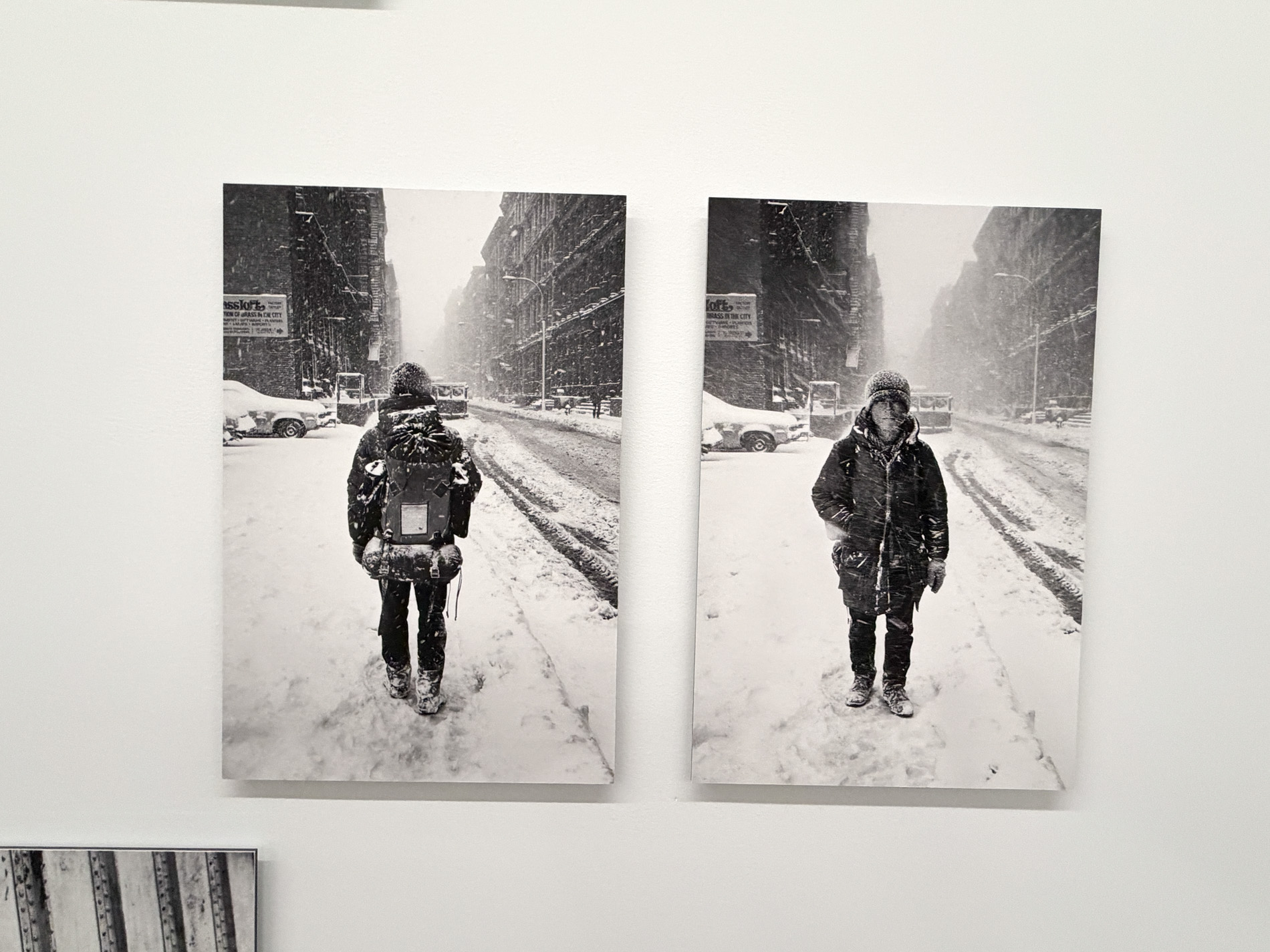
The third work, begun on 26 September 1981, was a year spent outdoors. The rule was to enter no building, no subway or train, car, aeroplane or boat, and no cave or tent either.
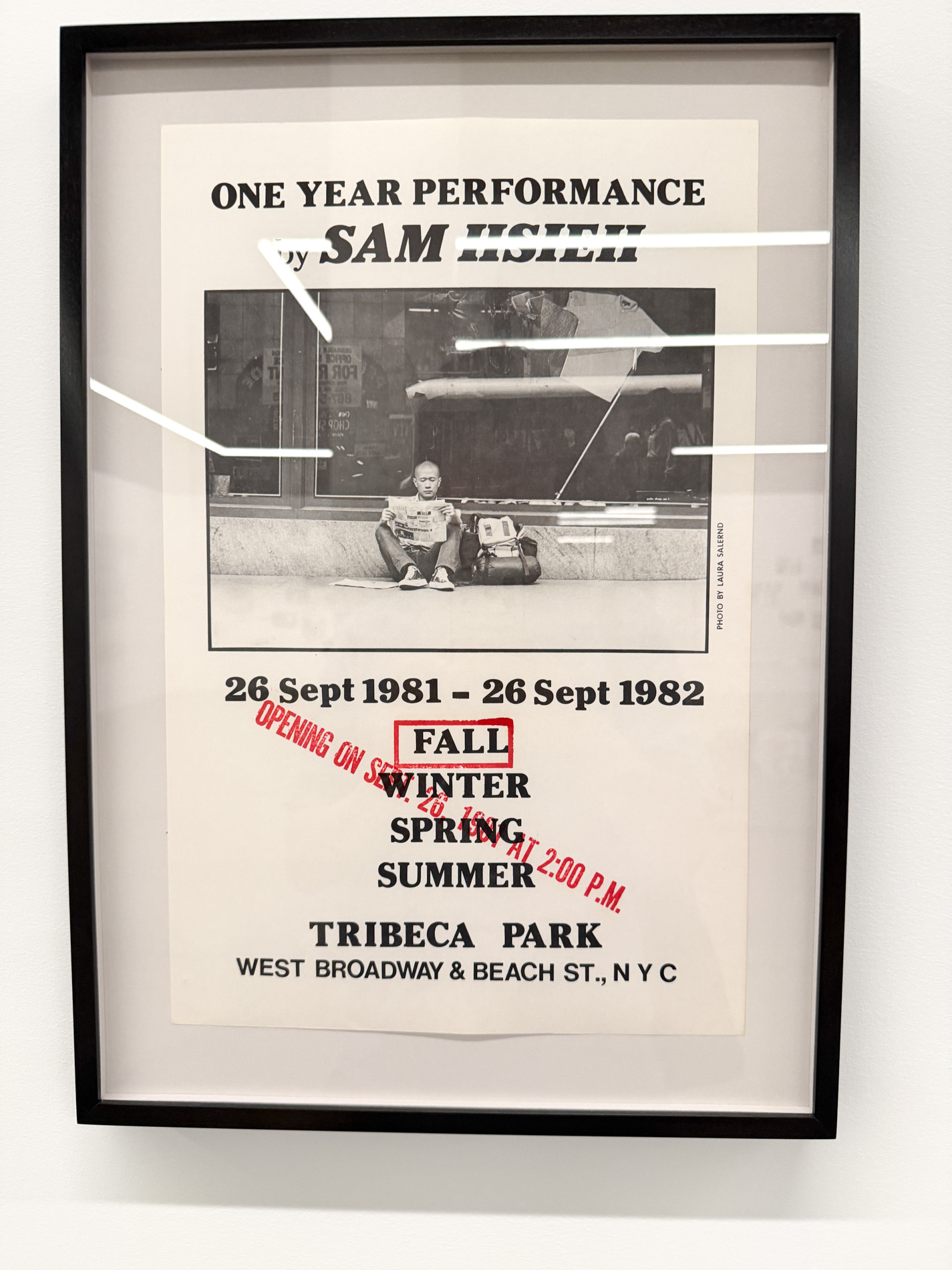
When a friend suggested he might at least learn English while he was out there for a year, the artist is said to have replied that he did not want to learn anything — he wanted to waste time. Harder than the rain, wind and cold, he says, was keeping himself clean.
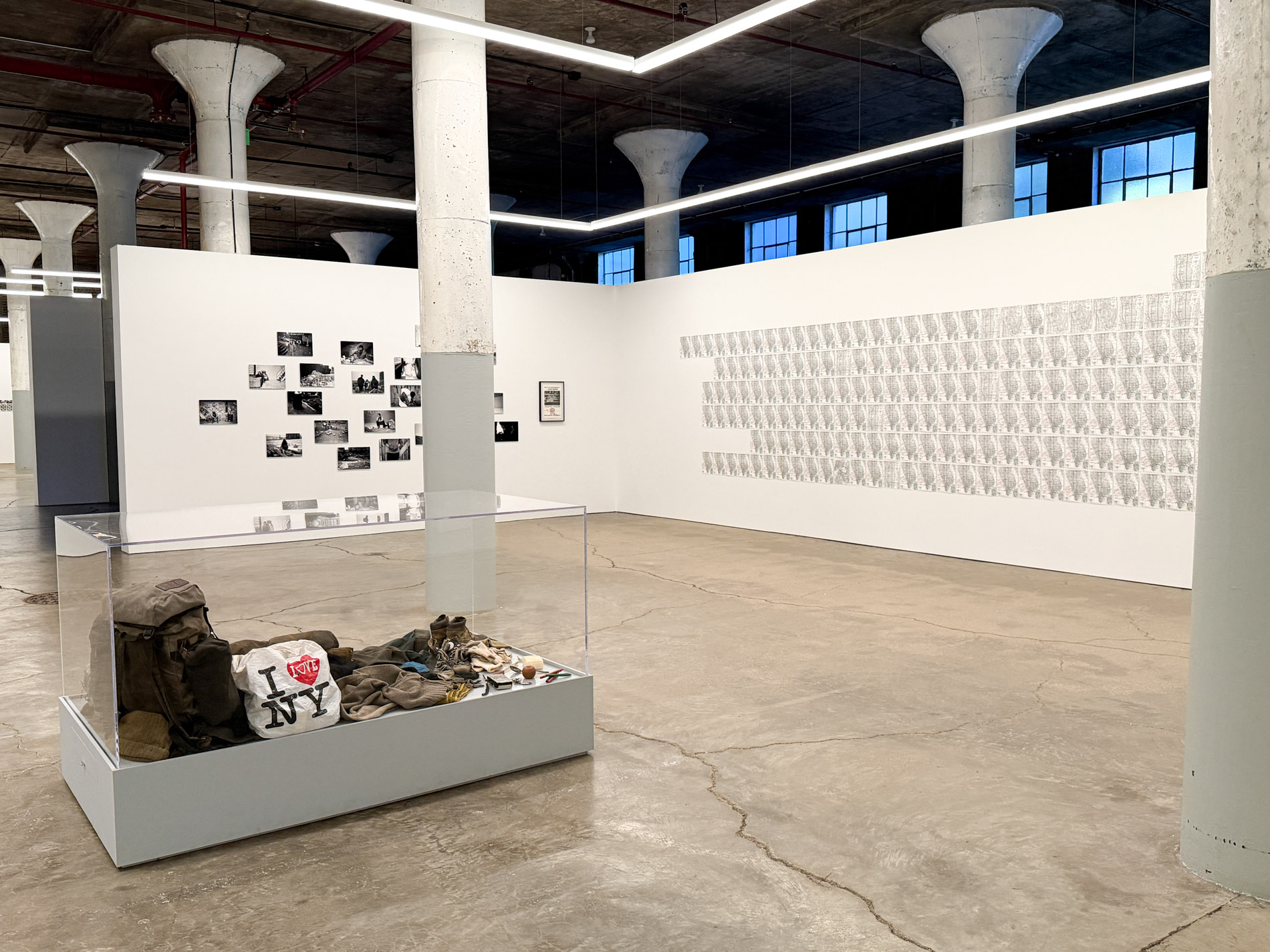
One whole wall is covered with maps of Manhattan, each marked with the route he walked that day. There were also photographs of him walking through snow with his pack on his back.
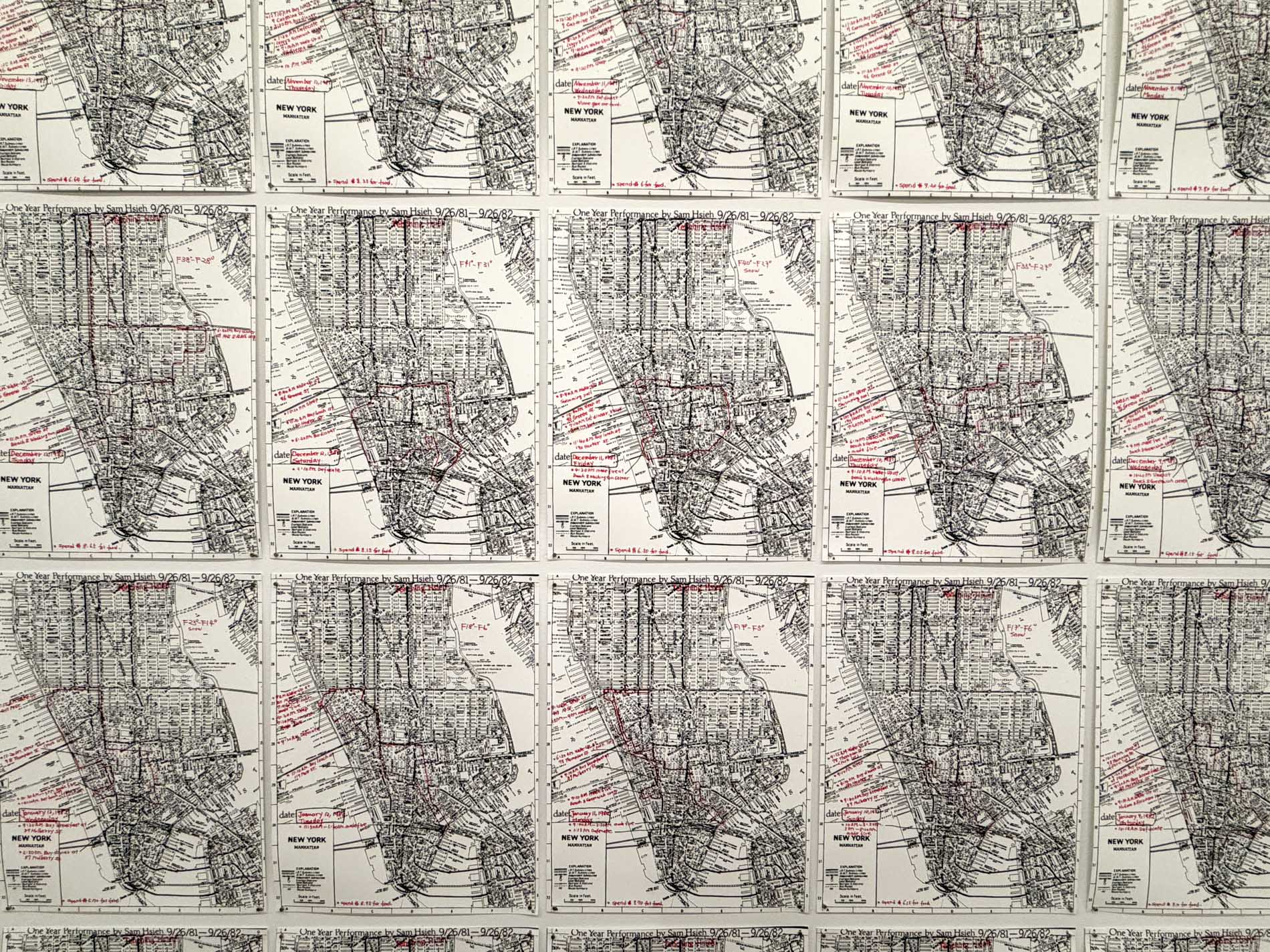
During the year he was taken into custody by the police once. A judge allowed him to remain outdoors, so the work was not broken off. The vitrine holds the sleeping bag he used and an “I ♥ NY” bag, along with the arrest record and a fingerprint card.
[4] Rope Piece — a year with two people tied together
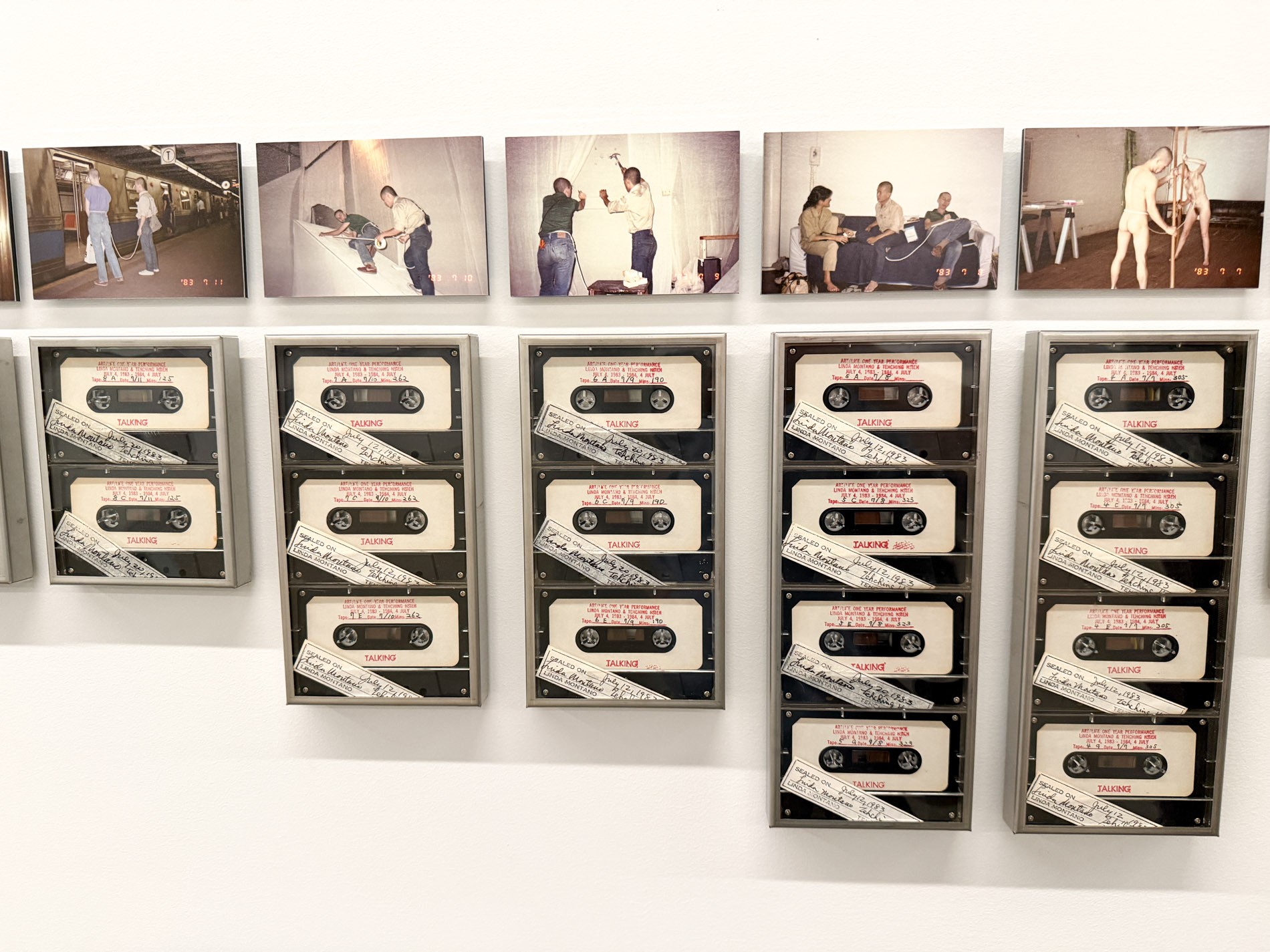
The fourth work began at six in the evening on 4 July 1983. With the artist Linda Montano, he spent a year with their waists tied together by a rope about 2.4 metres long.
The statement sets out four rules. To be together for a year and never to be alone. Indoors, to stay in the same room. To remain tied by the rope. And never to touch each other for the whole year.
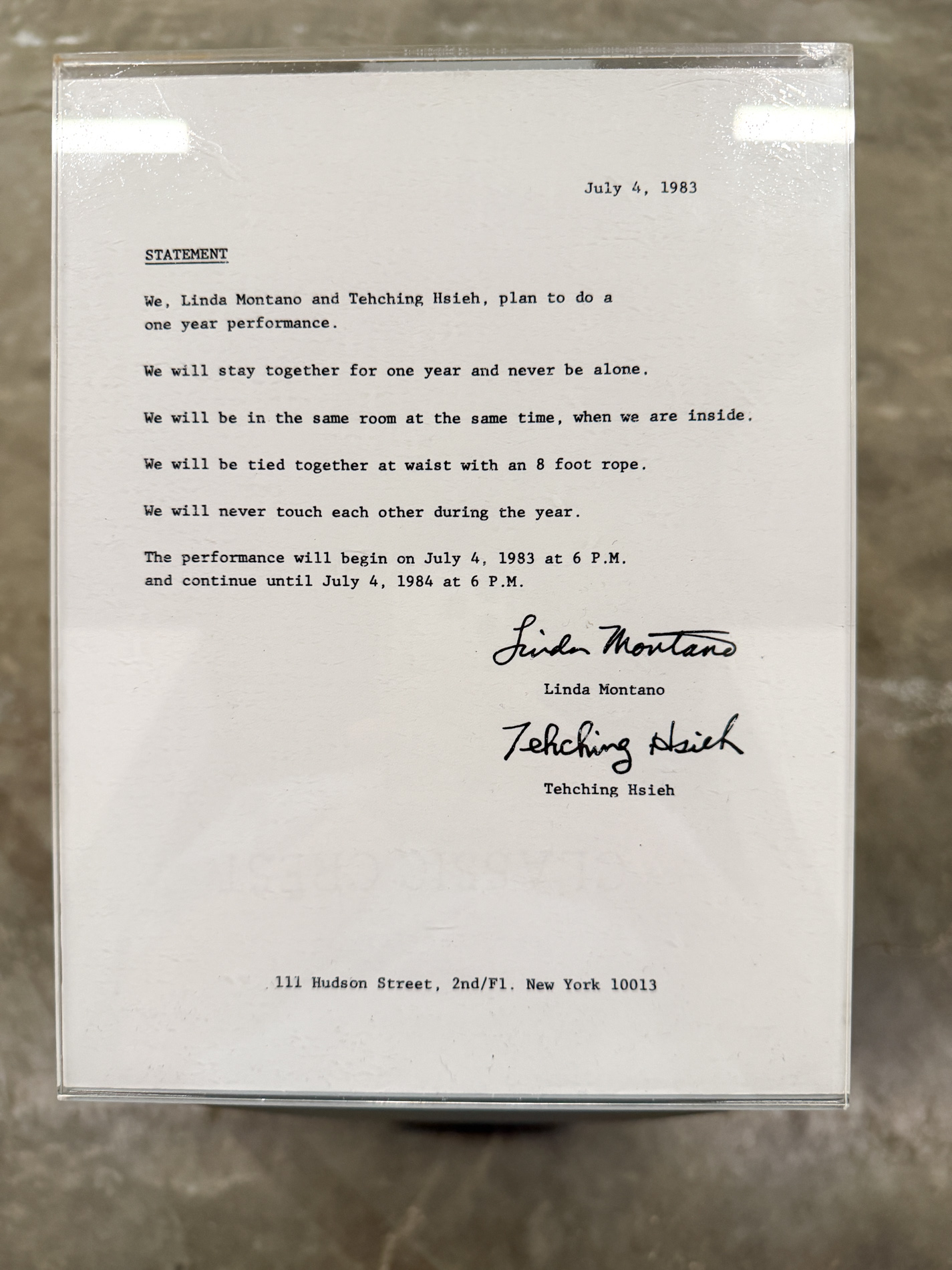
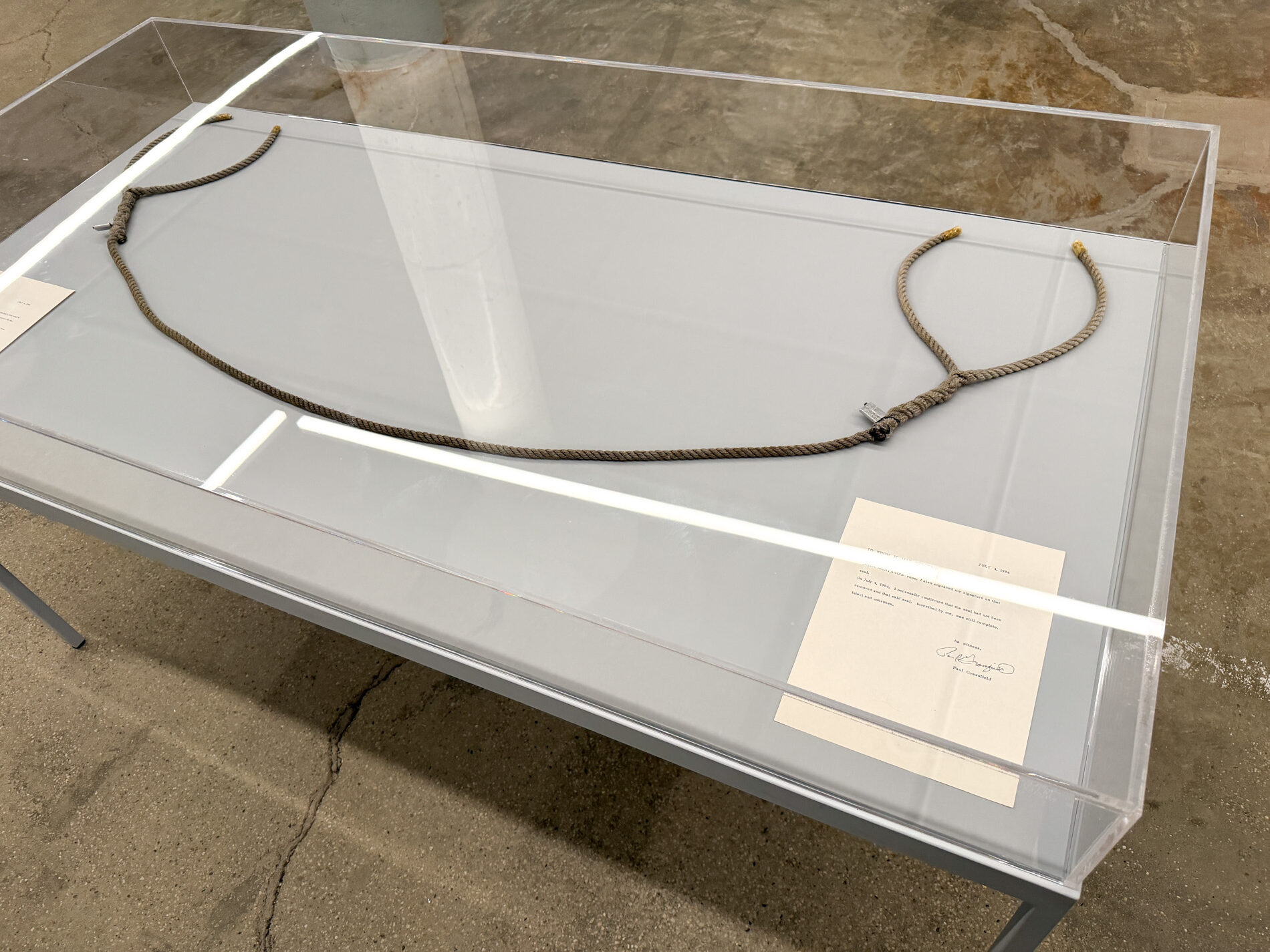
On show are the rope they actually used, the photographs taken of the two of them every day, and cassette tapes still sealed. The artist has said of this work that they became a cage for each other. Montano appeared alongside him at the opening talk, forty-one years on.
[5] No Art Piece — a year without art
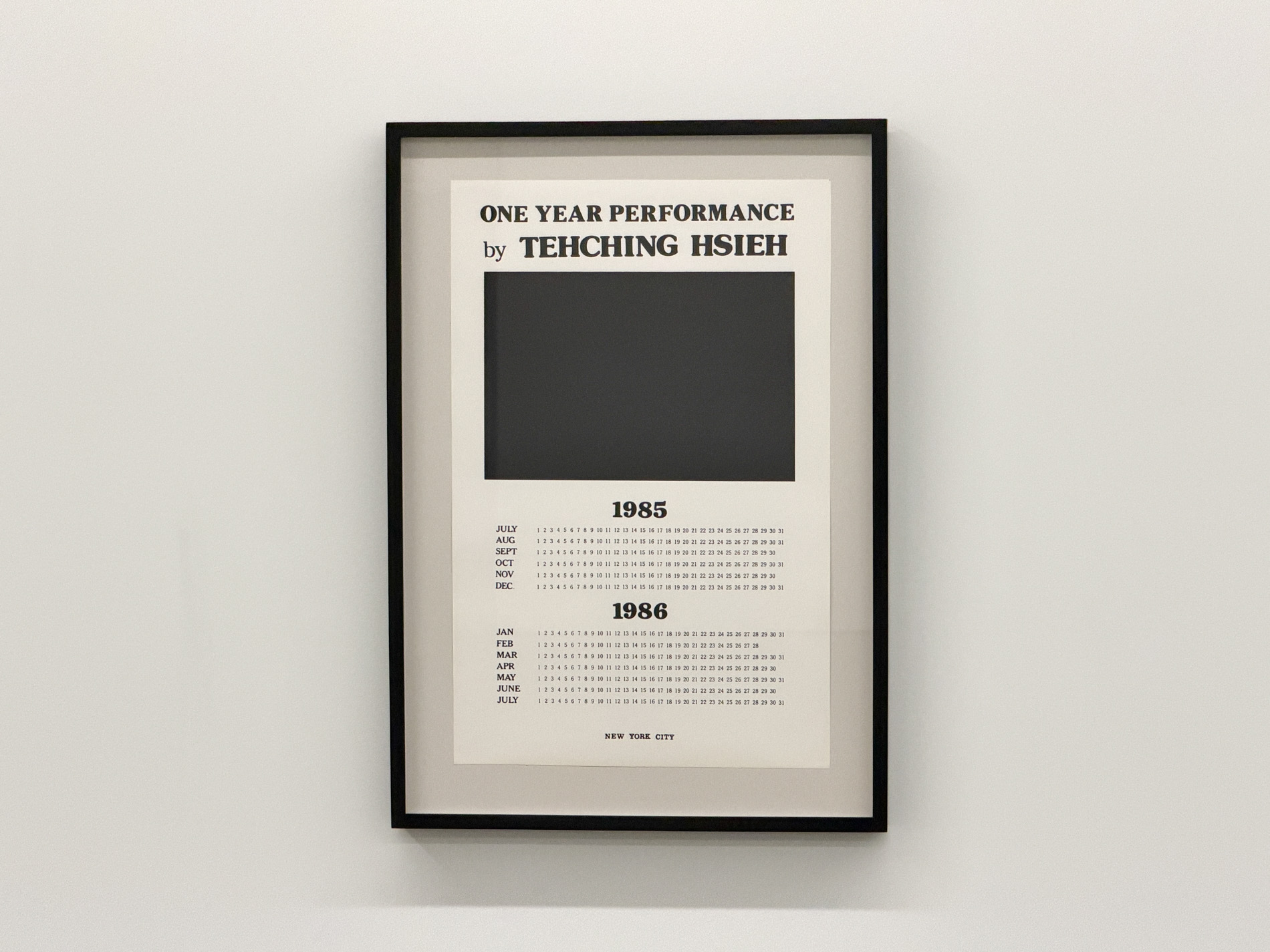
The fifth work began on 1 July 1985. Make no art, talk about no art, look at no art, read nothing about art, and go to no gallery or museum. A year of simply living, away from art.
All that stands in this room is a poster and the statement. The photograph on the poster has been blacked out. On the model at the entrance, the frame for this year carried ART TIME and LIFE TIME side by side.
[6] Thirteen Year Plan — thirteen years of showing nothing
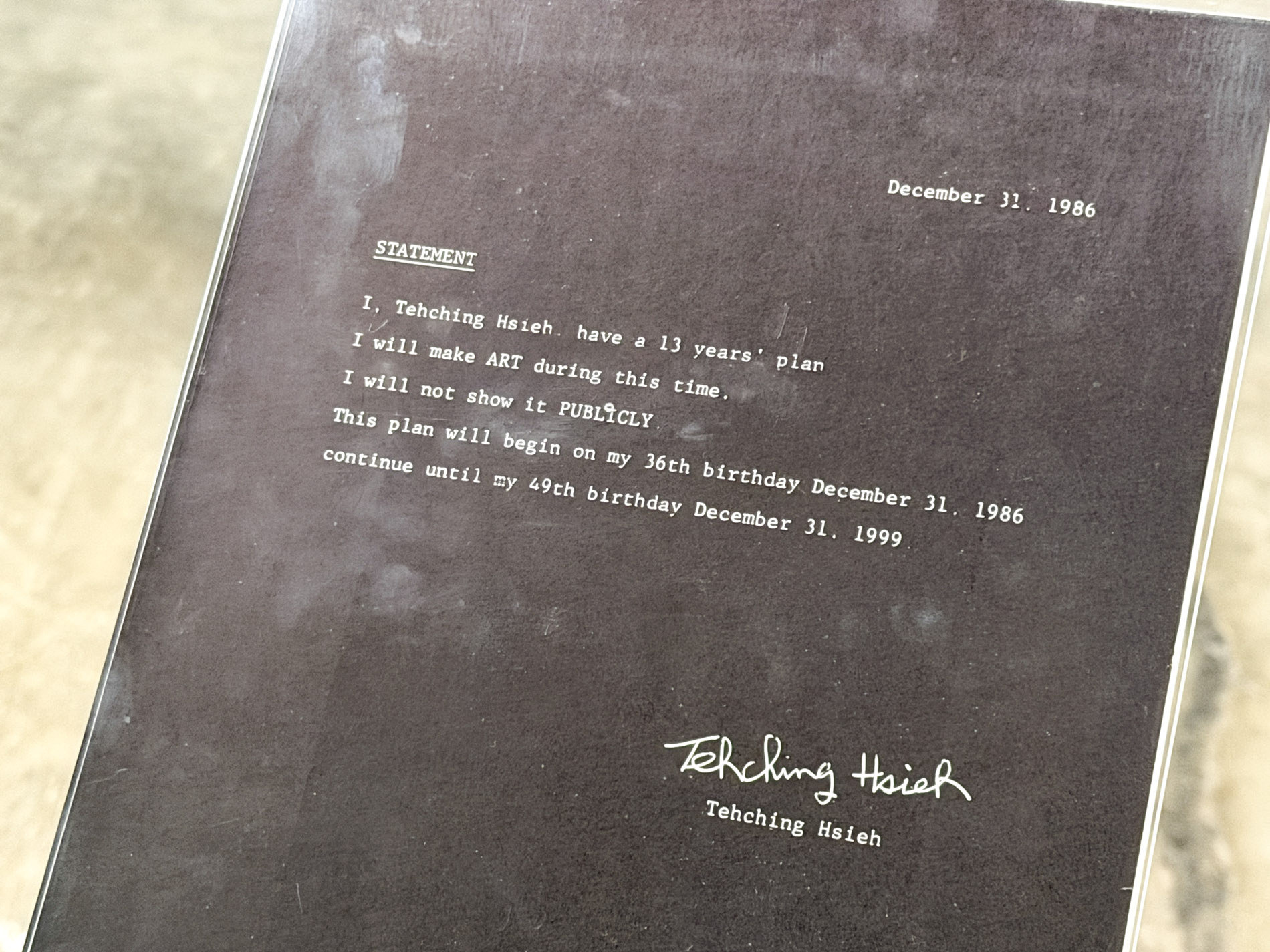
The last work began on 31 December 1986, his thirty-sixth birthday, and ran until 31 December 1999, his forty-ninth.
The statement, typed in white on black paper, says that during this period he will make art but will not show it. The room runs almost the full length of the lower level, and here too there is nothing but a poster and the statement.
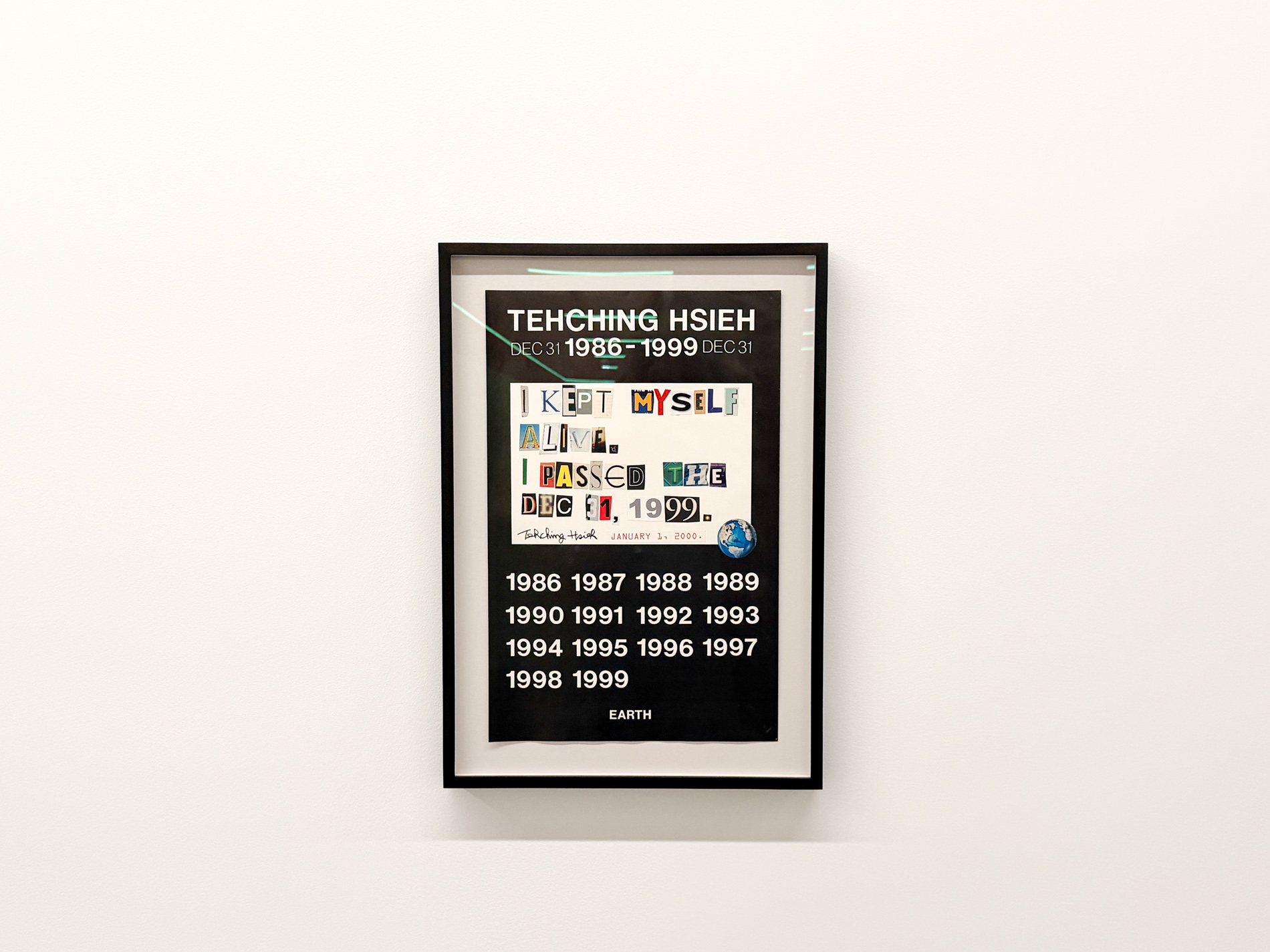
The poster made thirteen years later carries cut-out letters reading “I KEPT MYSELF ALIVE. I PASSED THE DEC 31, 1999.”
The artist compares his work to an iceberg. What he showed is only the part visible above the water; the year without art and the thirteen years without showing lie beneath the surface and shape the whole just as much. This was his last work: he has made none since 2000.
“My art is doing time”
In a 2025 interview the artist said that almost everything shown at Dia was made while he was living without papers. He also said that his art is doing time. In English, doing time means both passing time and serving a prison sentence. He called New York the best cage of all.
Humberto Moro, who organised the exhibition, says that in an age when everyone broadcasts themselves and attention moves on at once, it is precisely Hsieh’s way of stepping back from the stage and disappearing that resonates most strongly.
The artist says that walking through the lower level takes about two hours. If you are coming down after finishing the galleries upstairs, leave yourself plenty of time. We cover the building itself and the displays on the upper floor in a separate article.
→ [Photo Report] Dia Beacon 2026 | Beacon, New York
Words and photographs: art on editorial team